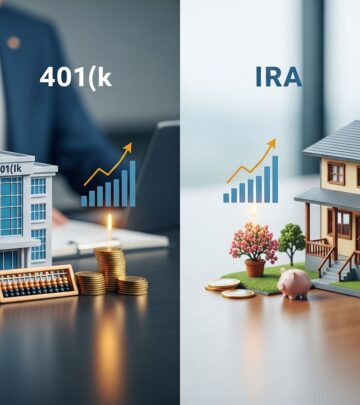
How to Save for Retirement Without a 401(k)
Discover proven strategies to build a secure retirement nest egg even without employer-sponsored 401(k) plans or matching contributions.

Not everyone has access to a 401(k) plan through their employer, whether you’re self-employed, work part-time, or at a company without retirement benefits. The good news is you can still build substantial retirement savings using alternative vehicles and smart strategies. This guide covers all the essential methods to achieve financial independence without traditional employer plans.
Understand Why You Don’t Need a 401(k)
401(k) plans offer tax advantages and employer matches, but they’re not the only path. According to the IRS, individual retirement accounts (IRAs) provide similar tax-deferred growth, and you have full control over investments without plan restrictions. Without a 401(k), you avoid high administrative fees (often 1-2% annually) that erode returns, gaining flexibility to choose low-cost index funds yielding 7-10% average historical returns.
Focus on consistent saving: even $200 monthly at 7% return compounds to over $500,000 in 40 years. The key is starting now, regardless of your current savings level—small amounts grow significantly over time.
Maximize Individual Retirement Accounts (IRAs)
IRAs are the cornerstone for 401(k)-less savers. There are two main types:
- Traditional IRA: Contributions may be tax-deductible, growth is tax-deferred, withdrawals taxed as income in retirement.
- Roth IRA: Contributions with after-tax dollars, tax-free growth and qualified withdrawals—ideal if you expect higher taxes later.
In 2026, contribution limits are $7,000 annually ($8,000 if 50+), per IRS guidelines. Open one at low-cost brokers like Vanguard or Fidelity. Automate contributions to mimic 401(k) payroll deductions.
| IRA Type | Tax Treatment | Best For | 2026 Limit |
|---|---|---|---|
| Traditional | Deductible contributions, taxed withdrawals | High current tax bracket | $7,000/$8,000 |
| Roth | After-tax contributions, tax-free withdrawals | Low current bracket, expect higher future taxes | $7,000/$8,000 |
Income limits apply for Roth deductibility, but backdoor Roth strategies allow high earners to contribute indirectly.
Leverage Health Savings Accounts (HSAs)
If eligible for a high-deductible health plan (HDHP), HSAs offer triple tax advantages: pre-tax contributions, tax-free growth, tax-free medical withdrawals. Post-65, use for any purpose (taxed like IRA).
2026 limits: $4,150 individual/$8,300 family ($1,000 catch-up if 55+). Treat as a ‘super IRA’—80% invest in stocks for long-term growth. Unused funds roll over indefinitely, perfect for retirement healthcare costs averaging $315,000 per couple.
- Contribute max annually.
- Invest aggressively if under 50.
- Reimburse current expenses later to maximize growth.
Use Taxable Brokerage Accounts
Once IRAs/HSAs are maxed, brokerage accounts provide unlimited contributions and liquidity. No withdrawal penalties, though gains are taxed.
Strategies to minimize taxes:
- Buy-and-hold low-turnover index funds (e.g., S&P 500 ETFs with 0.03% expense ratios).
- Tax-loss harvesting: Sell losers to offset gains.
- Qualified dividends and long-term capital gains taxed at 0-20% vs. ordinary income up to 37%.
Historical data shows stocks outperform bonds long-term (10% vs. 5% annually). A $10,000 investment at 7% net of taxes grows to $76,000 in 30 years.
Cut Expenses Ruthlessly to Boost Savings Rate
Saving without a 401(k) requires discipline. Aim for 15-25% savings rate by tracking expenses.
Key cuts:
- Housing: Downsize or house hack (rent rooms)—largest expense at 30% income.
- Transportation: One car, public transit, biking—save $10,000/year.
- Food: Cook at home, meal prep—cut $300/month.
- Subscriptions: Audit and cancel unused services ($100+/month savings).
Use 50/30/20 rule: 50% needs, 30% wants, 20% savings/debt. Apps like YNAB or Mint automate tracking.
Build Multiple Income Streams
Side hustles supercharge savings. Gig economy offers flexibility:
- Freelancing: Upwork, Fiverr—skills like writing, graphic design average $50/hour.
- Rideshare/Delivery: Uber, DoorDash—$20-30/hour part-time.
- Rent Assets: Airbnb spare room, Turo car—passive income.
- Online Businesses: Dropshipping, affiliate marketing—scale to $5,000+/month.
Direct 100% of side income to retirement accounts. A $1,000 monthly hustle adds $500,000+ over 30 years at 7%.
Delay Social Security and Optimize Pensions
Social Security is a foundation—average $1,900/month, but delaying to 70 boosts 8%/year (up to 132% of age-62 benefit).
If eligible for pensions, understand vesting. Part-time workers often qualify via multiple employers.
Invest Wisely: Diversify and Stay the Course
Asset allocation by age: 110 – age in stocks (e.g., 70% stocks at 40). Rebalance annually.
- 60% US stocks
- 20% International stocks
- 10% Bonds
- 10% Real estate/REITs
Avoid timing market—dollar-cost average. Vanguard studies show low-cost indexing beats 90% active funds over 15 years.
Pay Off High-Interest Debt First
Debt is savings killer. Prioritize >7% interest (credit cards at 20%+). Use debt snowball/avalanche.
Post-debt, redirect payments to savings. Eliminating $500/month debt frees equivalent savings.
Plan for Healthcare and Long-Term Care
Medicare starts at 65, but gaps exist. HSAs cover pre-65; Marketplace plans affordable via subsidies.
Long-term care insurance or self-insure via real estate/home equity.
Real Estate as Retirement Asset
Own home free-and-clear: No rent/mortgage saves $1,500/month. Reverse mortgage as last resort.
Rental properties generate cash flow—5-8% yields after expenses.
Frequently Asked Questions (FAQs)
Q: Can I save enough without a 401(k) match?
A: Yes—max IRAs/HSAs, use taxable accounts, cut costs. Matches are free money, but self-directed saving often outperforms due to flexibility and lower fees.
Q: What’s the best first step?
A: Open a Roth IRA, contribute bi-weekly, invest in total market index fund.
Q: How much do I need to retire?
A: 25x annual expenses (4% rule). $40,000/year needs = $1M portfolio.
Q: Self-employed? What options?
A: SEP-IRA (up to 25% income, $69,000 max), Solo 401(k) if desired.
Q: Late starter—can I catch up?
A: Yes—catch-up contributions, delay SS, work longer, frugality. $10,000/year from 50-65 at 7% = $300,000+.
Track Progress and Adjust
Annual reviews: Net worth statement, project growth. Tools like Personal Capital free portfolio analysis.
Milestones: Emergency fund (6 months), debt-free, max contributions.
Retirement isn’t age—it’s financial independence. With discipline, 401(k)-free savers thrive.
References
- Retirement topics – IRA contribution limits — Internal Revenue Service. 2025-11-06. https://www.irs.gov/retirement-plans/plan-participant-employee/retirement-topics-ira-contribution-limits
- Stock Market Returns — New York University Stern School of Business. 2025-01. https://pages.stern.nyu.edu/~adamodar/New_Home_Page/datafile/histretSP.html
- Health Savings Accounts (HSAs) — Internal Revenue Service. 2025-05-28. https://www.irs.gov/taxtopics/tc502
- Fidelity Retiree Health Care Cost Estimate — Fidelity Investments. 2025-06. https://www.fidelity.com/viewpoints/retirement/retiree-health-care-costs
- Benefits Planner: Retirement — Social Security Administration. 2025-12. https://www.ssa.gov/benefits/retirement/planner/ageincrease.html
- Vanguard’s Principles for Investing Success — Vanguard. 2024-12. https://advisors.vanguard.com/insights/article/series/principlesforinvestingsuccess
- The 4% Rule — William Bengen via Financial Planning Association. 1994 (seminal, validated in recent studies). https://www.financialplanningassociation.org/article/journal/MAY04-determining-withdrawal-stages-using-4-rule-0
Similar Articles








Read full bio of medha deb