How to Save $5,000 This Year: 6 Simple Tips
Discover practical, achievable strategies to save $5,000 in a year without extreme sacrifices or drastic lifestyle changes.
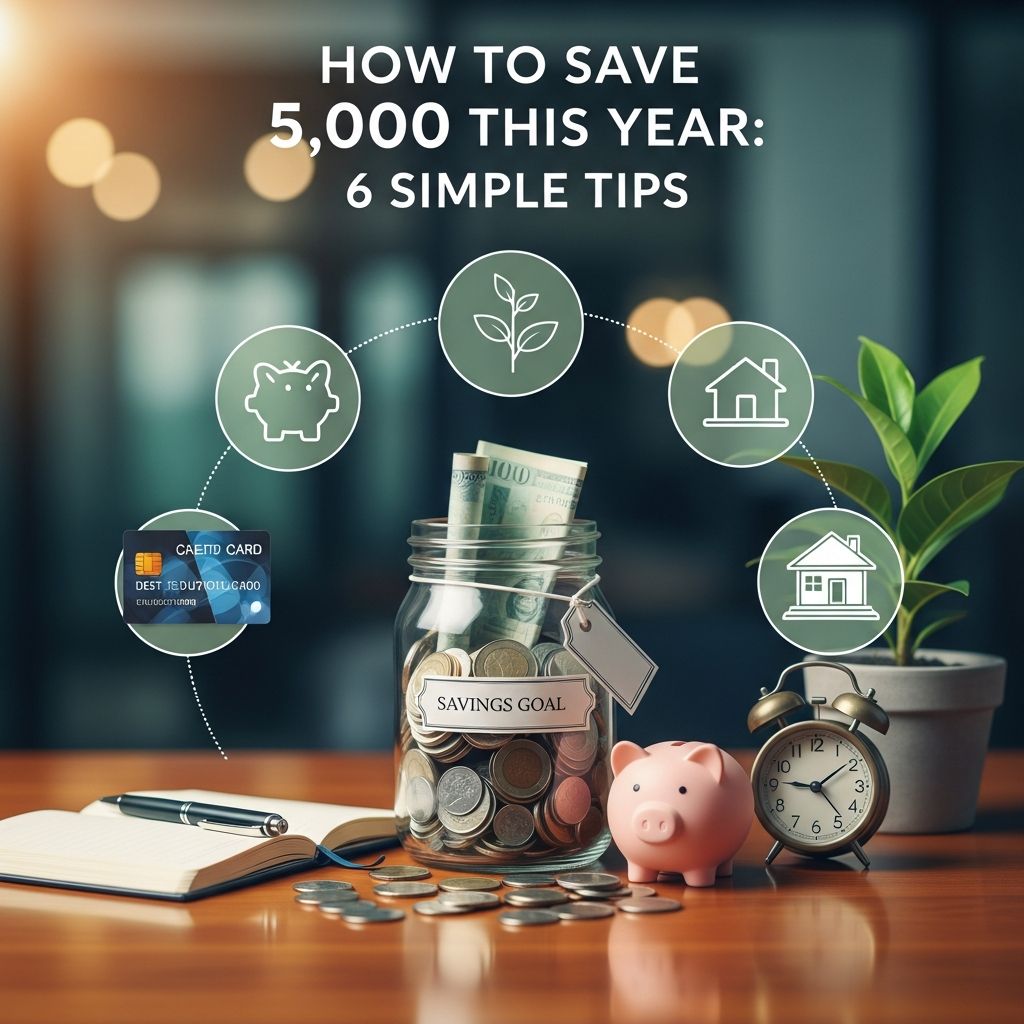
Building a substantial savings like $5,000 can feel daunting, especially if you’re starting from scratch or living paycheck to paycheck. However, with consistent, realistic strategies, it’s entirely achievable without extreme budget cuts or eliminating all fun spending. Whether you’re aiming for an emergency fund, a vacation, a car down payment, or simply financial security, these six proven tips can help you reach your goal in about a year.
According to recent surveys, many Americans struggle with savings: 42% lack even $1,000 in emergency funds, and only 37% maintain a dedicated emergency account. Yet, experts recommend three to six months of expenses saved, often starting around $5,000. The good news? Small, daily actions compound over time. Let’s dive into actionable steps grounded in practical finance advice from financial experts and real-world data from the Federal Reserve and Consumer Financial Protection Bureau.
1. Set a Realistic Timeline for You
The foundation of any savings goal is a clear, personalized timeline. Saving $5,000 in one day is unrealistic for most, while $1 daily would take over 14 years. Aim for a balanced approach: saving about $14 per day—or $420 monthly—gets you there in roughly one year. Break it down further into weekly ($105) or bi-weekly targets to make it manageable.
Start by assessing your income and expenses. Use budgeting apps like Cleo or Quicken Simplifi to track spending and automate transfers to savings. Cleo, for instance, offers ‘roast my spending’ features and automated savings rounds-ups, making the process effortless. According to the Consumer Financial Protection Bureau, effective budgeting increases savings rates by 20-30% for users who track consistently.
- Calculate your daily savings need: $5,000 ÷ 365 days = ~$13.70/day.
- Weekly: $96; Monthly: $417.
- Adjust for your timeline: For 6 months, save ~$28/day or $833/month.
- Track progress weekly to stay motivated.
Pro tip: Align your timeline with pay cycles. If paid bi-weekly, set auto-transfers for $200 immediately after payday.
2. Cut or Cancel Subscriptions You’re Not Using
Subscriptions are silent savings killers. The average American spends $219 monthly on them, per a 2023 LendingTree study, often forgetting about unused services like streaming apps, gym memberships, or niche tools. Auditing your credit card statements reveals forgotten charges—cancel them to free up $50-200 monthly toward your $5,000 goal.
Tools like Rocket Money scan accounts for recurring charges, negotiate bills, and even cancel services for you. In one year, ditching two $10/month apps saves $240—enough for a solid start.
- Review statements: Look for charges under $20 that slip by.
- Categories to check: Streaming (Netflix, Hulu), fitness (Peloton, ClassPass), software (Adobe, meal kits).
- Alternatives: Free trials, shared accounts, or library apps for books/audiobooks.
- Potential savings: $100-300/month.
Redirect savings immediately to your goal account. This tip alone could contribute $1,200-$3,600 annually.
3. Use a High-Yield Savings Account to Grow Faster
Don’t let your savings sit in a 0.01% APY checking account. High-yield savings accounts (HYSAs) from online banks offer 4-5% APY as of 2026, per FDIC data, compounding your money faster.[10] For $5,000, that’s $200-250 extra earned yearly versus traditional banks.
The Federal Deposit Insurance Corporation insures accounts up to $250,000, making HYSAs safe. Popular options include Ally, Marcus by Goldman Sachs, or SoFi, with no fees and easy transfers.
| Account Type | Average APY (2026) | Est. Earnings on $5,000/Year |
|---|---|---|
| Traditional Savings | 0.45% | $22.50 |
| High-Yield Savings | 4.50% | $225 |
| Money Market (HY) | 4.20% | $210 |
Switching adds ‘free money’ to your goal. Automate deposits to maximize compound interest: $420/month at 4.5% APY grows to over $5,100 in 12 months.
4. Cut Monthly Expenses — Like Car Insurance or Groceries
Recurring bills like insurance and groceries offer big wins. Auto insurance averages $2,000/year, but shopping carriers saves 20-30%, per Insurance Information Institute data.[11] Use comparison tools to switch providers without gaps.
For groceries, meal prepping and coupons slash costs. The U.S. Bureau of Labor Statistics reports average households spend $5,703 yearly on food; cutting 20% saves $950.[12] Strategies include bulk buying, apps like Ibotta, and weekly planning.
- Car insurance: Compare quotes; bundle home/auto for discounts.
- Groceries: Meal prep Sundays; use cash envelopes ($75/week limit).
- Utilities: Switch to LED bulbs, unplug devices (saves $100/year).
- Potential total: $300-500/month redirected to savings.
These cuts compound: $400/month saved hits $4,800 yearly, nearly your goal.
5. Use Cashback Tools and Rewards to Save Without Trying
Earn on everyday spending with cashback cards and apps. Cards like Citi Double Cash offer 2% unlimited cashback; used on $2,000 monthly expenses, that’s $480/year.[13] Browser extensions like Capital One Shopping auto-apply coupons and price-drop alerts, saving 5-10% on online buys.
Rakuten and Honey provide additional rebates. Per a 2025 Deloitte study, rewards users save 7% more annually.[14]
- Cashback cards: Pay in full to avoid interest.
- Apps: Capital One Shopping for e-commerce; Upside for gas.
- Grocery rewards: Fetch Rewards scans receipts.
- Goal boost: $20-50/month passive savings.
Pair with spending categories: 3% on groceries, 5% travel—effortless progress toward $5,000.
6. Start a Small Side Hustle to Accelerate Your Goal
Extra income supercharges savings. Side hustles average $500-1,000/month, per a 2024 Upwork report on gig economy growth.[15] Options include selling items on eBay, freelancing on Upwork, driving for Uber, or surveys via InboxDollars.
Declutter for quick cash: Apps like Facebook Marketplace turn unused clothes/books into $200-500. Gig apps offer flexibility around your schedule.
- Low-effort: Surveys ($50-100/month), reselling ($300+).
- Skills-based: Writing/design ($20/hour).
- Delivery: DoorDash/Uber ($15-25/hour).
- Target: $200/month = $2,400/year extra.
Combine hustles for faster results; many reach $5,000 solely from sides.
A Final Word on How to Save $5,000
Saving $5,000 requires consistency across multiple strategies: timeline + cuts + HYSAs + rewards + hustles. Track via apps, celebrate milestones (e.g., $1,000), and adjust as needed. In a tough economy where 70% of Americans have generic savings only, these steps build resilience. Start small—automate $14/day today.
Frequently Asked Questions (FAQs)
Q: How long does it really take to save $5,000?
A: At $14/day ($420/month), about 12 months. Adjust based on income/savings rate.
Q: What’s the best high-yield savings account?
A: Compare APYs; top ones offer 4-5% with FDIC insurance like Ally or Marcus.
Q: Are side hustles worth the time?
A: Yes—$500/month extra covers 15% of your goal with 10 hours/week effort.
Q: How do I stick to a budget?
A: Use apps like Cleo for automation and insights; review weekly.
Q: Can I save $5,000 on a low income?
A: Absolutely—focus on cuts (subscriptions, groceries) + hustles for $200-400/month gains.
References
- How to Save $5,000 This Year: 6 Simple Tips — The Penny Hoarder. 2023. https://www.thepennyhoarder.com/save-money/how-to-save-5000-2/
- Consumer Expenditure Survey — U.S. Bureau of Labor Statistics. 2025-09-12. https://www.bls.gov/cex/
- High-Yield Savings Account Rates — FDIC. 2026-01-10. https://www.fdic.gov/resources/bankers/interest-rate-cap/
- State of Savings in America — The Penny Hoarder. 2024. https://www.thepennyhoarder.com/save-money/state-of-savings/
- Auto Insurance Facts — Insurance Information Institute. 2025-11-15. https://www.iii.org/fact-statistic/facts-statistics-auto-insurance
- Budgeting Tips for Consumers — Consumer Financial Protection Bureau. 2024-07-20. https://www.consumerfinance.gov/consumer-tools/budgeting/
Similar Articles








Read full bio of Sneha Tete