How To Prepare An Income Statement: 10-Step Guide
Master income statement preparation with our comprehensive step-by-step guide for businesses.

An income statement is one of the most critical financial documents for any business. It provides a clear snapshot of your company’s profitability over a specific period, showing revenues, expenses, and the resulting net income or loss. Whether you’re a small business owner, an accountant, or a financial manager, understanding how to prepare an accurate income statement is essential for making informed business decisions and meeting regulatory requirements.
The income statement, also known as a profit and loss statement or P&L, forms the foundation of financial analysis. It reveals not only the bottom line but also helps identify trends, control costs, and evaluate operational efficiency. In this comprehensive guide, we’ll walk you through each step of preparing an income statement, from gathering data to calculating final net income.
Understanding the Basic Components of an Income Statement
Before diving into the preparation process, it’s important to understand the key elements that make up an income statement. These components work together to tell the financial story of your business:
Gross Sales: This represents the total sales revenue before any adjustments or deductions. It’s the raw revenue figure generated from selling products or services.
Cost of Goods Sold (COGS): These are the direct costs associated with producing the goods or services that your company sells, including materials, labor, and production expenses.
Gross Profit: Calculated by subtracting COGS from gross sales, this figure shows the profit before operating expenses are deducted.
Operating Expenses: These are the costs associated with running your day-to-day business operations, such as salaries, rent, utilities, marketing, and administrative costs.
Operating Income: This is the profit remaining after deducting all operating expenses from gross profit.
Tax Expenses: These represent the corporate income taxes your business owes.
Net Income: The final profit figure after all expenses and taxes have been deducted from total revenue, representing your company’s true bottom line.
Step-by-Step Guide to Preparing an Income Statement
Step 1: Choose Your Reporting Period
The first critical decision is determining the timeframe your income statement will cover. This period can be monthly, quarterly, or annual, depending on your business needs and reporting requirements.
Monthly reporting provides detailed insight into short-term trends, making it easier to implement tactical changes quickly. Quarterly reports offer a broader perspective on business performance while still capturing seasonal variations. Annual statements provide a comprehensive overview for long-term strategic planning and regulatory compliance.
Your choice should align with your industry standards, regulatory requirements, and internal management needs. Many larger corporations prepare quarterly statements for stakeholder reporting, while smaller businesses often benefit from monthly reviews to stay agile.
Step 2: Gather Financial Data
Accurate income statement preparation relies on having comprehensive financial information. The primary sources for this data include:
- Your general ledger serves as the foundation, containing detailed records of all transactions.
- Expense reports document all business expenditures.
- Revenue records track all income sources.
- Tax filings provide information on income taxes paid.
For businesses without dedicated accounting professionals, financial management tools and accounting software can streamline this data collection process, automatically consolidating information from payroll systems, corporate cards, and expense reimbursements.
Step 3: Calculate Total Revenue
Begin your income statement by calculating the total revenue generated during your reporting period. This calculation should include all revenue streams, not just primary sales:
- Revenue from sales of goods and services forms the core of most businesses.
- Interest income from investments or loans extended.
- Revenue from asset sales.
- Other miscellaneous income sources.
For example, if a manufacturing company earned $500,000 from product sales and $1 million from selling a facility during the quarter, total revenue would be $1.5 million.
Step 4: Calculate Cost of Goods Sold (COGS)
COGS represents the direct costs of producing goods or delivering services. For manufacturing companies, this includes:
- Raw materials used in production.
- Direct labor costs for production workers.
- Manufacturing overhead directly tied to production.
For service-based businesses, you’ll calculate the Cost of Services Sold (COSS) instead, which may include subcontracting fees, professional supplies, and direct service delivery labor.
For instance, if a company purchased $100,000 in raw materials and paid $50,000 in production labor during the quarter, the COGS would be $150,000.
Step 5: Calculate Gross Profit
Gross profit is determined by subtracting COGS from total revenue. This figure represents the profit available to cover operating expenses and other costs:
Gross Profit = Net Sales – COGS
Using our previous example, if total revenue is $1.5 million and COGS is $150,000, gross profit would be $1.35 million.
Step 6: Account for Operating Expenses
Operating expenses include all costs required to run your business that aren’t directly tied to producing goods or services. Common categories include:
- Salaries and wages for administrative staff.
- Rent or lease payments for office space.
- Utilities and facility maintenance.
- Marketing and advertising expenses.
- Professional fees for consultants and legal services.
- Office supplies and equipment.
- Insurance premiums.
Organize these expenses logically to make your income statement easier to understand and analyze. Categorizing expenses helps identify where money is being spent and reveals opportunities for cost reduction.
Step 7: Calculate Operating Income and Earnings Before Taxes
Operating income is found by subtracting total operating expenses from gross profit. This figure shows how much profit your core business operations generate before considering taxes and other non-operational items.
Continuing our example, if gross profit is $1.35 million and operating expenses total $31,500, operating income would be $1.318 million. This calculation is crucial because it reveals the profitability of your actual business operations, separate from tax implications.
Step 8: Account for Other Income and Expenses
Many businesses have additional income or expenses beyond their core operations, such as investment income, interest expenses, or losses on asset sales. These should be added to or subtracted from operating income to arrive at earnings before taxes.
Step 9: Calculate Income Tax Expense
Determine your business’s income tax obligations based on your pre-tax earnings. This amount varies depending on your business structure, location, and applicable tax rates.
Step 10: Calculate Net Income
The final step is calculating net income by subtracting income tax expense from earnings before taxes. This represents your company’s actual profit after all expenses and obligations have been paid.
For example, if a company had pre-tax earnings of $1,318,500 and paid $347,952 in income taxes, the net income would be $970,548.
Income Statement Format: Single-Step vs. Multi-Step
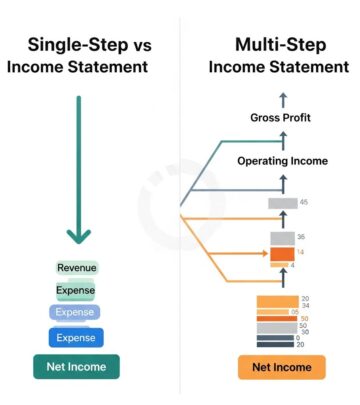
Single-Step Income Statement
The single-step format simplifies the calculation process by using one formula:
Net Income = (Revenues + Gains) – (Expenses + Losses)
This straightforward approach works well for small businesses or service providers with simple operations. It provides a quick snapshot of profitability without detailed breakdowns of different expense categories.
Multi-Step Income Statement
The multi-step format provides greater detail and insight by calculating gross profit and operating income as intermediate steps. This approach includes distinct sections for:
- Net Sales
- Cost of Goods Sold
- Gross Profit
- Total Operating Expenses
- Operating Income
- Other Income and Expenses
- Income Before Taxes
- Income Tax Expense
- Net Income
The multi-step format is preferred by larger businesses, investors, and creditors because it provides clearer visibility into business performance and helps identify specific areas of profitability or concern.
Common Income Statement Mistakes to Avoid
Categorization and Income Recognition Errors
One of the most frequent mistakes in income statement preparation is misclassifying expenses or revenues. An expense might be incorrectly categorized, or one-time gains might be omitted entirely. Using accounting software with detailed checklists helps ensure accurate entries and comprehensive income tracking.
Adjustments and Expense Management Issues
Prepaid expenses and depreciation must be correctly recorded to reflect the actual periods they apply to. For example, prepaid insurance should be spread across the months of coverage, and depreciation should be calculated consistently. Advanced accounting software can automate these adjustments and minimize entry errors.
Data Integrity and Reconciliation Problems
Manual data entry often introduces errors like duplication or omissions. Automating data entry processes and conducting regular audits helps reduce these mistakes. Monthly account reconciliations are essential for maintaining data integrity and ensuring financial records are accurate and compliant with accounting standards.
Creating a Trial Balance Report
Before preparing your final income statement, create a trial balance report. This report details the ending balance for each account that will appear on the income statement and provides all the figures needed for accurate calculations.
A trial balance can be generated using accounting software like QuickBooks Online, which automatically pulls account balances and calculates totals. This step is crucial for ensuring that all accounts are included and that your financial records are in balance.
Income Statement Example
| Line Item | Amount |
|---|---|
| Total Revenue | $1,500,000 |
| Cost of Goods Sold | -$150,000 |
| Gross Profit | $1,350,000 |
| Operating Expenses | |
| Production | $50,000 |
| Co-working Space | $12,000 |
| Office Supplies | $1,500 |
| Marketing Consultant | $9,000 |
| Legal Consultant | $9,000 |
| Total Operating Expenses | -$31,500 |
| Operating Income | $1,318,500 |
| State and Federal Income Taxes | -$347,952 |
| Net Income | $970,548 |
Best Practices for Income Statement Preparation
Maintain consistent formatting and presentation across all reporting periods to facilitate trend analysis and comparison. Use descriptive line item names that clearly indicate what expenses or revenues they represent. Implement proper categorization systems from the start to avoid confusion later. Review your income statement carefully before finalizing it to catch errors or inconsistencies. Consider using color-coding in spreadsheets to differentiate between hard-coded data and calculated figures—a common practice is using blue for input data and black for calculated results.
Frequently Asked Questions
Q: How often should I prepare an income statement?
A: The frequency depends on your business needs. Monthly statements help track short-term trends, quarterly statements provide broader analysis, and annual statements are typically required for tax and regulatory purposes. Many businesses prepare all three for comprehensive financial management.
Q: What’s the difference between cash basis and accrual basis income statements?
A: Cash basis income statements record revenue and expenses when cash is received or paid, while accrual basis statements record them when they are earned or incurred, regardless of cash movement. Accrual basis is generally preferred for more accurate financial reporting.
Q: Can I prepare an income statement using spreadsheet software?
A: Yes, spreadsheet software like Excel can be used to prepare income statements. However, accounting software like QuickBooks Online offers automation features that reduce errors and save time, especially for businesses with complex operations.
Q: What should I do if my net income is negative?
A: A negative net income (loss) indicates your expenses exceeded your revenues. Review your expenses for areas to reduce costs, analyze whether revenue can be increased, and consider consulting with a financial advisor to develop an improvement plan.
Q: How do I handle seasonal variations in my income statement?
A: Monthly and quarterly income statements help reveal seasonal patterns. Consider comparing results to the same period in prior years and preparing annual statements to see overall performance across seasons.
References
- How to Prepare an Income Statement: 7 Steps — Rippling. 2024. https://www.rippling.com/blog/how-to-prepare-an-income-statement
- Preparing a Multiple Step Income Statement — Florida State College. 2024. https://www.tsc.fl.edu/media/divisions/learning-commons/resources-by-subject/business/financial-accounting/Preparing-a-Multiple-Step-Income-Statement.pdf
- Income Statement: Definition, Preparation, and Examples — QuickBooks. 2024. https://quickbooks.intuit.com/r/bookkeeping/income-statement-guide/
- How to Prepare an Income Statement — Harvard Business School Online. 2024. https://online.hbs.edu/blog/post/how-to-prepare-an-income-statement
- Income Statement – Definition, Explanation and Examples — Corporate Finance Institute. 2024. https://corporatefinanceinstitute.com/resources/accounting/income-statement/
Similar Articles








Read full bio of Sneha Tete