How To Plan Ahead For CD Taxes: 4 Smart Strategies For 2025
Learn how certificate of deposit interest is taxed and how to plan ahead so CD taxes do not erode your returns.

Certificates of deposit (CDs) can be a safe way to grow savings, but the interest you earn usually comes with a tax bill. Understanding how CDs are taxed, when those taxes are due, and how to plan ahead can help you keep more of your returns and avoid surprises at tax time.
What Is a CD and Why Taxes Matter
A certificate of deposit is a time deposit account offered by banks and credit unions that pays a fixed rate of interest for locking in your money for a set term, such as six months, one year, or five years. You typically agree not to withdraw funds before maturity, or you may face an early withdrawal penalty.
The main appeal of CDs is their combination of predictable interest and low risk; deposits at most banks are insured by the Federal Deposit Insurance Corporation (FDIC) up to applicable limits. However, the interest you earn on a CD is usually treated as taxable interest income, so your after-tax return may be lower than the rate advertised by the bank.
Are CD Interest Earnings Taxable?
In most cases, yes, CD interest is taxable. The Internal Revenue Service (IRS) treats interest earned on CDs as ordinary income, not as capital gains. That means it is taxed at the same rates that apply to your wages, salaries, and other ordinary income.
Key points about how CD interest is taxed:
- Taxed as ordinary income: CD interest is added to your other taxable income and taxed according to your marginal tax bracket.
- Taxable in the year it is credited: You owe tax on CD interest in the year it is credited or posted to your account, even if you leave the money in the CD and do not withdraw it.
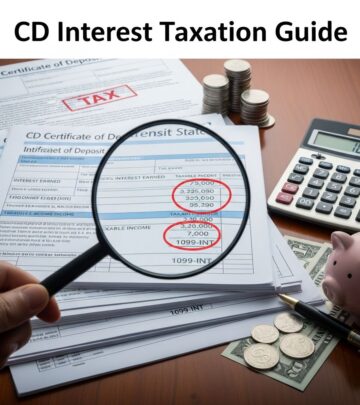
- Reported on Form 1099-INT: The bank or credit union generally reports your CD interest on IRS Form 1099-INT, which you should receive for any interest of $10 or more.
If your CDs are held in a tax-advantaged account, such as a traditional IRA, Roth IRA, or certain employer retirement plans, the tax treatment can be different. In those accounts, taxes on CD earnings may be deferred or, in the case of qualified Roth IRA withdrawals, potentially tax-free.
CD Taxes vs. Capital Gains: What’s the Difference?
It is important to distinguish between interest income and capital gains because they can be taxed differently. CDs generally generate interest income, not capital gains.
| Type of income | Typical source | Tax treatment |
|---|---|---|
| CD interest | Certificates of deposit at banks/credit unions | Taxed as ordinary income each year interest is credited. |
| Capital gains | Sale of stocks, mutual funds, real estate | Taxed as short- or long-term capital gains; rates can differ from ordinary income rates. |
Because CD interest is fully taxable at ordinary income rates, higher earners may see a larger portion of their CD yield go to taxes than they would on some long-term investments generating preferentially taxed capital gains.
When Do You Owe Taxes on CD Interest?
When you owe tax on CD interest depends on the CD’s term, how interest is credited, and whether the CD is held in a taxable account or a tax-advantaged account.
Single-Year CDs
For CDs that begin and mature in the same calendar year, all the interest earned is typically taxable in that year. For example, if you open a 9-month CD in February and it matures in November, the interest you receive for that CD is taxed for that tax year.
Multi-Year CDs
For CDs with terms longer than one year, you usually owe tax on the interest credited to the CD each year, even if you cannot access the money without penalty.
- If a five-year CD earns $50 in the first year, you must report and pay tax on that $50 for that year.
- The same applies for interest in years two through five; each year’s credited interest is taxable for that year.
This rule can surprise savers who expect to owe tax only when a long-term CD matures. The IRS generally requires you to report interest as it is credited, not only at maturity, when the interest becomes available.
CDs in Tax-Advantaged Accounts
CDs held inside certain retirement accounts can receive different tax treatment:
- Traditional IRA or 401(k): CD interest grows tax-deferred; you do not pay tax each year on earnings inside the account. Taxes are generally due when you take distributions, which are taxed as ordinary income.
- Roth IRA: CD interest can grow tax-free, and qualified withdrawals may be tax-free if IRS conditions (such as age and holding period) are met.
Placing CDs in tax-advantaged accounts can be one way to postpone or reduce the bite of CD taxes as part of a broader retirement strategy.
How CDs Are Reported to You and the IRS
Banks and credit unions must report most interest payments to both you and the IRS. If you hold a CD in a taxable account, you will typically receive IRS Form 1099-INT from the institution.
Form 1099-INT
Form 1099-INT reports the total interest you earned during the year from a given institution, including interest on CDs and other deposit accounts.
- You will usually receive a Form 1099-INT if your total interest from that institution is $10 or more for the year.
- The form is typically provided by the end of January, covering interest from the previous calendar year.
- CD interest normally appears in Box 1, labeled “Interest income.”
Even if you do not receive a Form 1099-INT because your interest is below $10, you are still required to report any taxable interest on your tax return.
How to Report CD Interest on Your Tax Return
To report CD interest to the IRS, you generally follow these steps:
- Gather all 1099-INT forms: Collect forms from every bank or credit union where you earned interest, including CDs and savings accounts.
- List interest on Schedule B (if required): If your total taxable interest from all sources exceeds a certain threshold (commonly $1,500), you must itemize it on Schedule B, Part I.
- Transfer totals to Form 1040: Your total interest income from Schedule B is entered on the appropriate line (currently Line 2b) of Form 1040 as taxable interest income.
From there, your CD interest becomes part of your total income and helps determine your adjusted gross income and taxable income, which in turn affect your tax bracket and overall tax liability.
How Early Withdrawal Penalties Affect CD Taxes
CDs often charge a penalty if you withdraw funds before the maturity date. For tax purposes, early withdrawal penalties can sometimes work in your favor.
- Penalty as a deduction: Early withdrawal penalties on CDs are generally deductible as an adjustment to income, even if the penalty exceeds the interest you earned.
- Reported separately: The financial institution may report the penalty in a specific box on Form 1099-INT, and it is usually claimed as a deduction on your tax return.
This deduction can help reduce your taxable income, partially offsetting the impact of the lost interest and any tax owed on interest you did receive.
Planning Ahead: Strategies to Manage or Reduce CD Taxes
While you cannot avoid taxes on legitimate interest income in a taxable account, you can plan ahead and use practical strategies to manage or reduce the tax impact of CDs as part of your overall financial plan.
1. Use Tax-Advantaged Accounts When Appropriate
Holding CDs inside retirement accounts can be an effective way to postpone or, in some cases, eliminate taxes on interest.
- Traditional IRA CD: Contributions may be tax-deductible (subject to IRS limits and income rules), and CD interest grows tax-deferred until withdrawal.
- 401(k) or similar plan: If your employer plan allows CDs, interest grows tax-deferred like other investments in the plan.
- Roth IRA CD: Contributions are made with after-tax dollars, but qualified withdrawals of interest may be tax-free, which can be attractive for long-term savers.
These accounts can be especially useful for higher-income investors who want to shield interest income from annual taxation.
2. Consider a CD Ladder for Timing and Flexibility
A CD ladder involves splitting your money among multiple CDs with staggered maturity dates—for example, one-year, two-year, three-year, four-year, and five-year CDs. Each year, one CD matures and can be reinvested.
Benefits of a CD ladder include:
- Cash flow planning: Regular maturities can help you plan when interest and principal will become available, which may simplify tax planning.
- Interest-rate risk management: Staggering terms reduces the risk of locking in all funds at one rate.
- Flexibility: As CDs mature, you can choose whether to reinvest in new CDs, move funds elsewhere, or adjust to changing tax and income needs.
3. Review and Adjust Tax Withholding
Rising interest rates can significantly increase the taxable interest you earn from CDs. In recent years, CD rates have been substantially higher than they were several years earlier, which can lead to a noticeable increase in taxable income for savers who hold large CD balances.
To avoid underpayment penalties and large tax bills, consider:
- Using the IRS tax withholding estimator or tax software to review whether your current withholding is adequate given your interest income.
- Adjusting your Form W-4 with your employer or making estimated tax payments if necessary.
4. Coordinate CDs with Other Tax Planning Techniques
You can also integrate CD investing into a broader tax strategy to reduce or offset the effect of CD interest on your tax bill. Common techniques include:
- Investing in tax-free municipal bonds or bond funds: Interest from many municipal bonds is exempt from federal income tax and sometimes from state taxes.
- Tax-loss harvesting: Selling investments at a loss in taxable brokerage accounts to offset gains or income, where appropriate.
- Using available tax credits: Applying credits, such as education or energy credits, which reduce tax liability dollar-for-dollar.
- Tax-efficient mutual funds and ETFs: Choosing investments designed to minimize taxable distributions.
- “Bunching” deductions: Timing certain deductible expenses—such as charitable contributions or medical costs—into a single year to exceed the standard deduction and itemize when it is most beneficial.
Common Mistakes People Make with CD Taxes
CD taxes are straightforward in many cases, but some common errors can lead to unexpected bills or IRS notices.
- Ignoring interest that was not withdrawn: Even if interest is left in the CD or rolled over into a new CD, it still may be taxable in the year it is credited.
- Overlooking small 1099-INT forms: Savers with multiple bank relationships sometimes forget to include small 1099-INT amounts, which can trigger underreporting notices.
- Confusing tax treatment of CDs in IRAs: Interest inside an IRA is not reported annually on your personal return; instead, distributions from the IRA are generally taxable.
- Underestimating the impact of rate changes: When CD rates rise sharply, interest income and associated taxes can increase much more than expected, especially for large deposits.
When to Seek Professional Tax Advice
While many CD investors can handle reporting interest on their own, certain situations call for professional guidance:
- You hold large CD balances and want to integrate them into a comprehensive tax and investment plan.
- You use multiple strategies—such as municipal bonds, tax-loss harvesting, and retirement accounts—and need to coordinate them.
- You are approaching retirement and want to decide how to balance CDs with other income sources in a tax-efficient way.
A qualified tax professional or financial planner can help you analyze your marginal tax rate, project the tax effect of your CDs, and select structures (like ladders and tax-advantaged accounts) that align with your goals.
Frequently Asked Questions (FAQs)
Q: Do I pay tax on CD interest even if I don’t withdraw it?
A: Yes, in most taxable accounts you owe tax for the year in which the interest is credited to your CD, even if you leave the money in the account or roll it into a new CD.
Q: How will I know how much CD interest to report on my taxes?
A: Your bank or credit union will usually send you Form 1099-INT summarizing the interest you earned for the year, and that information is also sent to the IRS. You must report the amount shown, plus any other taxable interest not reported on a 1099-INT.
Q: Are CDs ever tax-free?
A: CDs themselves do not provide tax-free interest in taxable accounts, but if you hold CDs inside a Roth IRA and meet IRS requirements for qualified distributions, the earnings, including CD interest, may be withdrawn tax-free.
Q: Do I have to file Schedule B if I have CD interest?
A: You may need Schedule B if your total taxable interest and ordinary dividends exceed a set threshold for the year (often $1,500) or if you have certain other reporting requirements. Schedule B lists each source of interest and is then summarized on your Form 1040.
Q: Can early withdrawal penalties on CDs lower my taxes?
A: Yes, early withdrawal penalties are generally deductible as an adjustment to income, which can reduce your taxable income and partially offset the tax impact of CD interest.
References
- Taxation of Certificate of Deposit Income — Annuity.org. 2024-04-02. https://www.annuity.org/personal-finance/banking/certificate-of-deposit/taxation/
- Understanding How Certificates of Deposit Are Taxed — RetireGuide. 2025-01-05. https://www.retireguide.com/retirement-planning/investing/certificate-of-deposit/taxes/
- How CDs Are Taxed: Tax Planning Guide — SmartAsset. 2024-06-10. https://smartasset.com/taxes/cd-tax
- Paying Tax on CD Interest — Bankrate. 2024-03-15. https://www.bankrate.com/banking/cds/paying-tax-on-cd-interest/
- How Are CDs Taxed? Learn the Tax Implications — BMO Financial Group. 2023-11-20. https://www.bmo.com/en-us/main/personal/bank-accounts/savings-and-cds/certificates-of-deposit/how-are-cds-taxed/
Similar Articles








Read full bio of medha deb