Employer Identification Number (EIN): 4 Easy Ways To Find Yours
Learn how to locate your EIN number and understand why your business needs one.
Understanding Your Employer Identification Number (EIN)
An employer identification number (EIN) is a unique nine-digit identifier assigned by the Internal Revenue Service (IRS) to business entities operating in the United States. This critical number serves as your business’s federal tax identification number, functioning similarly to a Social Security number but for your company rather than an individual. Understanding what your EIN is and how to locate it is essential for managing your business finances, complying with tax requirements, and maintaining proper business operations.
The EIN format is typically written as 00-0000000, which distinguishes it from a Social Security number written as 000-00-0000. Your EIN is exclusive to your business entity and never expires. The IRS will never reissue the same number to another business, even if the original business closes or goes bankrupt. This permanence makes your EIN a fundamental identifier throughout your business’s entire lifespan.
Why Your Business Needs an EIN
Most business entities require an EIN for various critical purposes. Understanding whether your business needs an EIN is the first step toward obtaining and properly managing this important number.
Mandatory Requirements for an EIN
Your business must obtain an EIN if you meet any of the following criteria:
– You have employees on your payroll- Your business operates as a corporation or partnership- You file certain tax returns including employment, excise, or alcohol, tobacco, and firearms taxes- You withhold income taxes other than wages from non-resident aliens- You use a Keogh retirement plan (a tax-deferred pension plan)- Your business is structured as a sole proprietorship with employees- Your business is organized as a single-member Limited Liability Company (LLC) with employees- Your business is a nonprofit organization- Your business works with trusts, estates, or other special organizational structures
Additional Reasons to Obtain an EIN
Beyond the mandatory requirements, you may want to obtain an EIN for several other important business reasons:
– Opening a business bank account to separate personal and business finances- Applying for business licenses and permits at federal, state, and local levels- Filing federal income tax returns and other required tax documentation- Establishing business credit with financial institutions and vendors- Making wholesale purchases where distributors require an EIN for verification- Hiring contractors and managing payroll processing- Setting up merchant services and payment processing accounts
Methods for Finding Your EIN
If you’ve already applied for an EIN but can’t remember the number, there are several reliable methods to locate it without going through the full application process again.
Check Your Documentation
Your first step should be to review documents you received during the EIN application process. Your EIN appears on several important documents:
– The IRS Form SS-4 confirmation letter you received after applying- Your business bank account opening documentation- Any business licenses or permits issued by state or local authorities- Your business tax returns filed with the IRS- Correspondence from the IRS regarding your business- Employment tax forms such as W-2s or quarterly estimated tax payment records
Contact the IRS Directly
If you cannot locate your EIN through documentation, you can contact the IRS directly for assistance. The IRS offers multiple contact methods:
– Call the IRS Business and Specialty Tax Line at 1-800-829-4933 (available Monday through Friday, 7 AM to 7 PM local time)- Contact your local IRS office in person with your business identification documents- Submit Form 4506-C to request copies of specific tax records that will include your EIN
Check with Your Financial Institutions
Banks and other financial institutions where you conduct business maintain records of your EIN. Contact your:
– Primary business bank for account information- Previous banks if you’ve moved accounts- Credit card processors and payment service providers- Business loan providers or credit unionsThese institutions should be able to provide your EIN from their records.
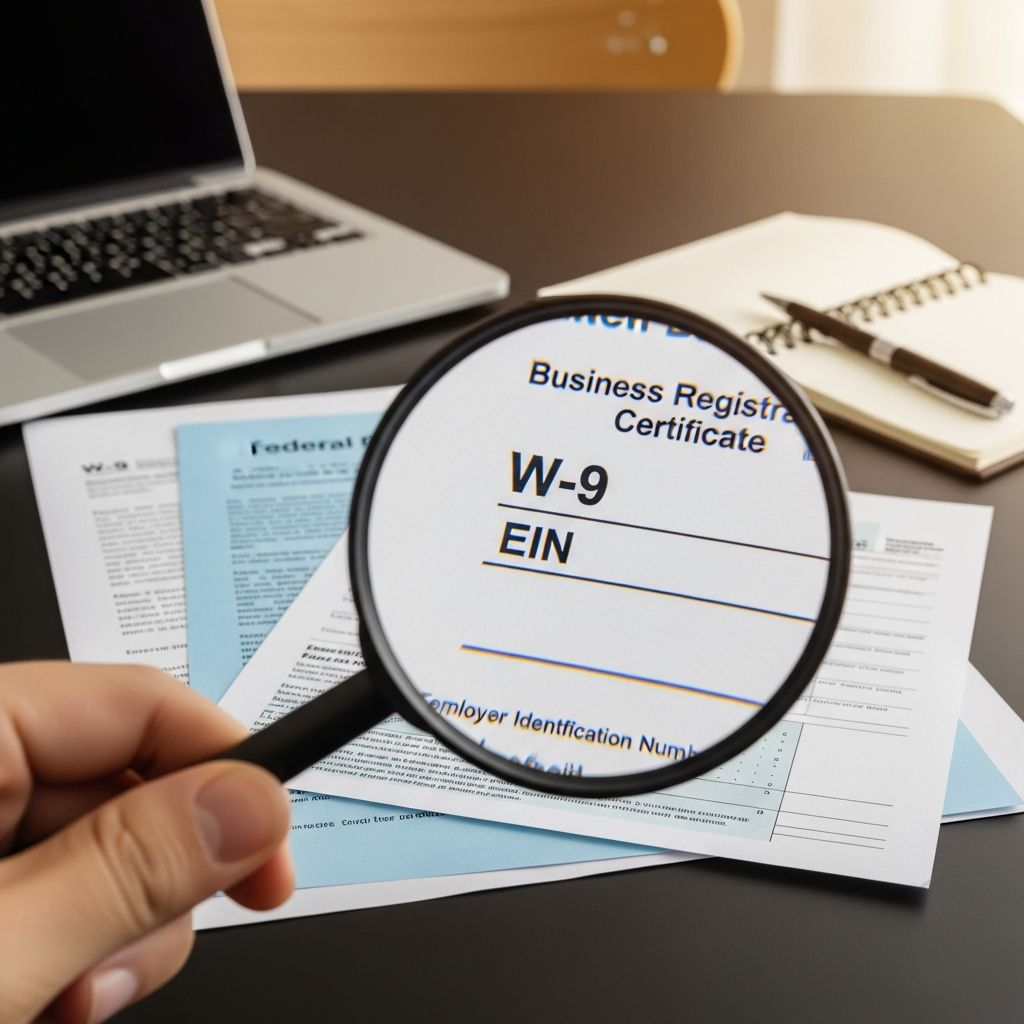
Review Business Registration Documents
Depending on your business structure, your state business registration documents often contain your EIN:
– Articles of incorporation (for corporations)- Articles of organization (for LLCs)- Partnership agreements (for partnerships)- Business registration certificates from your state- Assumed name (DBA) registration documents
When You Can Use Your EIN
Once you receive your EIN, you can use it immediately for most business purposes. However, there are specific timing considerations:
Immediate Uses
You can use your EIN right away for:
– Opening a business bank account- Applying for business licenses and permits- Filing tax returns by mail- Establishing business credit- Creating vendor accounts
Uses Requiring Waiting Period
The IRS recommends waiting up to two weeks before:
– Passing IRS Taxpayer ID Number (TIN) Matching Program verification- E-filing tax returns electronically- Making electronic tax deposits and payments through EFTPS (Electronic Federal Tax Payment System)This waiting period allows the IRS systems to fully process and register your new EIN in their database.
EIN vs. Other Tax Identification Numbers
Understanding the difference between an EIN and other tax identification numbers is important for proper business classification and tax reporting.
| Identifier | Used For | Format | Issued By |
|---|---|---|---|
| EIN (Employer Identification Number) | Business entities for federal tax purposes | 00-0000000 | IRS |
| SSN (Social Security Number) | Individual taxpayers | 000-00-0000 | Social Security Administration |
| TIN (Taxpayer Identification Number) | General tax identification (includes EIN and SSN) | Varies | IRS |
| FEIN (Federal Employer Identification Number) | Same as EIN (alternative term) | 00-0000000 | IRS |
An EIN is technically a type of Taxpayer Identification Number (TIN) used specifically for business entities, whereas sole proprietors without employees can use their Social Security number for tax purposes. However, once you hire employees or need to establish business credit, an EIN becomes necessary.
How to Apply for an EIN if You Don’t Have One
If you haven’t yet obtained an EIN, applying is a straightforward process that costs nothing.
Online Application (Fastest Method)
The quickest way to get an EIN is through the IRS online application:
– Visit the official IRS website’s EIN application portal- Complete Form SS-4 electronically- Receive your EIN immediately upon approval- The entire process typically takes just a few minutes
Application Requirements
When applying for an EIN, you’ll need to provide:
– Your business entity type (sole proprietorship, LLC, corporation, partnership, etc.)- The reason for applying (new business, change of organization, etc.)- Your business start or acquisition date- The principal industry classification of your business- Your legal business name and trade name (if applicable)- Your business location address- Personal information about the responsible person
Alternative Application Methods
If you prefer not to apply online, the IRS offers alternative methods:
– By phone: Call the IRS Business and Specialty Tax Line for telephone applications- By mail: Complete Form SS-4 and mail it to the appropriate IRS address for your location- By fax: Submit Form SS-4 to your regional IRS office via facsimile- By international application: Organizations formed outside the U.S. can apply by telephone
Important Considerations About Your EIN
Several important points should guide your approach to managing and protecting your EIN:
EIN Security and Privacy
Unlike a Social Security number, an EIN is not considered sensitive personal information. Businesses freely distribute their EINs through publications, websites, and other public channels. However, you should still protect it from fraudulent use and maintain accurate records of where you’ve provided it.
EIN Permanence
Your EIN remains with your business throughout its entire existence. Even if you change your business structure, location, or ownership, your original EIN typically remains valid. You would only apply for a new EIN if you fundamentally restructure your business entity type.
EIN Decoding
EIN decoder tools available online can identify in what state a company registered its EIN, based on the number’s structure. This can be useful for research or verification purposes, though it provides only limited information about the business itself.
Frequently Asked Questions
Q: How long does it take to receive an EIN?
A: Online applications typically provide an immediate EIN that you can use right away. The IRS recommends waiting up to two weeks before e-filing tax returns or making electronic payments to allow their systems to fully process the number, though many businesses use their EIN sooner without issues.
Q: Can I use my Social Security number instead of an EIN?
A: Sole proprietors without employees can use their Social Security number for business tax purposes. However, if you hire employees, establish business credit, or want to keep personal and business finances completely separate, you’ll need an EIN.
Q: Is there a cost to obtain an EIN?
A: No, obtaining an EIN is completely free. The IRS provides EINs at no cost whether you apply online, by phone, mail, or fax. Be cautious of third-party services charging fees to help with EIN applications.
Q: What if I’ve lost my EIN number?
A: You can retrieve your lost EIN by checking your original IRS confirmation letter, reviewing business bank account records, contacting the IRS directly, or requesting copies of your tax records using Form 4506-C.
Q: Do I need an EIN for a nonprofit organization?
A: Yes, every nonprofit organization must have an EIN, even if it will not have employees. Nonprofits apply for an EIN and typically obtain tax-exempt status separately through the IRS.
Q: Can I apply for an EIN before formally creating my business?
A: No, you should apply for an EIN after your business entity has been formally created but before you begin day-to-day operations. The application requires information about your established business structure.
Q: Will my EIN change if my business changes locations?
A: In most cases, your EIN remains the same even if your business relocates. You typically only need a new EIN if you change your business structure or certain organizational characteristics.
References
- What is an EIN? (Who Needs Employer ID Numbers & How to Apply) — Bill.com. 2024. https://www.bill.com/learning/employer-identification-number
- Employer Identification Number (EIN) — Cornell Law School Legal Information Institute. 2024. https://www.law.cornell.edu/wex/employer_identification_number_(ein)
- Employer Identification Number — Internal Revenue Service (IRS). 2025. https://www.irs.gov/businesses/employer-identification-number
- What is an Employer Identification Number (EIN)? — Bank of America Business. 2024. https://business.bankofamerica.com/en/resources/what-is-an-employer-identification-number-ein
- Get Federal and State Tax ID Numbers — U.S. Small Business Administration (SBA). 2025. https://www.sba.gov/business-guide/launch-your-business/get-federal-state-tax-id-numbers
- Employer Identification Number for Nonprofits — Internal Revenue Service (IRS). 2025. https://www.irs.gov/charities-non-profits/employer-identification-number
Similar Articles








Read full bio of Sneha Tete