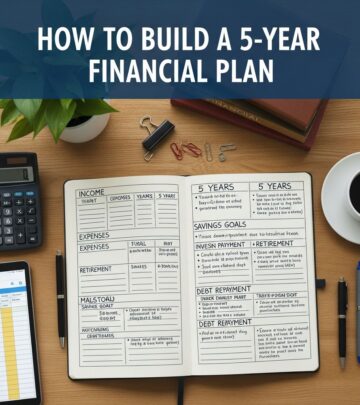
Financial 5-Year Plan: Step-By-Step Action Plan Template
Build your roadmap to financial success with a comprehensive 5-year plan covering debt, income, savings, and retirement.

How to Create a Financial 5-Year Plan
Many people wish for a better financial future, but without a concrete plan, those wishes remain just that—wishes. Days, months, and years pass by without meaningful progress. Instead of vaguely hoping for financial improvement, you need an actual game plan that serves as your roadmap to financial success. A 5-year financial plan is a powerful tool that transforms your aspirations into achievable goals backed by specific action steps.
Creating a financial 5-year plan begins with honest self-assessment and thoughtful planning. By taking the time to evaluate your current financial situation and articulate where you want to be in five years, you set the foundation for real, measurable progress. This guide walks you through each critical component of a comprehensive financial plan.
Assess Your Current Financial Situation
Before you can chart a course forward, you must understand where you stand today. This requires honest evaluation across four fundamental financial areas: debt, income, emergency savings, and retirement. Grab a piece of paper and write down your answers to the following questions for each category.
Understanding Your Debt
Debt is one of the biggest obstacles to building wealth. You cannot create lasting financial progress while carrying significant debt. The first step is acknowledging exactly how much debt you have and committing to a timeline for elimination.
Ask yourself these critical questions:
- Do you have debt? If so, what is the total amount?
- What types of debt do you carry (credit cards, student loans, car loans, mortgage)?
- When do you want to be completely debt-free?
By setting a specific deadline—whether it’s one year, two years, or three years—you create accountability and motivation. Your timeline should be ambitious yet realistic based on your current income and expenses.
Evaluating Your Income
Your income is your greatest wealth-building tool. It provides the fuel for everything else in your financial plan. Understanding both your current income and your income potential is essential for realistic goal-setting.
Consider these income-related questions:
- How much money do you make currently?
- How much money do you want to be making in five years?
- What career path or skills development will get you there?
- Are there opportunities for raises, promotions, or side income?
Income growth is fundamental to accelerating your financial progress. Without growth in your top-line revenue, it becomes significantly harder to advance your personal net worth, even if you are disciplined with saving.
Building Your Emergency Fund
No job is completely secure. Economic downturns, health issues, or unexpected circumstances can disrupt your income. Your emergency fund acts as a financial safety net, protecting you and your family during difficult times.
Evaluate your emergency preparedness with these questions:
- If you lost your job today, how long could you stay afloat and pay your bills?
- How many months of expenses should your emergency fund cover?
- What is a realistic target for your emergency savings within five years?
Financial experts generally recommend maintaining three to twelve months of living expenses in an easily accessible emergency fund. Your target depends on your job stability, number of dependents, and personal comfort level.
Planning for Retirement
Retirement may seem distant, but the decisions you make today significantly impact your retirement security. Even if retirement is decades away, understanding your retirement savings goals helps shape your 5-year plan.
Ask yourself:
- How much do you want to have saved for retirement in five years?
- Are you maximizing retirement account contributions?
- What is your strategy for long-term wealth accumulation?
Create Your Action Plan
Once you have answered these assessment questions and written them down, it is time to create specific action plans for each area. For each financial fundamental, write a detailed statement describing how you will achieve your goals. This transforms vague intentions into concrete commitments.
Your Debt Elimination Strategy
Write a statement that clearly outlines how you will pay off your debts faster. Your statement should include specific actions and a realistic timeline.
Example statement:
I will be completely out of debt in two years. To achieve this goal, I will find a part-time job working evenings and weekends for approximately 10 hours per week, generating additional income specifically for debt payoff. For the next two years, I will cut all expenses that are not absolute necessities. These are temporary sacrifices that I understand are required to reach my debt-freedom goal. I will utilize the debt snowball method, paying off the debt with the smallest balance first to create quick wins and build momentum toward my ultimate goal.
The debt snowball method, popularized by financial experts, focuses on eliminating smaller debts first. This approach provides psychological wins that fuel motivation and demonstrate tangible progress.
Your Income Growth Plan
Income growth requires intentional career development. Your income action plan should outline concrete steps to increase your earning potential.
Your income statement should address:
- What type of work or career do you want to pursue?
- How much higher income do you want to achieve?
- What qualifications, skills, or education will you need?
- What specific actions will you take to qualify for higher-paying work?
Whether through pursuing certifications, developing new skills, seeking promotions, or building a side business, your income plan should include concrete, actionable steps with timelines.
Your Emergency Fund Target
Create a specific statement outlining your emergency fund goal and how you will reach it.
Example statement:
Within five years, I will have an emergency fund large enough to protect me for 12 months of expenses. I will save $300 monthly, deposited automatically into a high-yield savings account separate from my checking account. This automatic transfer will occur on payday before I can spend the money, ensuring consistent progress toward my goal. By the end of five years, I will have accumulated $18,000 in emergency savings, providing substantial financial security and peace of mind.
Your Retirement Savings Plan
Retirement accounts offer powerful tax advantages that accelerate wealth building. Your plan should specify exactly how much you will contribute and how you will automate the process.
Example statement:
I will maximize my retirement contributions by saving $211 each pay period automatically to my Roth IRA through direct deposit, contributing the maximum annual amount. Additionally, I will save $673 each pay period to my 401(k) through automatic payroll deduction. By the end of each year, I will have contributed the maximum allowed amounts to both accounts. Over five years, with consistent contributions and compound growth, I will accumulate approximately $115,000 in retirement savings, establishing a strong foundation for my future security.
Understanding Financial Goal Timeframes
Financial goals fall into three categories based on timeframe. Understanding these distinctions helps you create a balanced, comprehensive plan.
| Goal Type | Timeframe | Characteristics | Examples |
|---|---|---|---|
| Short-Term Goals | 0-2 Years | Easiest to save for; require detailed planning on costs and usage; provide quick wins | Vacation, car repair fund, small home improvement |
| Mid-Term Goals | 2-5 Years | Require specific monthly savings targets; need flexibility for setbacks; should include cushion room | Home down payment, wedding, career transition |
| Long-Term Goals | 5+ Years | Require regular consistent savings; benefit from compound growth; may span decades | Retirement, college funding, major home purchase |
Your 5-year plan primarily focuses on short-term and mid-term goals while establishing the foundation for long-term success. Each category requires specific, detailed planning with realistic targets and built-in flexibility for unexpected life circumstances.
Making Your Plan Actionable and Sustainable
A financial plan only works if you actually follow it. Transform your written statements into daily habits and regular touchpoints.
Automate Your Finances
The most successful financial plans leverage automation. Set up automatic transfers to savings accounts, automatic bill payments, and automatic retirement contributions. This removes willpower from the equation and ensures consistent progress toward your goals.
Track Your Spending
You cannot manage what you do not measure. Use budgeting apps or spreadsheets to track every dollar you spend. Understanding exactly where your money goes reveals opportunities for cuts and helps you stay accountable to your plan.
Review Your Plan Regularly
Read your financial plan daily to stay motivated. Review it monthly to track progress, quarterly to make adjustments, and annually for comprehensive evaluation. This consistent engagement keeps your goals top-of-mind and allows you to celebrate progress.
Stay Flexible and Realistic
Life happens. Job losses, health emergencies, and unexpected expenses will test your plan. Build cushion room into mid-term and long-term goals to accommodate setbacks without complete derailment. A plan that is too rigid will create frustration; instead, create frameworks that are specific yet adaptable.
Customizing Your Plan to Your Situation
Your financial plan should reflect your unique circumstances, values, and priorities. While the framework remains consistent, your specific goals and strategies should align with your personal situation.
Consider factors such as:
- Your current life stage (student, early career, mid-career, near retirement)
- Your family structure and dependents
- Your job stability and income potential
- Your existing debt and assets
- Your risk tolerance and investment preferences
- Your personal values and priorities
For example, a young professional with no dependents might prioritize career advancement and investing, while a parent might focus on emergency savings and education funding. There is no one-size-fits-all approach; customization is essential.
The Long-Term Impact of a 5-Year Plan
Creating and executing a financial 5-year plan produces remarkable results. Five years may seem like a long time, but it passes regardless of whether you have a plan. The difference is that with a plan, five years from now you will have accomplished concrete financial goals and significantly improved your financial position.
By following through on your commitments and consistently executing your plan, you will likely be amazed at what you have accomplished. You may have eliminated significant debt, increased your income, built a robust emergency fund, and accelerated your retirement savings. More importantly, you will have developed financial discipline and confidence that propels you toward even greater success.
Frequently Asked Questions
Q: How often should I review and update my 5-year financial plan?
A: Review your plan daily for motivation, monthly to track progress toward goals, quarterly to make minor adjustments for changing circumstances, and annually for comprehensive evaluation and updates. Major life changes such as job loss, marriage, or unexpected inheritance may require immediate plan adjustments.
Q: What if I fall behind on my financial goals?
A: Falling behind does not mean failure. Life circumstances change unexpectedly. Reassess your situation, identify what derailed your progress, and adjust your plan accordingly. Building realistic cushion room into goals helps accommodate setbacks without complete plan abandonment. The key is resuming your efforts rather than giving up entirely.
Q: How much of an emergency fund should I target?
A: Financial experts generally recommend three to twelve months of living expenses. Your target depends on job stability, number of dependents, and personal comfort. Conservative budgeters often target twelve months, while others find three to six months sufficient. Your 5-year plan should reflect your personal situation and risk tolerance.
Q: Can I have multiple mid-term goals simultaneously?
A: Yes, you can pursue multiple mid-term goals within your 5-year plan. For example, you might simultaneously work toward paying off debt, building emergency savings, and saving for a home down payment. However, prioritize your goals based on importance and allocate your available income accordingly. Focus on one primary goal while making minimum progress on others, then shift focus as you achieve milestones.
Q: What is the debt snowball method?
A: The debt snowball method involves listing debts from smallest to largest balance and paying off the smallest first while making minimum payments on others. Once the smallest debt is eliminated, you move to the next smallest, and so on. This approach creates psychological momentum through quick wins and is particularly effective for motivation, though it may not minimize total interest paid.
References
- How to Create a Financial 5 Year Plan — Wise Bread. Accessed January 2026. https://www.wisebread.com/how-to-create-a-financial-5-year-plan
- FLM Step 12: Wise Bread blogger Linsey Knerl on goal setting — Money Management. Accessed January 2026. https://www.moneymanagement.org/blog/flm-step-12-wise-bread-blogger-linsey-knerl-on-goal-setting
- Financial Literacy Month — FNB Community Bank. Accessed January 2026. https://www.fnbmwc.com/about/blog/post.html?title=financial-literacy-month
- 6 Reasons Why Financial Planning Isn’t Just for the Wealthy — Wise Bread. Accessed January 2026. https://www.wisebread.com/6-reasons-why-financial-planning-isnt-just-for-the-wealthy
- How Financial Planners Prepare for Retirement 5 Years Out — Wise Money Show, YouTube. May 24, 2025. https://www.youtube.com/watch?v=2bd2TAHNJ3k
Similar Articles








Read full bio of Sneha Tete