How to Complete Schedule C: Step-by-Step Guide
Master Schedule C filing with our comprehensive step-by-step guide for self-employed professionals.
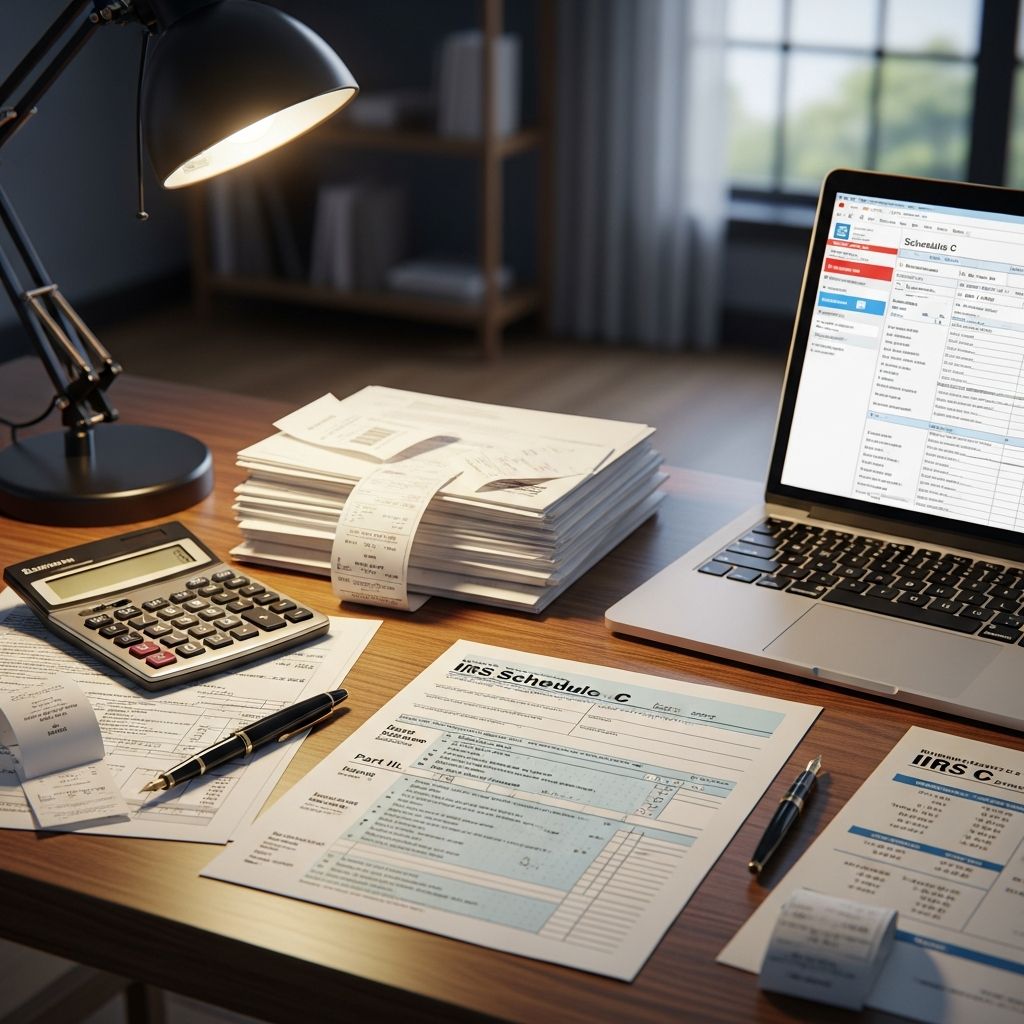
Schedule C (Form 1040) is one of the most important tax forms for self-employed individuals and sole proprietors. This form allows you to report the income or loss from a business you operate and calculate your net profit or loss for the tax year. Whether you’re a freelancer, consultant, small business owner, or independent contractor, understanding how to complete Schedule C accurately is essential for proper tax filing and potentially maximizing deductions.
Many self-employed taxpayers find Schedule C intimidating because it requires detailed financial information and careful attention to multiple sections. However, with the right preparation and step-by-step guidance, completing this form can be straightforward and manageable. This comprehensive guide will walk you through every section of Schedule C, explain what information you need to gather, and provide practical tips to ensure accuracy and compliance with IRS requirements.
What You Need Before Starting Schedule C
Before you begin filling out Schedule C, gathering all necessary documentation is critical. Without the proper records and information, you may miss deductions or make errors that could trigger an audit or delay your tax refund.
Essential Documents and Records
First and foremost, you’ll need your complete financial records for the tax year. This includes your balance sheet and income statement if you maintain formal accounting records. If you don’t have these prepared, gather your check register or any other transaction records from your business bank account.
You should also collect all receipts, invoices, and documentation that supports your claimed expenses. This is crucial because the IRS requires substantiation for all deductions claimed on Schedule C. Organize these documents by expense category to make the filing process easier and to ensure you don’t miss any deductible expenses.
Additionally, prepare the following items before beginning:
– Your Social Security Number (SSN)- Your Employer Identification Number (EIN) if you have one- Your business name and business address- Your Principal Business or Professional Activity (PBA) Code- Income documentation such as 1099-NECs, 1099-Ks, and bank statements- Records of all business expenses for the tax year- Inventory count and valuation if your business sells products- Mileage logs for each vehicle used for business purposes
Vehicle and Transportation Records
If you use vehicles for business purposes, maintaining accurate mileage logs is absolutely essential. You’ll need to document the total miles driven for business purposes, commuting, and personal use throughout the tax year. The IRS specifically requires detailed mileage records to support vehicle expense deductions, so this documentation must be contemporaneous and accurate.
Part One: Basic Information and Business Identification
The first section of Schedule C requires you to provide fundamental information about yourself and your business. This information establishes the connection between your personal tax return and your business reporting.
Your Personal Information
Start by entering your name as it appears on your personal tax return. This should be your legal name exactly as you’ve used it on previous tax documents. Next, enter your Social Security Number (SSN). This nine-digit number is mandatory for all Schedule C filers.
If you have obtained an Employer Identification Number (EIN) from the IRS, you have the option to enter it instead of your SSN. However, you should never enter both. Choose one identification number based on your business structure and filing requirements.
Line A: Principal Business or Profession
On Line A, provide a brief description of your business. Be specific about your industry and the type of product or service you provide. For example, instead of writing “consulting,” you might write “management consulting for manufacturing companies” or “freelance graphic design and web development.” This level of detail helps the IRS understand your business activities and is useful for matching your return with relevant tax rules.
The IRS uses this description to assign your business a Principal Business or Professional Activity (PBA) Code, which is reported on Line B.
Line B: Principal Business Activity Code
Enter the six-digit PBA Code that corresponds to your business activities. This code is essential for proper classification of your business. You can find the complete list of codes in the “Principal Business or Professional Activity Codes” section at the bottom of the IRS instructions for Schedule C. The codes help the IRS track different types of business activities and compare your return with similar businesses in your industry.
Line C: Business Name
If you operate your sole proprietorship under a name different from your own legal name (often called a “doing business as” or DBA name), enter that business name on Line C. If you operate under your own name, you can leave this line blank or enter your personal name.
Line D: Employer Identification Number
If you applied for an EIN using Form SS-4 and received an employer identification number, enter it on Line D. If you don’t have an EIN, leave this line blank. Many sole proprietors without employees don’t need an EIN and use only their SSN for tax purposes.
Line E: Business Address
Provide your business address on Line E. If you have a separate location where you conduct business, list that address. If you operate your business from your home, you can use your residential address. This address is used by the IRS for correspondence related to your business tax return.
Box F: Accounting Method
Select your accounting method: cash, accrual, or other. The vast majority of self-employed individuals and small business owners use the cash accounting method, which reports income when received and expenses when paid. Accrual accounting reports income when earned and expenses when incurred, regardless of when payment is received or made. Accrual accounting is typically used by larger businesses and may be required if you maintain inventory or have significant business operations.
Part Two: Income Section
The income section of Schedule C is where you report all revenue generated by your business during the tax year. Accuracy in this section is vital because it forms the foundation for calculating your net business income.
Line 1: Gross Receipts or Sales
On Line 1, enter your total gross receipts for the year. This includes all income from your business activities before deducting any expenses. Gather all 1099-NECs (for non-employee compensation) and 1099-Ks (for payment card transactions) you received, and add them to income reported directly to your bank account. Ensure this figure matches your business bank statements and other income documentation.
Line 2: Returns and Allowances
If you issued refunds to customers or provided credits or allowances during the tax year, report the total on Line 2. This reduces your gross income to reflect actual revenue retained by your business.
Line 3: Subtract Line 2 from Line 1
This calculation gives you your net receipts or sales, which carries forward in your Schedule C calculations.
Part Three: Cost of Goods Sold
If your business involves selling products rather than services, you’ll need to calculate and report your cost of goods sold (COGS). This section doesn’t apply to service-based businesses.
Understanding Cost of Goods Sold
Cost of goods sold includes the direct costs of producing or purchasing the goods that you sell. This includes raw materials, labor directly involved in production, and the cost of inventory purchased for resale. It does not include indirect expenses like rent for your office space, administrative salaries, or marketing costs.
Line 42: Inventory at End of Year
On Line 42, you’ll calculate your COGS using the inventory method. You need to determine the value of inventory at the end of the tax year. This requires counting all unsold inventory and valuing it appropriately, typically using either the first-in-first-out (FIFO) or lower-of-cost-or-market method.
Line 4: Cost of Goods Sold
Once you’ve completed the COGS calculation on Line 42, enter that total on Line 4. If you don’t sell goods or didn’t subcontract labor, enter zero.
Part Four: Business Deductions and Expenses
This is the most comprehensive section of Schedule C, where you report all ordinary and necessary business expenses. Maximizing legitimate deductions reduces your taxable business income and your overall tax liability.
Common Business Expense Categories
Schedule C provides specific lines for various business expenses. Let’s review the major categories:
Line 8: Advertising
Report all costs associated with advertising your business, including online advertising, print ads, social media promotion, website development for marketing purposes, and promotional materials.
Line 9: Car and Truck Expenses
You can claim either actual vehicle expenses or use the standard mileage rate. Actual expenses include gas, oil, repairs, insurance, registration, and depreciation. The standard mileage rate is simpler and allows you to multiply your total business miles by the current IRS rate.
Line 27: Meals and Entertainment
Business meals and entertainment are generally deductible at 50% of the actual cost. Keep receipts documenting the date, location, attendees, and business purpose of each meal or entertainment expense.
Line 20a and 20b: Rent or Lease
On Line 20a, report rental costs for business-related vehicles, machinery, and equipment. On Line 20b, enter other business-related rent payments such as commercial office or retail space rental. This does not include mortgage payments on property you own, though it does include rent paid for a home office if you use the actual expense method.
Line 21: Repairs and Maintenance
Enter business-related repairs and maintenance costs, including labor, supplies, tools, and contractor fees. Important distinction: do not include expenses that improve, better, or restore property to a better condition than before. These capital improvements must be depreciated rather than deducted. Also exclude the value of your own labor.
Line 22: Supplies
Include office supplies, materials used in your business, and other consumable items necessary for operations. This typically includes items with a useful life of less than one year.
Line 23: Taxes and Licenses
Report business licenses, permits, professional certifications, and self-employment tax paid. Do not include federal income taxes or state income taxes.
Line 24: Travel
Deduct business-related travel expenses including airfare, lodging, and ground transportation. Keep documentation showing the business purpose of your travel.
Line 25: Utilities
If you rent commercial space, include utilities. If you use the home office deduction, this may be calculated as part of that calculation.
Line 26: Wages
Report wages paid to employees, but do not include your own salary or guaranteed payments to partners. You must have filed appropriate employment tax forms for employee wages.
Line 30: Depreciation
If you own business property with a useful life of more than one year, you can deduct depreciation. This includes equipment, vehicles, buildings, and furniture. You’ll need to complete Form 4562 (Depreciation and Amortization) to calculate allowable depreciation.
Part Five: Vehicle Information
If you claim vehicle expenses, you must provide specific information about each vehicle used for business purposes.
Line 43: Date Vehicle Placed in Service
Enter the date when you first began using the vehicle for business purposes. This determines when depreciation begins and affects your deduction calculations.
Line 44: Total Vehicle Mileage
Using information from your detailed mileage log, enter the total miles driven for the year in Line 44a (business miles), Line 44b (commuting miles), and Line 44c (personal use miles). The IRS requires that you maintain contemporaneous records supporting these mileage claims.
Line 45: Vehicle Availability for Personal Use
Indicate whether your vehicle was available for personal use during off-duty hours. This information helps determine what percentage of the vehicle’s use qualifies as business-related for deduction purposes.
Calculating Your Net Profit or Loss
After completing all sections of Schedule C, you’ll calculate your total expenses and determine your net profit or loss by subtracting total expenses from your gross income. A positive number represents net profit; a negative number represents a loss. This figure carries forward to your Form 1040 individual tax return.
Frequently Asked Questions
Q: Do I need an EIN to file Schedule C?
A: No. As a sole proprietor, you can use your Social Security Number instead of an EIN. However, obtaining an EIN is recommended if you have employees, hire contractors, open a business bank account, or want to keep personal and business finances separate.
Q: Can I deduct home office expenses on Schedule C?
A: Yes. If you use part of your home exclusively for business, you can deduct either a simplified rate or actual expenses. The simplified option allows you to deduct $5 per square foot up to 300 square feet.
Q: What if I operate multiple businesses?
A: You must complete a separate Schedule C for each business you operate, each with its own business income and expenses.
Q: When is Schedule C due?
A: Schedule C is filed as part of your Form 1040 individual income tax return, which is due April 15th of the following year (or the next business day if April 15th falls on a weekend or holiday).
Q: What is the difference between business expenses and capital purchases?
A: Business expenses are costs with a useful life of less than one year and are fully deductible in the current year. Capital purchases (like equipment or vehicles) have a useful life of more than one year and must be depreciated over time.
Filing Your Schedule C
Once you’ve completed Schedule C, it must be filed with your Form 1040 personal income tax return. You can file electronically using tax preparation software, through a tax professional, or by mailing paper forms to the IRS. Ensure all information is accurate, all supporting documentation is organized, and that you meet the annual filing deadline to avoid penalties and interest.
References
- 2024 Instructions for Schedule C (Form 1040) — Internal Revenue Service. 2024. https://www.irs.gov/instructions/i1040sc
- About Schedule C (Form 1040), Profit or Loss from Business — Internal Revenue Service. https://www.irs.gov/forms-pubs/about-schedule-c-form-1040
- A Step-by-Step Guide to Filing Schedule C (Form 1040) — Ambrook. https://ambrook.com/education/taxes/schedule-c
- How to Fill Out Your Schedule C Perfectly (With Examples) — Keeper Tax. https://www.keepertax.com/posts/schedule-c
- How To File Schedule C Form 1040 — Bench Accounting. https://www.bench.co/blog/tax-tips/schedule-c
Similar Articles








Read full bio of Sneha Tete