How to Calculate Loan Payments and Total Costs
Master loan payment calculations: Learn formulas, use calculators, and understand your true borrowing costs.

Understanding how to calculate loan payments is essential for making informed financial decisions. Whether you’re considering a personal loan, auto loan, or mortgage, knowing what your monthly payment will be and how much total interest you’ll pay helps you budget effectively and avoid costly mistakes. This comprehensive guide explains the methods, formulas, and tools available to calculate your loan payments accurately.
Key Takeaways
- Loan payments are calculated using three primary factors: principal amount, interest rate, and repayment period
- Online loan calculators provide the fastest and most convenient way to estimate monthly payments without complex math
- Understanding the difference between monthly cost and total cost gives you a complete picture of your borrowing expenses
- An amortization schedule shows how your payments are split between principal and interest over time
- You can use mathematical formulas to calculate payments manually if you prefer hands-on calculations
Understanding the Three Essential Components
To calculate any loan payment accurately, you need to understand the three fundamental components that determine what you’ll pay each month.
Principal Amount
The principal is the original amount you borrow from a lender. If you take out a $20,000 personal loan, that $20,000 is your principal. This figure serves as the foundation for all payment calculations. As you make monthly payments, the principal balance decreases, which in turn affects how much interest you’ll owe on subsequent months.
Interest Rate
The interest rate represents the cost of borrowing money, expressed as an annual percentage. Different lenders offer different rates based on factors like your credit score, income, and the type of loan. Interest rates can range significantly—for personal loans, rates typically vary from 6.70% to 35.99% depending on your creditworthiness. The interest rate directly impacts your monthly payment; a higher rate means higher monthly payments and greater total interest paid.
Repayment Period
The repayment period, also called the loan term, is the length of time you have to pay back the loan. Common terms for personal loans range from one to ten years, with most lenders offering standard terms between two and seven years. A longer term means smaller monthly payments but more total interest paid over the life of the loan, while a shorter term results in higher monthly payments but less total interest.
Methods to Calculate Loan Payments
There are two primary approaches to calculating loan payments: using online calculators or applying mathematical formulas manually. Each method has distinct advantages depending on your comfort level with calculations and your specific needs.
Method 1: Using Online Loan Calculators
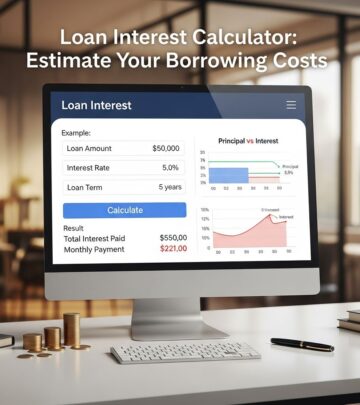
The most popular and user-friendly method for calculating loan payments is using online loan calculators. These tools handle all the complex mathematics for you, requiring only that you input basic information about your loan. Most calculators ask for three pieces of information: the loan amount (principal), the interest rate, and the loan term in years or months.
Online calculators offer several advantages over manual calculation. They provide instant results, eliminate the possibility of mathematical errors, and allow you to quickly test different scenarios by adjusting variables. You can compare how different interest rates or loan terms affect your monthly payment and total cost without lengthy calculations. Many calculators also display an amortization schedule, showing exactly how much principal and interest you’ll pay each month.
Bankrate offers several specialized loan calculators tailored to different loan types, including personal loan calculators, auto loan calculators, student loan calculators, and mortgage calculators. These tools are designed to give you a general idea of what to expect with any type of loan payment without requiring you to fill out a formal application, making them ideal for comparing options and understanding your financial situation before you commit.
Method 2: Using the Loan Payment Formula
If you prefer to calculate loan payments manually or want to understand the mathematics behind the numbers, you can use the standard loan payment formula. This formula works for any amortized loan and produces your fixed monthly payment.
The loan payment formula is:
M = P × r × (1+r)ⁿ / [(1+r)ⁿ − 1]
In this formula:
- M = Your monthly payment
- P = Principal (the loan amount)
- r = Monthly interest rate (annual APR divided by 12)
- n = Total number of months (loan term in years multiplied by 12)
Let’s work through a practical example. Suppose you borrow $20,000 at a 6% annual interest rate for a 5-year term:
- P = $20,000
- r = 0.06 ÷ 12 = 0.005
- n = 5 × 12 = 60 months
Using the formula: M = $20,000 × 0.005 × (1.005)⁶⁰ / [(1.005)⁶⁰ − 1] = approximately $387 per month.
While this formula is accurate, it requires more effort than using an online calculator. However, understanding how it works provides insight into why your payments are structured the way they are.
Understanding Simple Interest Calculations
For the first month’s interest payment, you can use a simpler calculation method. This helps illustrate how interest works on your loan before diving into more complex amortization concepts.
To calculate your first month’s interest:
- Divide your annual interest rate by 12 to get your monthly rate. For a 6% annual rate: 0.06 ÷ 12 = 0.005
- Multiply this monthly rate by your initial loan balance. For a $20,000 loan: 0.005 × $20,000 = $100
In this example, you would pay $100 in interest during your first month. This demonstrates that the portion of your payment going toward interest is calculated based on the outstanding principal balance each month. As you pay down the principal, less of each subsequent payment goes toward interest, and more goes toward reducing your principal balance.
Amortization Schedules: Tracking Your Payments
An amortization schedule is a detailed table showing how your loan payments break down between principal and interest over the entire repayment period. This schedule illustrates a key principle of loan repayment: early payments are heavily weighted toward interest, while later payments go more toward principal.
Example Amortization Schedule
Here’s an example of an amortization schedule for a $20,000 loan at 6% annual interest over 5 years (60 months), with a monthly payment of $387:
| Month | Starting Balance | Monthly Payment | Paid Toward Principal | Paid Toward Interest | New Balance |
|---|---|---|---|---|---|
| 1 | $20,000 | $387 | $287 | $100 | $19,713 |
| 2 | $19,713 | $387 | $288 | $99 | $19,425 |
| 3 | $19,425 | $387 | $290 | $97 | $19,136 |
| 4 | $19,136 | $387 | $291 | $96 | $18,845 |
| 5 | $18,845 | $387 | $292 | $94 | $18,552 |
| 6 | $18,552 | $387 | $294 | $93 | $18,258 |
| 7 | $18,258 | $387 | $295 | $91 | $17,963 |
| 8 | $17,963 | $387 | $297 | $90 | $17,666 |
| 9 | $17,666 | $387 | $298 | $88 | $17,368 |
| 10 | $17,368 | $387 | $300 | $87 | $17,068 |
| 11 | $17,068 | $387 | $301 | $85 | $16,767 |
| 12 | $16,767 | $387 | $303 | $84 | $16,464 |
Notice how in month 1, only $287 of your $387 payment goes toward the principal, while $100 goes toward interest. By month 12, $303 goes toward principal and only $84 toward interest. This pattern continues throughout the loan term, with increasingly more of each payment reducing your principal balance.
Comparing Loan Options: Monthly vs. Total Cost
When evaluating different loan offers, it’s crucial to look beyond just the monthly payment amount. The total cost of the loan—including all interest paid over the life of the loan—provides a complete picture of what you’ll actually spend.
Monthly Payment vs. Total Cost Analysis
Consider two loan scenarios for the same $20,000 principal with different terms:
- 3-Year Term: Higher monthly payment but less total interest paid
- 5-Year Term: Lower monthly payment but more total interest paid
Your choice depends on your financial situation. If you can afford higher monthly payments and want to minimize total interest, choose the shorter term. If you need lower monthly payments to fit your budget, the longer term may be necessary, though you’ll pay more interest overall.
How to Use Online Loan Calculators Effectively
Online loan calculators are versatile tools with multiple applications beyond simple payment estimation.
Steps to Use a Basic Loan Calculator
- Enter the principal loan amount you’re considering borrowing
- Select or enter your desired loan term in years
- Enter the interest rate (if unsure, use your lender’s current average rates)
- Click the calculate button to see your estimated monthly payment
- Review the amortization schedule to see the breakdown of principal and interest payments
Maximizing Your Calculator Results
Online calculators become even more powerful when you use them to test different scenarios:
- Budget Assessment: Determine how much you can afford to borrow based on your target monthly payment
- Refinancing Analysis: Calculate potential savings by entering a lower interest rate than your current loan
- Early Payoff Planning: See how much you could save by increasing monthly payments or choosing a shorter term
- Rate Comparison: Test how different interest rates affect your monthly payment and total cost
- Term Evaluation: Compare side-by-side results for different loan lengths
Factors That Affect Your Loan Payment
Beyond the basic formula, several factors influence your actual loan payment and total cost.
Credit Score Impact
Your credit score significantly affects the interest rate you’ll receive. Borrowers with excellent credit scores may qualify for rates around 8%, while those with poor credit might face rates near 30% or higher. This difference substantially impacts your monthly payment and total interest paid.
Loan Type Variations
Different loan types have different calculation methods. Personal loans typically use fixed-rate amortization. Auto loans may have similar calculations but different standard terms. Mortgages often include additional factors like property taxes, insurance, and potentially private mortgage insurance (PMI).
Payment Timing Effects
Interest fluctuates with your outstanding principal balance. Making a payment five days late means your principal balance remains higher for those five additional days, resulting in more interest charged. This demonstrates why staying current with payments is financially beneficial beyond just avoiding penalties.
Practical Applications and Decision-Making
Personal Loan Considerations
When calculating personal loan payments, consider your current financial obligations and future income stability. Personal loans typically offer more flexibility than auto loans or mortgages, but your monthly payment affects your overall debt-to-income ratio, which impacts your creditworthiness.
Auto Loan Planning
For auto loans, remember that your monthly payment directly correlates with the vehicle’s price and your down payment. A larger down payment reduces the principal, lowering your monthly payment and total interest significantly.
Mortgage Decisions
For mortgages, the down payment percentage substantially affects your monthly payment. A higher down payment reduces the loan amount but also affects insurance requirements and interest rates available to you.
Frequently Asked Questions
Q: What’s the difference between APR and interest rate?
A: The interest rate is the percentage charged on your loan balance, while APR (Annual Percentage Rate) includes the interest rate plus other costs associated with borrowing. APR gives you a more complete picture of the true cost of borrowing, though for calculation purposes, you typically use the interest rate for monthly payments.
Q: Can I calculate loan payments in Excel?
A: Yes, you can create your own loan calculator in Excel using the PMT function or by building formulas based on the loan payment formula. However, for most people, using an online calculator is faster and less prone to formula errors.
Q: Why do early payments mostly go toward interest?
A: Interest is calculated on your outstanding balance each month. Since your balance is highest at the beginning of the loan, your first payments accrue the most interest. As you pay down the principal, less of each payment goes toward interest and more toward principal reduction.
Q: How can I lower my monthly payment?
A: You can lower your monthly payment by extending your loan term, reducing the loan amount (making a larger down payment), securing a lower interest rate through refinancing or improving your credit score, or choosing a different loan product better suited to your needs.
Q: Should I always choose the longest loan term?
A: Not necessarily. While longer terms mean lower monthly payments, you’ll pay significantly more total interest. Choose a term that balances your monthly budget with minimizing total interest costs based on your financial situation.
References
- How To Calculate Loan Payments And Costs — Bankrate. 2025. https://www.bankrate.com/loans/personal-loans/how-to-calculate-loan-payments/
- Simple Loan Payment Calculator — Bankrate. October 02, 2025. https://www.bankrate.com/loans/simple-loan-payment-calculator/
- How To Calculate Loan Interest: Simple And Amortized — Bankrate. 2025. https://www.bankrate.com/loans/personal-loans/how-to-calculate-loan-interest/
- Personal Loan Calculator — Bankrate. 2025. https://www.bankrate.com/loans/personal-loans/personal-loan-calculator/
- Loan Calculator — Bankrate. 2025. https://www.bankrate.com/loans/loan-calculator/
Similar Articles








Read full bio of Sneha Tete