How to Calculate Compound Interest: Formulas and Methods
Master compound interest calculations with proven formulas and practical examples.

Understanding how to calculate interest is fundamental to managing personal finances, investing wisely, and planning for long-term financial goals. Whether you’re saving for retirement, investing in stocks, or borrowing money, knowing how interest works can help you make better financial decisions. This comprehensive guide explores the formulas and methods used to calculate both simple and compound interest.
Understanding Interest Basics
Interest represents the cost of borrowing money or the return on invested capital. When you deposit money in a savings account or invest in bonds, banks and financial institutions pay you interest. Conversely, when you borrow money through loans or credit cards, you pay interest to the lender. The amount of interest depends on several key factors:
- Principal Amount: The initial sum of money invested or borrowed
- Interest Rate: The percentage charged or earned annually (or per compounding period)
- Time Period: The duration for which money is invested or borrowed
- Compounding Frequency: How often interest is calculated and added to the principal
These variables form the foundation of all interest calculations and determine the final amount you’ll earn or owe.
Simple Interest Formula
Simple interest is the most straightforward method of calculating interest. It’s calculated only on the principal amount, and interest doesn’t compound. This means you earn or pay the same amount of interest each period.
The Simple Interest Formula
The formula for calculating simple interest is:
Simple Interest = P × R × T
Where:
- P = Principal (initial amount of money)
- R = Annual interest rate (expressed as a decimal)
- T = Time period in years
Simple Interest Example
Suppose you invest $1,000 at an annual interest rate of 5% for 3 years:
Simple Interest = $1,000 × 0.05 × 3 = $150
Your total amount after 3 years would be $1,000 + $150 = $1,150. Simple interest remains popular for short-term loans and certain bond calculations, but it’s less common in modern savings and investment products.
Compound Interest Formula
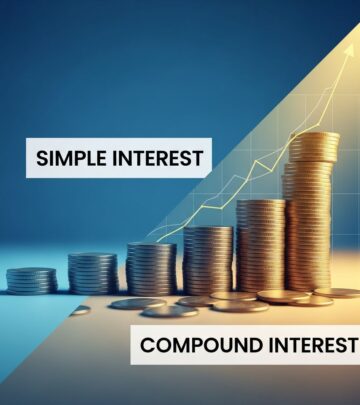
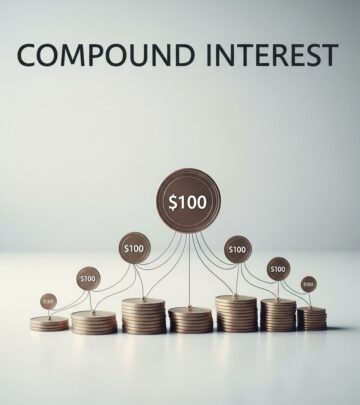
Compound interest is more sophisticated and represents how most real-world financial products work. With compound interest, interest is calculated on both the principal and previously earned interest. This creates exponential growth over time, often called “interest on interest.”
The Compound Interest Formula
The standard formula for compound interest is:
A = P(1 + r/n)^(nt)
Where:
- A = Final amount after time period
- P = Principal (initial investment)
- r = Annual interest rate (expressed as a decimal)
- n = Number of times interest is compounded per year
- t = Time period in years
Compound Interest Example
Let’s use the same $1,000 investment at 5% annual interest for 3 years, but compounded annually (n=1):
A = $1,000(1 + 0.05/1)^(1×3)
A = $1,000(1.05)^3
A = $1,000 × 1.157625
A = $1,157.63
Notice that with compound interest, you earn $157.63 instead of $150 with simple interest. The extra $7.63 represents the “interest on interest.” This difference grows significantly over longer time periods and with more frequent compounding.
Compounding Frequencies and Their Impact
The frequency at which interest compounds dramatically affects the final amount. Common compounding periods include:
| Compounding Frequency | Value of n | How Often Interest Compounds |
|---|---|---|
| Annually | 1 | Once per year |
| Semi-Annually | 2 | Twice per year |
| Quarterly | 4 | Four times per year |
| Monthly | 12 | Twelve times per year |
| Daily | 365 | Every day |
| Continuously | e (2.718…) | Infinitely throughout the year |
Using the same $1,000 investment at 5% for 3 years with different compounding frequencies:
- Annually (n=1): $1,157.63
- Semi-Annually (n=2): $1,158.70
- Quarterly (n=4): $1,159.27
- Monthly (n=12): $1,159.78
- Daily (n=365): $1,160.02
As you can see, more frequent compounding results in slightly higher returns. However, the differences become less significant beyond monthly compounding.
Continuous Compounding Formula
Continuous compounding represents the theoretical maximum amount of compound interest. It uses the mathematical constant e (approximately 2.718) and is expressed as:
A = Pe^(rt)
Where:
- A = Final amount
- P = Principal
- e = Euler’s number (approximately 2.718)
- r = Annual interest rate (as a decimal)
- t = Time in years
For our $1,000 example at 5% for 3 years:
A = $1,000 × e^(0.05×3)
A = $1,000 × e^0.15
A = $1,000 × 1.161834
A = $1,161.83
Continuous compounding yields the maximum possible return, though it’s primarily a theoretical concept used in advanced financial mathematics rather than in actual banking products.
Comparing Simple vs. Compound Interest Over Time
The true power of compound interest becomes evident over longer time periods. Here’s a comparison of $1,000 invested at 5% annually for different durations:
| Years | Simple Interest | Compound Interest (Annual) | Difference |
|---|---|---|---|
| 5 | $1,250.00 | $1,276.28 | $26.28 |
| 10 | $1,500.00 | $1,628.89 | $128.89 |
| 20 | $2,000.00 | $2,653.30 | $653.30 |
| 30 | $2,500.00 | $4,321.94 | $1,821.94 |
This table clearly demonstrates how compound interest significantly outperforms simple interest over extended periods. After 30 years, compound interest generates nearly $1,822 more than simple interest on the same initial investment.
Practical Applications and Real-World Scenarios
Savings Accounts and Certificates of Deposit
Banks typically offer compound interest on savings accounts and certificates of deposit (CDs). Most savings accounts compound interest monthly or daily, meaning your earnings accelerate as interest accrues on your interest. Understanding these calculations helps you choose the best savings vehicle for your needs.
Loan and Debt Calculations
When borrowing money, compound interest works against you. Credit card companies, auto lenders, and mortgage companies all charge compound interest. Knowing how to calculate this helps you understand the true cost of borrowing and make informed decisions about debt repayment strategies.
Investment Returns
Long-term investments in stocks, bonds, and mutual funds benefit from compound returns. Reinvesting dividends and capital gains allows your portfolio to compound over time, significantly enhancing wealth accumulation for retirement and other financial goals.
Tools and Methods for Calculating Interest
Manual Calculation
Using the formulas provided above, you can manually calculate interest with a calculator. This method requires careful attention to the variables and mathematical operations involved.
Spreadsheet Software
Microsoft Excel, Google Sheets, and similar programs offer built-in financial functions like FV (Future Value) and RATE that simplify compound interest calculations. These tools are particularly useful for complex scenarios involving multiple variables.
Online Calculators
Numerous free online compound interest calculators are available that automate calculations instantly. These tools often include additional features like graphs showing growth over time and the ability to adjust variables in real-time.
Financial Advisor Assistance
For significant financial decisions, consulting a qualified financial advisor can provide personalized calculations and recommendations tailored to your specific circumstances and goals.
Key Factors Affecting Interest Calculations
- Higher Interest Rates: Even small differences in rates compound dramatically over time
- Longer Time Horizons: Extended investment periods exponentially increase compound interest benefits
- Regular Contributions: Adding periodic deposits amplifies compounding effects significantly
- Compounding Frequency: More frequent compounding periods yield higher returns
- Early Investment: Starting investments early maximizes compound growth potential
Frequently Asked Questions About Interest Calculations
Q: What’s the difference between annual percentage rate (APR) and annual percentage yield (APY)?
A: APR is the annual cost of a loan without considering compounding, while APY accounts for compound interest. APY is typically higher than APR for savings products because it reflects the actual annual return including compound interest effects.
Q: How often should I check my investment’s compound interest growth?
A: While compound interest works continuously, checking your investments quarterly or annually is sufficient for most people. Frequent checking can lead to emotional decision-making rather than long-term strategy adherence.
Q: Can I use these formulas for any type of interest-bearing account?
A: Yes, these formulas apply to savings accounts, CDs, bonds, loans, and credit cards. However, specific products may have unique terms and conditions affecting interest calculations, so always review the fine print.
Q: What’s the “Rule of 72” and how does it relate to compound interest?
A: The Rule of 72 is a quick estimation method where you divide 72 by your interest rate to determine how many years it takes for your money to double. For example, at 6% interest, your money doubles in approximately 12 years (72÷6=12).
Q: How does inflation affect compound interest returns?
A: Inflation erodes the purchasing power of your returns. If your compound interest rate is 5% but inflation is 3%, your real return is approximately 2%. Always consider inflation when evaluating investment returns.
Q: Should I prioritize investments with the highest interest rates?
A: While higher rates are attractive, consider overall risk tolerance, investment timeline, and diversification. Higher-yielding investments often carry greater risk, so balance potential returns with your financial goals and comfort level.
Conclusion
Mastering interest calculations is essential for making informed financial decisions. Whether calculating simple interest for short-term scenarios or compound interest for long-term investments, understanding these formulas empowers you to evaluate financial products critically. The power of compound interest, often described as the eighth wonder of the world, demonstrates why starting early and remaining invested for extended periods creates substantial wealth accumulation. By applying these principles and utilizing available calculation tools, you can optimize your financial strategy and work toward achieving your long-term financial objectives.
References
- What Is Compound Interest? — U.S. Securities and Exchange Commission (SEC). https://www.sec.gov/investor/alerts/ia_investsmart.pdf
- Annual Percentage Rate and Annual Percentage Yield — Consumer Financial Protection Bureau (CFPB). https://www.consumerfinance.gov/about-us/newsroom/cfpb-report-examines-disclosure-annual-percentage-rates-annual-percentage-yields/
- Understanding Compound Interest and the Impact on Financial Health — Federal Reserve Financial Education Resources. https://www.federalreserve.gov/
- Time Value of Money and Interest Calculations — National Endowment for Financial Education (NEFE). https://www.nefe.org/
- Investment Returns and Compounding: A Practical Guide — Investor.gov, a site by the SEC and FINRA. https://www.investor.gov/introduction-investing
Similar Articles








Read full bio of medha deb