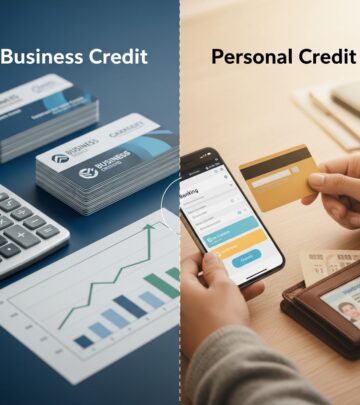
How to Build Strong Business Credit Fast
Learn step-by-step how to establish, grow, and protect your business credit so you can qualify for better financing and vendor terms.

Building solid business credit can help your company qualify for better financing, negotiate favorable terms with vendors, and protect your personal finances. This guide walks through everything from setting up your business correctly to using credit products strategically and monitoring your scores over time.
What Is Business Credit and Why It Matters
Business credit is a record of how your company manages its debts and financial obligations. It includes your payment history with lenders, vendors, and service providers, and is summarized in one or more business credit scores maintained by business credit bureaus such as Dun & Bradstreet, Experian Business, and Equifax Business.
According to the U.S. Small Business Administration (SBA), establishing business credit helps separate your business and personal finances and can make it easier to access financing and vendor terms as your company grows.
Key reasons business credit is important
- Access to financing: Lenders often review business credit to decide whether to approve loans or lines of credit and at what interest rates.
- Better vendor terms: Strong credit can help you secure net 30 or longer payment terms from suppliers.
- Protect personal assets: With solid business credit, you may rely less on personal guarantees and credit cards.
- Professional image: A well-established business credit profile signals legitimacy to partners, landlords, and insurers.
Step 1: Separate Your Personal and Business Finances
The foundation of business credit is demonstrating that your company is a distinct legal and financial entity. This separation is critical for both legal protection and accurate reporting of business credit activity.
Choose a legal structure
While sole proprietorships can operate with the owner’s personal credit, forming a separate entity is usually better for building business credit.
- LLC (Limited Liability Company): A flexible structure that separates business and personal liability.
- Corporation (C-Corp or S-Corp): Often used for larger or growth-focused businesses and can strengthen perceived credibility.
- Other entities: Depending on your jurisdiction, there may be additional options, but the key is creating a distinct legal entity.
Register your business
Register your business name with the appropriate state or local authority and obtain any licenses required in your industry. Lenders and bureaus look for consistent information across your registrations, tax records, and credit files.
Open a business bank account
Major banks recommend opening a dedicated business bank account as one of the earliest steps in building business credit. Use the account for:
- Receiving customer payments
- Paying suppliers and operating expenses
- Handling loan proceeds and repayments
A clean separation between your personal and business transactions helps demonstrate professional financial management to both lenders and bureaus.
| Personal Finances | Business Finances |
|---|---|
| Personal checking and savings accounts | Dedicated business checking and savings accounts |
| Personal credit cards and loans | Business credit cards, trade lines, and business loans |
| Impacts personal credit reports | Builds business credit reports and scores |
| Used for household expenses | Used exclusively for business income and expenses |
Step 2: Establish Your Business Identity for Credit
To appear on business credit reports, your company needs standardized identifiers that lenders and bureaus recognize.
Get an Employer Identification Number (EIN)
An Employer Identification Number (EIN) is a unique ID issued by the IRS for tax and reporting purposes. It functions like a Social Security number for your business and is commonly required to:
- Open business bank accounts
- Apply for business credit cards
- File business tax returns
- Report payroll and other federal tax obligations
The IRS provides EINs at no cost, and most formal business entities are required to have one.
Obtain a D-U-N-S Number
Dun & Bradstreet uses a unique nine-digit identifier called a D-U-N-S Number to track a company’s credit file. The SBA notes that registering for a D-U-N-S number is one of the first steps in establishing business credit, as it enables vendors and lenders to report your company’s payment history to Dun & Bradstreet.
- Apply directly with Dun & Bradstreet, typically at no cost.
- Ensure your business name, address, and industry classification are accurate.
- Update the profile when your location, ownership, or structure changes.
Standardize your NAP (Name, Address, Phone)
Keep your business name, address, phone number, and website consistent across:
- State and local registrations
- Bank and credit accounts
- Vendor accounts and invoices
- Tax and licensing records
Consistency reduces the risk of fragmented or duplicate credit files.
Step 3: Start Using Credit in Your Business’s Name
Once your business identity is in place, you can start building a credit history through accounts that report to the business credit bureaus.
Open a business credit card
Banks and financial institutions emphasize that a business credit card is a practical tool for building business credit, provided it is used responsibly. Consider:
- Starting with the bank where you hold your business checking account.
- Choosing a card that explicitly reports payment history to business credit bureaus.
- Using the card for regular business purchases you can pay off quickly.
Paying on time and keeping balances low helps build a positive payment history and supports a stronger business credit profile.
Establish trade lines with vendors and suppliers
Trade lines are credit arrangements with suppliers that allow you to buy now and pay later (for example, net 30, net 45, or net 60 terms). Banks and business credit resources highlight trade lines as a key component of business credit building.
To use trade lines effectively:
- Work with vendors that report payment history to business credit bureaus.
- Use these accounts for recurring business necessities (supplies, inventory, equipment, or logistics).
- Ensure invoices are always paid on or before the due date.
- As your history improves, negotiate higher limits or longer terms.
Consider small lines of credit
Some banks or community lenders may offer a small business line of credit once you have a business bank account, EIN, and initial revenue. Even a modest limit, used sparingly and repaid on time, can help diversify your credit mix and strengthen your profile.
Step 4: Manage Credit Utilization and Debt Levels
Your approach to borrowing and repayment can significantly influence your business credit scores. Financial institutions frequently highlight both payment behavior and debt levels as central factors.
Keep your credit utilization ratio low
The credit utilization ratio is the percentage of your available revolving credit (such as credit cards and lines of credit) that you are actually using.
- Many banking resources recommend keeping utilization below 30% to support healthy credit.
- If your utilization rises, consider paying balances earlier in the billing cycle or requesting a higher limit.
- A lower utilization level indicates you are not overly dependent on credit for day-to-day operations.
Control overall debt levels
Beyond utilization, total debt relative to your revenue and cash flow matters. To keep business debt healthy:
- Reduce unnecessary or nonessential expenses.
- Consolidate high-interest debts where appropriate.
- Renegotiate loan or financing terms if cash flow becomes tight.
- Negotiate payment terms with vendors and suppliers to match your revenue cycle.
Managing debt prudently can enhance your creditworthiness and support more favorable financing terms in the future.
Step 5: Build a Strong Payment History
Payment history is consistently cited as one of the most important elements of a business credit profile. The goal is to show that your company reliably meets its obligations.
Always pay on time or early
- Set up calendar reminders or automated payments for recurring bills.
- Pay vendor invoices before the due date whenever possible; some business credit scoring models reward early payments.
- If you anticipate a delay, contact the lender or vendor in advance to try to arrange a temporary adjustment.
Diversify your positive history
A mix of different credit types can enrich your business credit profile over time:
- Business credit cards
- Vendor and supplier trade lines
- Equipment financing or term loans
- Business line of credit
As each account reports on-time payments, your overall credit profile becomes more robust.
Step 6: Monitor Your Business Credit Reports and Scores
Business credit files are maintained by several different bureaus, and each may collect information from different lenders and vendors. Regular monitoring can help you spot errors early and confirm that your efforts are being reflected in your scores.
Know the main business credit bureaus
- Dun & Bradstreet: Uses tools like the PAYDEX score, heavily influenced by payment timeliness.
- Experian Business: Maintains an Intelliscore Plus and other risk metrics for commercial borrowers.
- Equifax Business: Offers business risk scores and payment index measures.
Different lenders may rely on different bureaus or scores, so it is useful to understand your profile across multiple agencies.
Check your reports regularly
- Request access to your business credit reports from each major bureau.
- Verify that your company details, accounts, and payment histories are accurate.
- Investigate any unknown accounts or sudden score changes promptly.
Dispute errors
If you find incorrect information, each bureau has a process for submitting documentation and requesting corrections. Resolving errors can improve your score and prevent misunderstandings with lenders or suppliers.
Step 7: Maintain and Strengthen Business Credit Over Time
Building business credit is not a one-time project. It is an ongoing process that grows with your company’s size, industry risk, and financial needs.
Best practices for long-term credit health
- Continue using your business credit card responsibly, keeping balances low and paying in full where possible.
- Maintain relationships with vendors and suppliers that report to the bureaus, and ask new vendors whether they report payment history.
- Review your business credit reports periodically and address issues quickly.
- Update your business information with bureaus when you change address, ownership, or legal structure.
- Plan financing ahead of major growth or investment needs so you are not forced to borrow under pressure.
Frequently Asked Questions (FAQs)
Q: How long does it take to build business credit?
A: Some positive data can appear on your business credit reports within a few months once you have trade lines or credit accounts that report to the bureaus and you pay on time. However, building a deep, established profile typically takes longer.
Q: Do I need an EIN to build business credit?
A: In most cases, yes. Banks and the SBA recommend obtaining an EIN to separate your personal and business finances and to open business banking and credit accounts that can report to business credit bureaus.
Q: Will my personal credit still be used?
A: Many lenders and card issuers review personal credit and may require a personal guarantee, especially for new businesses. As your business credit strengthens, you may qualify for products that rely more heavily on your company’s credit profile.
Q: What is a good credit utilization ratio for my business?
A: Banks and credit education resources commonly suggest keeping your utilization under about 30% of your total available revolving credit to support a strong credit profile.
Q: Which accounts should I open first to start building business credit?
A: After forming your business, getting an EIN, and opening a business bank account, many experts recommend starting with a business credit card and a few vendor trade lines that report to the major business credit bureaus.
References
- What is Business Credit and How do I Build It? — Bank of America. 2024-01-01. https://business.bankofamerica.com/en/resources/what-is-business-credit-and-how-do-i-build-it
- Establish Business Credit — U.S. Small Business Administration (SBA). 2023-07-10. https://www.sba.gov/business-guide/plan-your-business/establish-business-credit
- How to Build Business Credit: A Step-By-Step Guide — Ameris Bank. 2023-09-15. https://www.amerisbank.com/Personal/Learn/Financial-Articles-Advice/Running-A-Business/How-to-Build-Business-Credit-A-Step-By-Step-Guide
- The Guide to Building a Rock-Solid Business Credit Score — First Financial Bank. 2023-11-20. https://www.bankatfirst.com/business/resources/flourish/build-business-credit.html
- A How-To Guide to Building Business Credit — Scale Bank. 2024-02-05. https://scale.bank/a-how-to-guide-to-building-business-credit/
- What is Business Credit & How to Build it Effectively — PNC Bank. 2023-06-30. https://www.pnc.com/insights/small-business/manage-business-finances/what-is-business-credit.html
- Establish Business Credit Fast: 7-Step Guide for 2025 — Nav. 2025-01-01. https://www.nav.com/resource/how-to-establish-business-credit/
Similar Articles








Read full bio of Sneha Tete