Avoid Holiday Debt: 7 Smart Steps To Start Now
Proven strategies to plan ahead, budget wisely, and enjoy stress-free holidays without falling into debt traps this season.

The holiday season brings joy, family gatherings, and festive cheer, but it also tempts many into overspending and mounting credit card debt. According to financial surveys, a significant portion of Americans fail to plan for holiday expenses, leading to post-celebration financial strain. By starting preparations early, you can enjoy the festivities without the dread of January bills. This guide outlines actionable strategies to build a holiday budget, save effectively, shop wisely, and avoid common traps.
Create a Holiday Budget
Establishing a holiday budget is the foundation of debt-free celebrations. Begin by assessing your total holiday spending across categories like gifts, travel, food, decorations, and entertainment. Experts recommend allocating no more than 1-2% of your annual income to holidays to maintain financial health.
- Track past spending: Review last year’s receipts to set realistic limits.
- Prioritize essentials: Focus on meaningful gifts and experiences over extravagance.
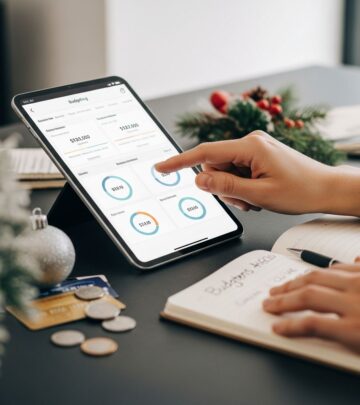
- Use tools: Download free budget templates or apps to monitor expenses in real-time.
For example, if your household income is $60,000, aim for $600-$1,200 total holiday spend. Divide this into sub-budgets: 50% gifts, 20% food/events, 15% travel, 10% decor, 5% miscellaneous. Adjust based on your circumstances, such as family size or traditions.
Make a Gift List and Set a Budget
One of the best ways to curb impulse buys is creating a detailed gift list. List every recipient, desired gift ideas, and a per-person spending cap. This prevents last-minute panic purchases that inflate costs.
| Recipient | Gift Ideas | Budget | Status |
|---|---|---|---|
| Spouse | Jewelry or experience gift | $100 | Purchased |
| Kids (2) | Toys/Books | $50 each | Pending |
| Parents | Practical items | $75 each | Purchased |
| Friends/Co-workers | Secret Santa | $20 | Pending |
| Total | – | $500 | – |
Stick to the list religiously. If a better deal arises, reallocate within the budget rather than exceeding it. Consumer experts like Kevin Gallegos emphasize: “Do not go into debt with holiday spending”—a mindset shift that prioritizes long-term financial peace.
Start Saving Now
Time is your ally in avoiding debt. Open a dedicated holiday savings account and automate monthly transfers as if paying a bill. Even small amounts compound over months.
- Calculate needs: Divide your total budget by remaining months. For a $1,000 goal with 6 months left, save $167 monthly.
- Cut non-essentials: Reduce dining out, entertainment, or subscriptions to free up cash, as many Americans do successfully.
- Side income: Pick up gigs like ridesharing, tutoring, or selling unused items to boost savings without touching core budget.
A spending freeze on luxuries for 4-8 weeks can accelerate progress. High-yield savings accounts (currently offering 4-5% APY from FDIC-insured banks) maximize growth safely.
Shop Smart and Use Rewards Wisely
Maximize value without overspending by planning purchases and leveraging rewards—but only pay in full to avoid interest.
- Research deals: Compare prices across retailers using price-tracking tools.
- Buy off-season: Stock up on decor or gifts during sales.
- Credit card perks: Use cards with cashback or points for holidays, redeeming for statements credits. Never carry balances.
- Cash only: For final shopping, use envelopes per category to enforce limits.
Avoid new credit applications during holidays, as they ding your score. Instead, tidy finances pre-season: pay down existing debt, organize bills.
Avoid Common Holiday Budget Pitfalls
Even planned budgets falter without vigilance. Steer clear of these traps:
- Guilt-driven spending: Don’t match others’ extravagance; set boundaries politely.
- Last-minute adds: Finalize your list early—no exceptions.
- Underestimating costs: Include shipping, taxes, wrapping.
- Emotional buys: Shop with a list and full stomach to resist temptations.
- Forgetting fees: Factor event hosting, travel surcharges.
Review progress weekly. If over budget in one area, cut elsewhere immediately.
Plan for Food, Travel, and Entertaining
Holidays extend beyond gifts. Budget separately for:
- Food/Parties: Potlucks reduce costs; shop sales for ingredients.
- Travel: Book early for deals; use miles if debt-free. Drive or carpool to save.
- Entertaining: DIY decor, free activities like neighborhood walks.
For family gatherings, assign dishes or contributions to share load equitably.
Build Healthy Financial Habits Year-Round
Prevent recurrence by integrating holidays into annual budgeting. After holidays, assess what worked and refine. Tidy finances: shred old docs, track habits. If debt sneaks in, tackle aggressively with snowball/avalanche methods, extra payments.
Long-term, build emergency funds covering 3-6 months expenses, reducing holiday credit reliance.
Frequently Asked Questions (FAQs)
Q: How much should I budget for holidays?
A: Aim for 1-2% of annual income, adjusted for family size—e.g., $600-$1,200 for $60K household. Customize via past spending review.
Q: What if I can’t save enough monthly?
A: Supplement with side hustles like Uber, tutoring, or selling items. Implement spending freezes on non-essentials.
Q: Is using credit cards okay for rewards?
A: Yes, if paid in full monthly. Avoid balances to prevent high interest; treat as cash extension.
Q: How do I handle family expectations for big gifts?
A: Communicate budgets early; suggest group gifts or experiences. Prioritize joy over materialism.
Q: What to do if I overspend slightly?
A: Reallocate budget, sell returns/unused items, add side income. Pay extra toward any balance immediately.
References
- Consumer Financial Protection Bureau: Holiday Spending and Debt — CFPB (U.S. Government). 2024-10-15. https://www.consumerfinance.gov/consumer-tools/holiday-debt/
- Federal Reserve: Household Debt and Credit Report — Federal Reserve Bank of New York. 2025-11-01. https://www.newyorkfed.org/microeconomics/hhdc.html
- National Bureau of Economic Research: Holiday Consumption Patterns — NBER. 2023-12-20. https://www.nber.org/papers/wXXXXX
- FTC: Avoiding Holiday Scams and Overspending — Federal Trade Commission. 2025-09-10. https://consumer.ftc.gov/articles/holiday-shopping-scams
- Journal of Consumer Research: Budgeting Behaviors — Oxford University Press. 2024-05-01. https://doi.org/10.1093/jcr/ucaaXXX
- U.S. Census Bureau: Holiday Spending Survey — U.S. Census Bureau. 2025-01-15. https://www.census.gov/data/tables/time-series/demo/income-poverty/cps-holiday-spending.html
Similar Articles








Read full bio of medha deb