Student Loans: How They Work And Smart Repayment Tips
Understand how student loans work from application to payoff so you can borrow wisely and protect your financial future.
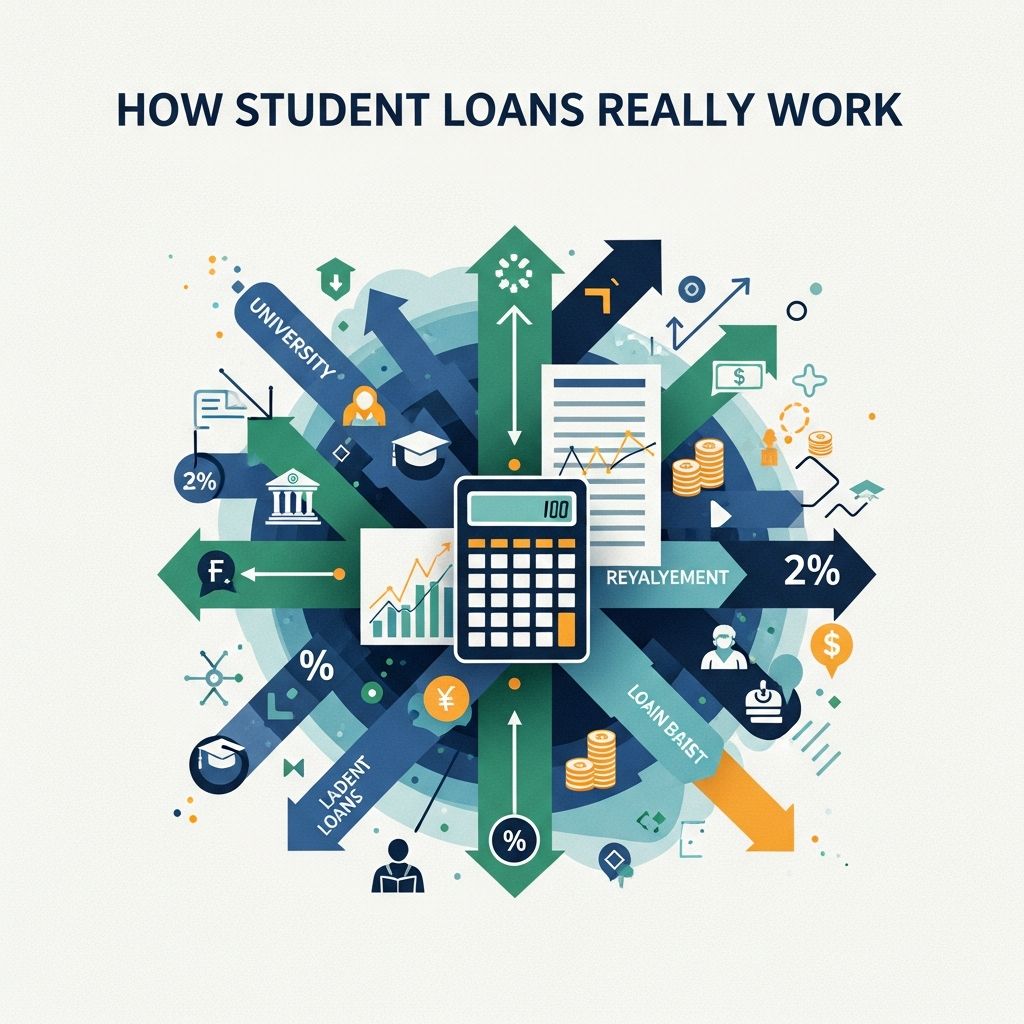
Student loans can open the door to higher education, but they also create long-term financial obligations that affect your budget, credit, and future choices. Understanding exactly how student loans work before you borrow empowers you to make informed decisions and avoid unnecessary debt.
This guide breaks down what student loans are, the types available, how interest and repayment work, and smart strategies for borrowing less and paying off balances faster.
What Are Student Loans?
Student loans are borrowed funds designed to help pay for education costs like tuition, fees, books, housing, and transportation. Unlike grants or scholarships, student loans must be repaid with interest.
In the United States, most education borrowing happens through two broad categories:
- Federal student loans issued or backed by the U.S. Department of Education
- Private student loans issued by banks, credit unions, or other private lenders
Federal student loans are the primary source of education borrowing and carry standardized terms set by law, including fixed interest rates and access to income-driven repayment plans.
How Student Loans Work in Simple Terms
At a high level, student loans follow a predictable cycle:
- You apply for financial aid and loan eligibility is determined.
- The lender disburses funds to your school to pay tuition and fees.
- Any remaining funds may be refunded to you for other education expenses.
- Interest may accrue while you are in school, depending on the loan type.
- After you leave school or drop below half-time enrollment, a grace period may apply.
- You then enter repayment and must make regular payments until the loan is paid in full, forgiven, or discharged.
Types of Student Loans
Not all student loans are created equal. The type of loan you take out affects interest costs, protections, and repayment options.
Federal Student Loans
Federal student loans are funded or guaranteed by the federal government and are accessed by completing the Free Application for Federal Student Aid (FAFSA). They usually offer more flexible repayment options and protections than private loans.
Direct Subsidized Loans
Direct Subsidized Loans are for eligible undergraduate students with financial need.
- The government pays the interest while you are enrolled at least half time, during the grace period, and during certain deferments.
- Available only to undergraduates.
- Annual and lifetime borrowing limits apply.
Direct Unsubsidized Loans
Direct Unsubsidized Loans are available to both undergraduate and graduate students and are not based on financial need.
- Interest starts accruing as soon as the loan is disbursed.
- You can choose to pay interest while in school or allow it to capitalize (be added to the principal) later.
- Higher borrowing limits than subsidized loans, especially for graduate students.
Direct PLUS Loans
Direct PLUS Loans include Parent PLUS Loans for parents of dependent undergraduates and Grad PLUS Loans for graduate/professional students.
- Require a basic credit check; adverse credit history can affect approval.
- Can cover up to the cost of attendance minus other aid.
- Interest rates are typically higher than those for Direct Subsidized and Unsubsidized Loans.
Direct Consolidation Loans
A Direct Consolidation Loan allows you to combine multiple qualifying federal student loans into a single new loan with one servicer.
- Creates one monthly payment instead of several.
- New interest rate is a weighted average of prior rates, rounded up to the nearest one-eighth of a percent.
- May extend repayment, lowering the monthly payment but increasing total interest paid.
Private Student Loans
Private student loans are offered by banks, credit unions, and other private lenders. Terms vary by lender, and approval is typically based on credit, income, and sometimes a co-signer.
- May use fixed or variable interest rates.
- Often require good credit or a creditworthy co-signer for the best rates.
- Do not qualify for federal income-driven repayment or federal loan forgiveness programs.
Because private loans offer fewer protections, many experts suggest exhausting federal options and scholarships before turning to private borrowing.
How Student Loan Interest Works
Interest is the cost you pay to borrow money. Understanding how it is calculated and added to your loan can help you reduce what you ultimately pay.
Fixed vs Variable Rates
- Federal student loans use fixed interest rates set annually by Congress, which remain the same for the life of the loan.
- Private student loans may offer fixed or variable rates, with variable rates changing over time based on market benchmarks.
How Interest Is Calculated
Federal loans typically use simple daily interest based on the outstanding principal balance.
The general formula is:
Daily interest = (Interest rate ÷ 365) × Outstanding principal balance
That daily interest is added up over the month and reflected in your next bill. If you do not pay at least the interest due, the unpaid portion can increase your balance through capitalization when certain events occur, such as the end of a grace period or deferment.
Capitalization
Capitalization happens when unpaid interest is added to your principal balance, causing future interest to be calculated on a larger amount.
- Occurs on many unsubsidized federal loans when you enter repayment or after some deferments and forbearances.
- Common on private loans if you postpone payments or use forbearance.
Minimizing capitalization—by paying at least the accruing interest whenever possible—can reduce total borrowing costs.
Borrowing Limits and Eligibility
You cannot borrow unlimited amounts through federal student loans. There are annual and aggregate limits based on your dependency status, year in school, and loan type.
Federal Loan Limits (Overview)
Federal Direct Loan limits distinguish between dependent and independent students, with higher thresholds for the latter.
| Student Type | Level | Approximate Annual Limit (Subsidized + Unsubsidized) |
|---|---|---|
| Dependent undergraduate | 1st year | Up to $5,500 (subsidized portion capped) |
| Dependent undergraduate | 4th+ year | Up to $7,500 |
| Independent undergraduate | 1st year | Up to $9,500 |
| Graduate / professional | N/A | Higher limits, usually through Unsubsidized and PLUS loans |
Exact limits can change with legislation, so students should always verify current figures on the official Federal Student Aid website.
Eligibility Basics
To receive most federal student loans you must:
- Be a U.S. citizen or eligible noncitizen.
- Have a valid Social Security number (with limited exceptions).
- Be enrolled at least half time in an eligible degree or certificate program.
- Maintain satisfactory academic progress.
- Not be in default on existing federal student loans.
How to Get Student Loans
The process for getting a student loan differs between federal and private lending.
Applying for Federal Student Loans (FAFSA)
To access federal loans and other federal aid such as grants and work-study, you must complete the FAFSA (Free Application for Federal Student Aid) every academic year.
- Provide financial information for yourself and, if dependent, your parents.
- Your school uses FAFSA data to create a financial aid package, which may include federal loans, grants, and work-study.
- You can review, accept, reduce, or decline the loan portion of the package.
Applying for Private Student Loans
Private lenders have their own application processes, typically separate from the FAFSA.
- Application generally requires a credit check, proof of income, and often a co-signer.
- Lenders present interest rate offers and terms based on credit risk.
- You choose the loan amount (subject to cost of attendance limits) and sign a promissory note.
Because private loans lack federal protections, it is wise to compare multiple offers and understand all terms before committing.
Repayment: How and When You Pay Back Student Loans
Repayment terms determine how long you will be paying and how much interest you will ultimately pay.
Grace Periods
Many federal loans offer a grace period after you graduate, leave school, or drop below half-time before you must start repaying.
- Direct Subsidized and Unsubsidized Loans typically have a six-month grace period.
- Interest often continues to accrue, particularly on unsubsidized loans.
Private lenders may offer grace periods, but terms vary; some require payments while in school or immediately after graduation.
Standard and Alternative Federal Repayment Plans
For federal student loans, several repayment plans are available.
- Standard Repayment Plan: Fixed payments over up to 10 years (or longer for consolidation loans).
- Graduated Repayment Plan: Payments start lower and increase every two years over a similar term.
- Extended Repayment Plan: For larger balances, extends repayment up to 25 years, reducing monthly payments but increasing total interest.
Income-Driven Repayment (IDR) Plans
Income-driven repayment plans tie your student loan payments to your income and family size.
- Common IDR plans include Revised Pay As You Earn (REPAYE), Pay As You Earn (PAYE), Income-Based Repayment (IBR), and Income-Contingent Repayment (ICR).
- Payments are generally set as a percentage of discretionary income and recalculated each year.
- Remaining balances may be forgiven after 20–25 years of qualifying payments, depending on the plan.
Private Loan Repayment
Private lenders set their own repayment structures. Some common features include:
- Immediate full payments, interest-only payments, or deferred payments while in school.
- Typical terms of 5–20 years.
- Limited or no income-based options.
Because private loans are contractual obligations, modifying payments may require refinancing, forbearance, or negotiation with the lender.
Pros and Cons of Student Loans
Taking on student loans can be a strategic investment in your education, but it comes with trade-offs.
Potential Benefits
- Enable access to education that may otherwise be unaffordable.
- Help cover both direct costs (tuition, fees) and indirect costs (housing, books, transportation).
- Federal loans offer borrower protections like deferment, forbearance, and income-driven repayment.
- Education is associated with higher median earnings and lower unemployment rates on average.
Key Drawbacks
- Monthly payments can strain your budget after graduation.
- Interest can significantly increase the total cost of your education over time.
- High debt loads can delay goals such as homeownership, saving for retirement, or starting a business.
- Private loans lack federal protections and forgiveness programs.
Smart Strategies for Managing and Reducing Student Loan Debt
You can dramatically reduce the long-term impact of student loans by being strategic before, during, and after college.
Borrow Less Whenever Possible
- Pursue scholarships, grants, and work-study before borrowing.
- Consider starting at a community college and transferring to a four-year school.
- Live frugally while in school to keep living costs—and required borrowing—lower.
- Aim to keep your total expected monthly loan payments at or below a manageable portion of your projected starting income (many financial educators suggest around 8–10%).
Make Payments While in School
- Pay interest on unsubsidized and private loans while you are studying to prevent capitalization.
- Even small payments can reduce your total cost and shorten your payoff timeline.
Avoid Excessive Private Loans
- Max out safer federal options before considering private loans.
- If private borrowing is necessary, compare multiple lenders for rates, fees, and flexible repayment options.
- Use a co-signer cautiously; they are legally responsible if you cannot pay.
Create a Payoff Plan After Graduation
- Know your total balance, interest rates, and servicers for each loan.
- Choose a repayment plan that balances affordability and total interest cost.
- Target extra payments to the highest-interest loan first while keeping others current.
- Consider refinancing carefully for private loans if you can secure significantly better rates, understanding that refinancing federal loans into private loans means losing federal protections.
Watch Out for Delinquency and Default
Missing payments can damage your credit and trigger collections or other serious consequences.
- Federal loans are generally considered in default after about 270 days of nonpayment.
- Default can lead to wage garnishment, tax refund seizure, and loss of eligibility for additional federal aid.
- If you are struggling, contact your servicer early to discuss income-driven plans or temporary relief options.
Student Loan Forgiveness and Relief Options
Some borrowers may qualify for partial or full forgiveness of federal loans under specific conditions.
Public Service Loan Forgiveness (PSLF)
- For borrowers working full time for qualifying government or nonprofit employers.
- Requires 120 qualifying monthly payments under an eligible repayment plan on Direct Loans.
- Remaining balance may be forgiven tax-free under current rules.
Other Forgiveness and Discharge Paths
- Teacher loan forgiveness for certain educators in low-income schools.
- Closed school discharge if your school shuts down while you are enrolled or soon after.
- Total and permanent disability discharge under strict criteria.
Private student loans generally do not offer standardized forgiveness programs; relief is usually limited to contractual terms or case-by-case decisions.
Frequently Asked Questions (FAQs)
Q: Do I have to accept the full loan amount offered in my financial aid package?
No. You can decline loans entirely or request a lower amount than what is offered. Accepting less can reduce your future monthly payments and total interest.
Q: Is it better to take federal or private student loans?
For most students, federal loans are safer to use first because they offer fixed rates, income-driven repayment, and potential forgiveness, whereas private loans lack these standard protections.
Q: What happens if I cannot afford my federal student loan payment?
Contact your loan servicer as soon as possible. You may qualify for an income-driven repayment plan, deferment, or forbearance, depending on your situation.
Q: Will student loans affect my credit score?
Yes. On-time payments can help you build a positive credit history, while late payments, delinquency, or default can severely damage your credit profile.
Q: Can I pay off my student loans early?
In most cases, yes. Federal student loans do not charge prepayment penalties, and many private lenders also allow early payoff without extra fees. Always confirm with your lender or servicer.
References
- Types of Aid – Federal Student Loans — U.S. Department of Education, Federal Student Aid. 2024-05-01. https://studentaid.gov/understand-aid/types/loans
- Funding Education Beyond High School: The Guide to Federal Student Aid — U.S. Department of Education. 2023-08-15. https://studentaid.gov/resources
- Private Student Loans — Consumer Financial Protection Bureau. 2023-06-20. https://www.consumerfinance.gov/pay-for-college/private-student-loans/
- The Premium and Value of a College Degree — Federal Reserve Bank of New York. 2022-06-01. https://www.newyorkfed.org/research/college-labor-market/college-labor-market_key-findings.html
- Estimating College Costs — U.S. Department of Education, College Scorecard. 2024-01-10. https://collegescorecard.ed.gov/
Similar Articles








Read full bio of Sneha Tete