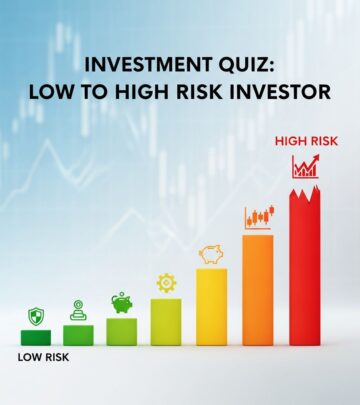
How Risk-Averse Are You? Money Personality Quiz
Understand your risk comfort level so you can build an investment plan that you can stick with in any market.

Everyone reacts differently to financial risk. Some people love the excitement of the stock market, while others prefer the certainty of guaranteed returns. Understanding how risk-averse you are is essential for choosing investments you can stick with over the long term.
This guide walks you through a simple quiz, explains what your score means, and shows you how to align your investing strategy with your risk comfort level and your goals.
What Does It Mean To Be Risk-Averse?
In personal finance, being risk-averse means you prefer certainty and stability over the chance of higher returns that come with more risk. A risk-averse person tends to avoid situations where they might lose money, even if there is also a chance to gain more money.
Economists describe risk aversion as the tendency to choose a guaranteed outcome over a gamble with the same expected value, simply because the gamble feels uncomfortable. Behavioral research consistently finds that most people are risk-averse in financial decisions, especially when losses feel more painful than equivalent gains feel good.
Risk aversion is not good or bad on its own. The key is to understand your natural tendencies so you can design a plan that both respects your comfort level and still helps you reach your goals.
Risk Aversion vs Risk Tolerance vs Risk Capacity
People often use these terms interchangeably, but they describe different things:
- Risk aversion: Your emotional dislike of uncertainty and potential losses.
- Risk tolerance: How much market ups and downs you can comfortably live with without panicking or abandoning your plan.
- Risk capacity: How much risk you can financially afford to take based on your income, savings, time horizon, and obligations.
Ideally, your investment strategy should sit at the intersection of all three: what you emotionally prefer, what you can handle without stress, and what you can realistically afford to risk.
How Risk-Averse Are You? The Quiz
Use the questions below to get a quick sense of your risk comfort level. Answer honestly based on how you would actually feel and act, not how you think you “should” respond.
For each question, choose the option that best describes you and note the points indicated.
1. How do you react when the market drops 20%?
- A. I would sell most or all of my investments to avoid further losses. (1 point)
- B. I would be very uncomfortable but probably stay invested. (2 points)
- C. I would see it as an opportunity to buy more at lower prices. (3 points)
2. If an investment could double your money in five years but might lose 30% in a bad year, would you invest?
- A. No, I would avoid it; the possible loss is too stressful. (1 point)
- B. Maybe, but only with a smaller portion of my money. (2 points)
- C. Yes, I would be comfortable with that tradeoff. (3 points)
3. How important is it to you that your account balance rarely goes down?
- A. Extremely important; I want stable or guaranteed returns. (1 point)
- B. Somewhat important; I can handle occasional declines. (2 points)
- C. Not very important; I care more about long-term growth. (3 points)
4. How long until you need the money you are investing?
- A. Less than 3 years. (1 point)
- B. Between 3 and 10 years. (2 points)
- C. More than 10 years. (3 points)
5. How would you describe your reaction to financial uncertainty?
- A. It keeps me up at night; I crave predictability. (1 point)
- B. I notice it but can usually manage my worry. (2 points)
- C. I accept uncertainty as a normal part of investing. (3 points)
6. Which portfolio feels most comfortable to you?
- A. Mostly cash and bonds, very little in stocks. (1 point)
- B. A mix of stocks and bonds. (2 points)
- C. Mostly stocks with a small portion in bonds or cash. (3 points)
Scoring Your Risk-Aversion Quiz
Add up your points from the six questions:
- 6–8 points: Very risk-averse (conservative)
- 9–13 points: Moderately risk-averse (balanced)
- 14–18 points: Less risk-averse (aggressive)
This quiz is a simplified, educational tool, not a clinical or regulatory assessment. Academic research on risk attitudes commonly uses more detailed questionnaires and statistical scales, but shorter measures like this can still correlate meaningfully with real-world investment choices.
| Score Range | Risk Style | General Investment Approach |
|---|---|---|
| 6–8 | Very risk-averse | Focus on stability and capital preservation |
| 9–13 | Moderately risk-averse | Balanced mix of growth and safety |
| 14–18 | Less risk-averse | Growth-focused, accepts more volatility |
What Your Result Says About You
1. Very Risk-Averse (Conservative)
If you scored between 6 and 8 points, you value security and predictability over high growth. You may strongly dislike seeing your account balance fluctuate, and you might prefer guaranteed or near-guaranteed outcomes.
Common traits of very risk-averse investors:
- Prefer savings accounts, certificates of deposit (CDs), or government bonds.
- Feel anxious when hearing about market downturns or volatility.
- May avoid investing altogether for fear of losing money.
The challenge with being very risk-averse is that ultra-safe assets historically earn lower returns than riskier investments like stocks. Over long periods, low returns may make it harder to keep up with inflation, which erodes purchasing power over time.
2. Moderately Risk-Averse (Balanced)
If you scored between 9 and 13 points, you are comfortable with some risk but want to avoid extremes. You are willing to accept moderate ups and downs for the potential of better long-term growth, as long as the risk level feels controlled.
Common traits of moderately risk-averse investors:
- Open to investing in diversified stock and bond funds.
- Concerned about losses but able to stay invested during normal market cycles.
- Prefer a balanced or target-date portfolio that automatically adjusts risk over time.
This group often benefits from clearly defined goals and written investment plans, which make it easier to stay disciplined when markets fluctuate.
3. Less Risk-Averse (Aggressive)
If you scored between 14 and 18 points, you are relatively comfortable with uncertainty and volatility. You may focus more on long-term growth potential than on short-term market swings.
Common traits of less risk-averse investors:
- Comfortable with higher stock allocations and growth-oriented investments.
- View market downturns as potential buying opportunities.
- More willing to experiment with new strategies, within reason.
However, being comfortable with risk does not remove the possibility of substantial losses during downturns. Research on individual investors shows that even confident investors can overestimate their risk tolerance and react emotionally when markets fall sharply.
How Risk Aversion Affects Your Investing Strategy
Your level of risk aversion influences several parts of your financial life:
- Asset allocation: How much you hold in stocks, bonds, and cash.
- Investment choices: Whether you prefer index funds, bonds, CDs, or individual stocks.
- Behavior in downturns: Whether you stay invested or exit the market when prices fall.
- Progress toward goals: How quickly your money may grow over time.
Financial planners often emphasize that your risk tolerance is a key factor in building your portfolio, along with your time horizon and goals. Aligning your investment mix with your comfort level can help you avoid panic selling and other costly mistakes during volatile periods.
Balancing Your Risk Aversion With Your Goals
Being honest about your risk aversion is important, but so is making sure your strategy gives you a realistic chance of reaching your goals. Here is how to balance both:
- Clarify your time horizon. Money you need in the next few years typically belongs in safer, more liquid investments. Money for long-term goals (10+ years) can usually tolerate more market risk.
- Match risk to the goal. Short-term goals (like an emergency fund or a house down payment) usually call for more conservative choices, while retirement savings often benefit from more growth assets early on.
- Use diversification. Spreading your money across asset classes (stocks, bonds, cash) and within them reduces the impact of any single investment’s performance.
- Adjust gradually. If you are very risk-averse but need more growth, consider increasing your stock allocation slowly over time rather than all at once.
Tips To Invest Confidently At Any Risk Level
Regardless of your quiz score, you can build an approach that respects your comfort level while still moving you forward.
- Build a solid safety net. An emergency fund covering several months of expenses can make market volatility feel less threatening and reduce the temptation to tap long-term investments.
- Automate your investing. Automatic contributions into a diversified portfolio support consistency and help you benefit from dollar-cost averaging over time.
- Educate yourself. Learning the basics of how markets work, what different asset classes do, and how diversification reduces risk can improve your confidence and decision-making.
- Review but don’t obsess. Checking your accounts too often can amplify emotional reactions. Setting scheduled review times (for example, quarterly) encourages a more objective view.
- Adjust as your life changes. Risk capacity and tolerance can shift with major life events such as a new job, marriage, children, or nearing retirement.
Frequently Asked Questions (FAQs)
Does being risk-averse mean I should not invest in stocks?
No. Being risk-averse does not mean avoiding stocks entirely. It means choosing a level of stock exposure that you can tolerate without abandoning your plan during downturns. Many conservative investors still hold some stocks through diversified funds to help keep up with inflation and long-term goals.
Can my risk aversion change over time?
Yes. Studies show that risk attitudes can vary with wealth, age, and life circumstances. People often become more conservative as they approach major goals or retirement because they have less time to recover from large losses.
How accurate are risk-tolerance quizzes?
Risk-tolerance quizzes and questionnaires provide a useful starting point but are not perfect. Research comparing different methods of measuring risk aversion finds that simple survey questions can correlate with actual investment behaviors, but no single question fully captures a person’s attitude. Use quizzes as guidance, then reflect on your real-life reactions to risk.
What if my risk aversion is higher than what my goals require?
If a very conservative strategy makes it unlikely that you will reach your goals, you may need to adjust either your goals (for example, contributing more money or extending your time horizon) or slowly increase your risk exposure while monitoring your comfort level. Working with a qualified financial professional can help you find a realistic compromise.
Is taking more risk always better for long-term returns?
No. While higher-risk assets such as stocks have historically offered higher average returns than lower-risk assets like government bonds, they also come with greater volatility and the possibility of large losses. The goal is not to take the maximum risk, but the right amount of risk for your situation and temperament.
References
- A Simplified Measure of Investor Risk Aversion — John E. Grable & Swarn Chatterjee, Journal of Financial Counseling and Planning. 2019-06-01. https://fpperformancelab.org/wp-content/uploads/A-Simplified-Measure-of-Investor-Risk-Aversion.pdf
- How to Measure Your Risk Tolerance — Henssler Financial. 2022-05-01 (approx. last updated). https://www.henssler.com/how-to-measure-your-risk-tolerance/
- Investing Basics: What Is Asset Allocation? — U.S. Securities and Exchange Commission (SEC). 2021-08-18. https://www.investor.gov/introduction-investing/investing-basics/asset-allocation
- Individual Investors and Volatility — Federal Reserve Bank of St. Louis Review (summary of research on household portfolios). 2020-09-01. https://research.stlouisfed.org/publications/review/2020/09/22/individual-investors-and-volatility
Similar Articles








Read full bio of Sneha Tete