Net Tangible Assets: 6-Step Guide To Calculate Value
Master the calculation of net tangible assets for better financial analysis and investment decisions.
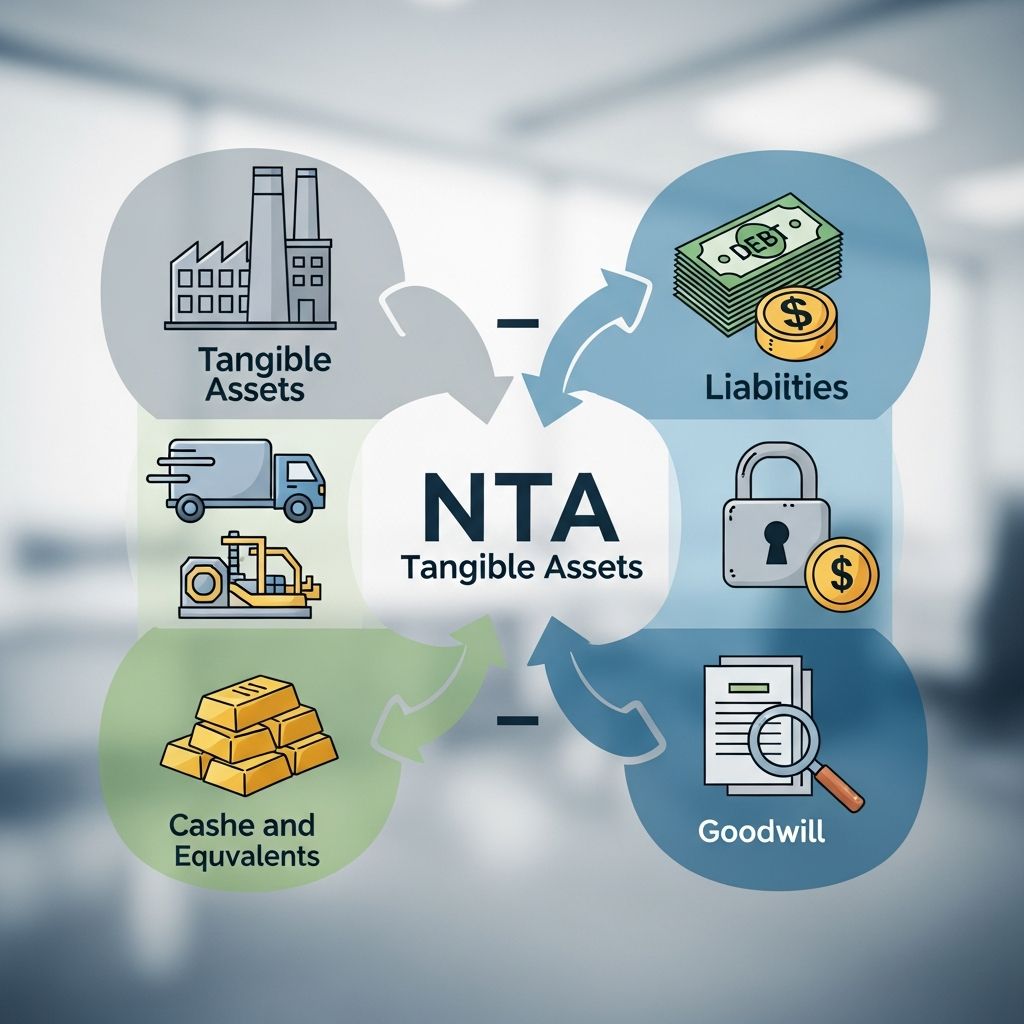
How Net Tangible Assets Are Calculated
Net tangible assets represent the value of a company’s physical assets minus its liabilities and intangible assets. This metric is essential for investors, creditors, and financial analysts who need to understand a company’s true worth based on its concrete, physical holdings. Understanding how to calculate net tangible assets is crucial for making informed investment decisions and assessing a company’s financial health.
Understanding Net Tangible Assets
Net tangible assets, also known as net tangible book value, provide a conservative measure of a company’s financial position. Unlike total assets, which may include goodwill, patents, and other intangible assets that can fluctuate significantly, net tangible assets focus exclusively on physical, measurable assets. This calculation strips away accounting concepts and presents what a company would theoretically be worth if liquidated immediately at book value.
The importance of net tangible assets lies in its ability to provide investors with a clearer picture of a company’s actual asset base. For investors interested in value investing or those concerned about downside risk, this metric is particularly valuable because it represents the hard assets backing the company’s operations.
The Basic Formula for Net Tangible Assets
The fundamental formula for calculating net tangible assets is straightforward:
Net Tangible Assets = Total Assets – Total Liabilities – Intangible Assets
This simple yet powerful equation breaks down into three main components that require careful identification and calculation:
- Total Assets: All resources owned by the company with monetary value
- Total Liabilities: All financial obligations the company owes to external parties
- Intangible Assets: Non-physical assets that lack physical substance
Identifying and Calculating Total Assets
Total assets are listed on a company’s balance sheet and include everything the company owns that has value. These assets are typically categorized into two main groups: current assets and non-current assets.
Current assets are resources expected to be converted into cash within one year, including:
- Cash and cash equivalents
- Accounts receivable
- Inventory
- Prepaid expenses
- Short-term investments
Non-current assets are long-term holdings expected to provide value beyond one year, including:
- Property, plant, and equipment
- Long-term investments
- Leasehold improvements
- Vehicles and machinery
- Land and buildings
Understanding Total Liabilities
Total liabilities represent all financial obligations a company owes to creditors, employees, suppliers, and other external parties. These liabilities are also divided into current and non-current categories.
Current liabilities must be paid within one year:
- Accounts payable
- Short-term loans
- Current portion of long-term debt
- Accrued expenses
- Customer deposits
Non-current liabilities extend beyond one year:
- Long-term bonds
- Mortgage loans
- Deferred tax liabilities
- Pension obligations
- Long-term lease obligations
Identifying Intangible Assets
Intangible assets are the most critical component to understand when calculating net tangible assets because they must be excluded from the calculation. These non-physical assets add value to a company but lack physical substance. Common examples include:
- Goodwill: The premium paid for an acquisition above fair market value
- Patents: Legal rights to exclusive use of inventions or processes
- Trademarks: Brand names and symbols that provide market recognition
- Copyrights: Intellectual property rights for creative works
- Customer relationships: Value derived from established customer bases
- Brand value: The worth of a company’s reputation and market position
- Licenses: Rights to operate or use specific processes or technologies
- Franchises: Rights to operate under a brand name or system
Step-by-Step Calculation Process
To calculate net tangible assets accurately, follow these systematic steps:
Step 1: Gather Financial Information Obtain the company’s most recent balance sheet from financial statements, SEC filings, or investor relations websites.
Step 2: Calculate Total Assets Sum all current and non-current assets listed on the balance sheet. This figure represents everything the company owns.
Step 3: Calculate Total Liabilities Sum all current and non-current liabilities to determine the company’s total financial obligations.
Step 4: Identify Intangible Assets Carefully review the balance sheet to identify all intangible assets. These are often listed separately or can be found in the notes to financial statements.
Step 5: Apply the Formula Subtract total liabilities and intangible assets from total assets to arrive at net tangible assets.
Step 6: Calculate Net Tangible Assets Per Share Divide net tangible assets by the number of outstanding shares to determine the per-share value.
Net Tangible Assets Per Share
A particularly useful metric is net tangible assets per share, which divides the total net tangible assets by the number of outstanding shares. This calculation helps investors compare the company’s tangible asset value on a per-share basis.
Net Tangible Assets Per Share = Net Tangible Assets ÷ Number of Outstanding Shares
This metric is valuable for comparing companies of different sizes and can indicate whether a stock is trading at a discount or premium to its tangible asset value. Value investors often use this metric to identify stocks trading below their net tangible asset value, which may represent investment opportunities.
Practical Example
Consider a hypothetical manufacturing company with the following balance sheet information:
| Item | Amount |
|---|---|
| Total Assets | $50,000,000 |
| Including Goodwill | $5,000,000 |
| Including Patents | $3,000,000 |
| Including Trademarks | $2,000,000 |
| Total Liabilities | $20,000,000 |
| Outstanding Shares | 5,000,000 |
Calculation:
Total Intangible Assets = $5,000,000 + $3,000,000 + $2,000,000 = $10,000,000
Net Tangible Assets = $50,000,000 – $20,000,000 – $10,000,000 = $20,000,000
Net Tangible Assets Per Share = $20,000,000 ÷ 5,000,000 = $4 per share
Why Net Tangible Assets Matter
Net tangible assets serve several important functions in financial analysis:
- Investment Analysis: Helps investors identify undervalued companies trading below tangible asset value
- Risk Assessment: Provides insight into a company’s ability to cover liabilities with physical assets
- Liquidation Value: Approximates what shareholders would receive if the company were liquidated
- Credit Analysis: Assists creditors in evaluating loan repayment security
- Comparative Analysis: Enables meaningful comparisons between companies of different sizes and industries
- Conservative Valuation: Offers a more conservative valuation method than methods including intangible assets
Advantages and Limitations
Advantages:
- Provides a conservative, easy-to-understand valuation metric
- Focuses on tangible, measurable assets
- Useful for identifying undervalued stocks
- Helps assess downside risk protection
- Relatively objective compared to other valuation methods
Limitations:
- Ignores the value of intangible assets that may drive future profits
- May overstate value if assets are outdated or obsolete
- Does not reflect earning power or profitability
- Book values may differ significantly from market values
- Less relevant for service-based or technology-focused companies
Frequently Asked Questions
Q: What is the difference between net tangible assets and net worth?
A: Net tangible assets exclude intangible assets and measure only physical assets minus liabilities, while net worth (shareholders’ equity) includes all assets minus liabilities. Net tangible assets provide a more conservative valuation.
Q: Why do companies have intangible assets?
A: Companies develop intangible assets through research and development, brand building, customer relationships, and acquisitions. These assets generate value and competitive advantages but lack physical form.
Q: How often should net tangible assets be calculated?
A: Net tangible assets should be calculated quarterly when companies release financial statements and annually for comprehensive financial reviews. Investors may update calculations more frequently if significant acquisitions or asset sales occur.
Q: Is net tangible assets useful for all industries?
A: Net tangible assets is most useful for asset-heavy industries like manufacturing, real estate, and utilities. It is less relevant for technology, pharmaceutical, or service-based companies where intangible assets represent the primary value drivers.
Q: How does depreciation affect net tangible assets?
A: Depreciation reduces the book value of tangible assets over time, which directly lowers net tangible assets. The balance sheet reflects depreciated asset values, so the calculation automatically accounts for this reduction.
Q: Can net tangible assets be negative?
A: Yes, net tangible assets can be negative if total liabilities exceed total assets minus intangible assets. This indicates the company would have no tangible asset value remaining after paying all liabilities, signaling financial distress.
Q: How does goodwill affect the net tangible assets calculation?
A: Goodwill is an intangible asset that must be subtracted in the net tangible assets calculation. This exclusion is important because it reflects the premium paid in acquisitions, which doesn’t represent actual physical value.
References
- Financial Accounting Standards Board (FASB): Accounting Standards Codification — FASB. 2024. https://www.fasb.org/
- U.S. Securities and Exchange Commission: Form 10-K Guide — SEC. 2024. https://www.sec.gov/cgi-bin/browse-edgar
- International Financial Reporting Standards (IFRS): Conceptual Framework for Financial Reporting — IFRS Foundation. 2024. https://www.ifrs.org/
- Graham, Benjamin and Dodd, David L. Security Analysis: Principles and Technique — McGraw-Hill Education. 1934. (Classic reference on fundamental analysis and asset valuation)
- CFA Institute: Financial Reporting and Analysis — CFA Institute. 2024. https://www.cfainstitute.org/
- Journal of Financial Economics: Asset Valuation and Balance Sheet Analysis — Elsevier Science Publishing. 2023. https://www.elsevier.com/journals/journal-of-financial-economics
Similar Articles








Read full bio of medha deb