How Much Should I Have Saved by My 20s and 30s?
Discover realistic savings benchmarks for your 20s and 30s, plus proven strategies to build wealth early and secure your financial future.

Saving money in your 20s and 30s lays the foundation for long-term financial security, from funding emergencies to retirement. While averages vary widely by income, location, and lifestyle, setting personalized goals proportional to your earnings is key. Popular benchmarks like the 50/30/20 rule—allocating 50% of after-tax income to needs, 30% to wants, and 20% to savings and debt—provide a practical starting point.
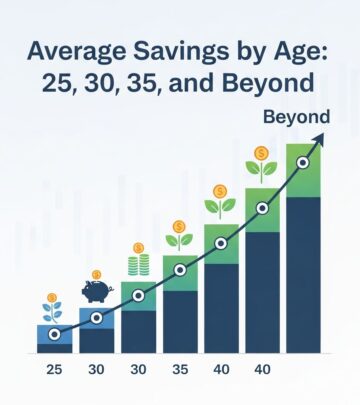
The average savings for Americans in their 20s range from $941 to $3,136, while those in their 30s hold $909 to $4,544, depending on income quartiles. These figures highlight that no one-size-fits-all amount exists; instead, focus on building habits like automating transfers and leveraging compound interest in high-yield accounts.
Setting Savings Goals at Every Age
Your savings targets should scale with your income and life stage. In your early 20s, prioritize an emergency fund covering 3-6 months of expenses—for someone spending $1,500 monthly, that’s $4,500 to $9,000. By age 30, aim for one year’s salary in total savings, including retirement accounts like 401(k)s or IRAs.
Gradual progress beats perfection. Use income-based rules to set achievable milestones:
- 20s: Build emergency fund (3-6 months expenses); save 10-20% of income; start retirement contributions if employer-matched.
- 30s: Solidify 6-12 months emergency fund; target 1x annual salary in retirement; save for major goals like home down payments.
Track progress with tools like budgeting apps that categorize spending into fixed needs, variable essentials, and discretionary wants.
Your 20s: Laying the Foundation
In your 20s, focus on habits over hefty sums. With entry-level salaries, saving $500+ monthly via the 50/30/20 model is ambitious but feasible by trimming wants. Median savings here hover around $1,568-$2,272.
| Age Group | Bottom 25% | Median | Top 25% |
|---|---|---|---|
| 20-24 | $627 | $1,568 | $3,136 |
| 25-34 | $909 | $2,272 | $4,544 |
Prioritize high-interest debt payoff alongside saving to avoid interest erosion. Automate 5-10% of paychecks into savings for effortless growth.
Your 30s: Accelerating Growth
By 30s, career advancement boosts income, enabling 15%+ retirement savings. Target 1x salary in retirement funds; use employer matches to double contributions effectively. Median savings rise to $2,272, with top earners at $4,544.
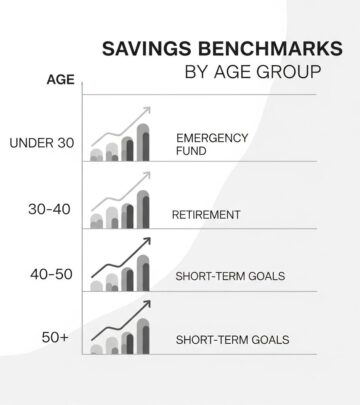
Balance family planning or homebuying by diversifying ‘savings buckets’: one for emergencies, one for short-term goals, another for retirement.
How to Save More Money in Your 20s and 30s
If behind, refine habits without drastic cuts. Key strategies include:
- Track expenses rigorously: Create a detailed monthly budget listing after-tax income against needs (50%), wants (30%), and savings/debt (20%). Cut non-essentials like frequent dining out and redirect to savings.
- Automate everything: Set payroll deductions or bank transfers—e.g., $100 per paycheck over $1,000. This builds savings unconsciously via ‘pay yourself first’.
- Use savings buckets: Separate accounts for emergencies, vacations, or home funds prevent cross-contamination and simplify tracking.
- Harness compound interest: High-yield savings accounts (HYSA) or CDs compound earnings on principal plus interest, amplifying growth. For example, $200 monthly at 4% APY grows significantly over decades.
- Maximize retirement perks: Contribute enough for full employer 401(k) match—free money. Aim for 10-15% of income.
In down markets, revisit savings rates (target 10%+), maintain asset allocation, and dollar-cost average investments for long-term gains.
Advanced Tips for Catching Up
Reevaluate spending: Fixed must-haves (rent, groceries), variable (utilities), discretionary (entertainment). Tools like recurring transfers or ‘surprise boosters’ automate boosts. For parents, start 529 plans early; pay off student loans systematically.
Live below means: Scale savings as income grows. Even 5% initially compounds powerfully over time.
Frequently Asked Questions (FAQs)
What is a good amount of savings for my 20s?
Aim for 3-6 months’ expenses in an emergency fund, plus 10-20% of income monthly. Medians range $1,500-$3,000, but prioritize habits over exact dollars.
How much should I have saved by age 30?
Experts recommend one year’s salary across all accounts, including retirement. Median is ~$2,272; scale to your income.
What is the 50/30/20 rule?
50% needs (essentials), 30% wants, 20% savings/debt. It’s flexible for early career savers.
How do I build an emergency fund?
Start small: Automate transfers for 3-6 months’ expenses in a HYSA. Avoid touching for non-emergencies.
Can I catch up on savings if I’m behind?
Yes—automate higher contributions, cut expenses, use compound interest. Increase to 15-20% as income rises.
Should I prioritize retirement or other goals in 30s?
Balance: Max employer matches first, then home/kids savings. Diversify accounts.
This comprehensive guide empowers you to tailor savings to your life. Consistent action in your 20s and 30s leverages time and compounding for substantial wealth. Monitor credit via free annual reports to stay on track.
References
- How Much Money Should I Have Saved by My 20s and 30s? — Equifax. 2023 (accessed 2026). https://www.equifax.com/personal/education/personal-finance/articles/-/learn/how-much-should-i-have-saved-by-20s-30s/
- 6 Important Financial Strategies For Your 20’s and 30’s — Silver Compass Advisors. 2023 (accessed 2026). https://silvercompassadvisors.com/6-important-financial-strategies-for-your-20s-and-30s/
- Savings by Age: How Much to Save in Your 20s, 30s, 40s & Beyond — Ally Bank. 2025 (accessed 2026). https://www.ally.com/stories/save/savings-by-age-how-much-to-save-in-your-20s-30s-40s-and-beyond/
- Financial Planning in Your 20s — AAA Northeast. 2024 (accessed 2026). https://magazine.northeast.aaa.com/daily/money/savings/financial-planning-in-your-20s/
- Financial Milestones by Age — Resource Center Inc. 2024 (accessed 2026). https://www.resourcecenterinc.com/blog/financial-milestones-by-age/
Similar Articles








Read full bio of medha deb