How Much Does It Cost to Refinance a Mortgage?
Understand mortgage refinancing costs, from origination fees to appraisals, and calculate if refinancing saves you money.

Mortgage refinancing can be an excellent strategy to reduce your interest rate and lower your monthly payments, but before you proceed, it’s crucial to understand all the costs involved. Refinancing essentially means replacing your current mortgage with a new home loan, potentially with a different lender. Since this process mirrors many aspects of a home purchase, you’ll encounter similar closing costs and fees. Understanding these expenses upfront will help you determine whether refinancing truly makes financial sense for your situation.
Typical Costs to Refinance a Mortgage
The cost to refinance a mortgage typically ranges from 3% to 6% of your loan amount. To put this in perspective, a homeowner refinancing an outstanding mortgage balance of $150,000 could expect to pay between $4,500 and $9,000 in refinancing costs. On a larger loan of $300,000, refinancing costs could range from $9,000 to $18,000.
Refinancing costs are fundamentally similar to the closing costs you pay when purchasing a home. The primary difference is that you won’t need to provide a down payment when refinancing since you already have equity in your property. However, the actual costs you’ll pay depend on several variables, including your loan type, whether you purchase discount points, your lender’s fee structure, and any additional paperwork your financial institution requires.
What Are All the Costs to Refinance a Mortgage?
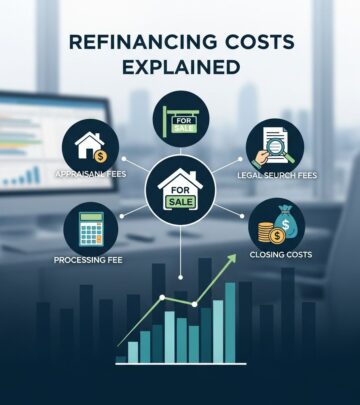
Refinancing involves multiple fees and expenses that can quickly accumulate. Understanding each component will give you a clear picture of your total refinancing costs:
Loan Origination Fees
These fees typically represent 0.5% to 1% of your mortgage amount and compensate the lender for processing and underwriting your loan.
Loan Application Fees
Most lenders charge a few hundred dollars for processing your refinance application and conducting the initial evaluation of your financial situation.
Title Service Fees
This category includes several related expenses: a title search fee (to verify property ownership and identify any liens), title insurance (to protect against claims against the property), and other miscellaneous title-related costs.
Home Appraisal Costs
A professional appraisal to determine your home’s current market value typically costs around $500. This appraisal helps the lender determine how much they’re willing to lend based on your home’s equity.
Discount Points
These optional fees allow you to lower your interest rate by paying upfront costs. The price varies based on your loan amount and loan type, and they’re entirely optional depending on your financial situation.
Other Miscellaneous Fees
Depending on your specific situation and location, you may encounter additional expenses including attorney fees, survey fees, credit report fees, and government recording fees.
Factors That Affect How Much Mortgage Refinancing Costs
Loan Amount
Your loan amount has the most significant influence on refinancing costs. Since many major expenses are calculated as a percentage of your new loan amount, borrowing more means paying higher fees. For example, origination fees and upfront mortgage insurance are both percentage-based. A savvy strategy is to refinance only for the amount you need rather than the maximum amount a lender offers. Just because your lender will let you borrow 90% of your home’s equity doesn’t mean you should take it.
Credit Score
Your creditworthiness directly impacts refinancing costs. With a strong credit score, you’ll qualify for better interest rates and may also receive breaks on refinancing fees. Lenders are more motivated to work with applicants who have excellent credit, so they may offer you lower origination fees or other cost reductions if your credit profile is exceptional.
Location
Geographic location significantly influences refinancing closing costs. The cost of labor in your area affects nearly every aspect of the mortgage refinance process. Appraisals, for instance, tend to be more expensive in high-cost-of-living areas and remote regions where appraisers must travel further to complete their evaluations.
Type of Refinance
The specific refinance option you choose impacts your total costs. A streamline refinance, which involves less documentation and faster processing, is typically the cheapest option. Conversely, a cash-out refinance—where you borrow against your home equity and receive the difference in cash—is usually more expensive than a standard rate-and-term refinance.
No-Closing-Cost Refinancing
This option appears to be the cheapest on the surface but comes with a significant trade-off. With a no-closing-cost refinance, your lender rolls the closing costs into your new loan amount. This means you’re not avoiding the refinance costs; you’re simply not paying them upfront. The catch is that you’ll have a higher interest rate, resulting in increased monthly mortgage payments throughout the life of your loan.
How Can I Save Money on Refinancing Costs?
While refinancing costs are substantial, several strategies can help you minimize expenses:
- Shop around with multiple lenders: Different lenders charge varying fees and may offer different terms. Getting quotes from several lenders allows you to compare costs and find the best deal.
- Refinance only what you need: Resist the temptation to borrow the maximum available. By refinancing a smaller amount, you’ll pay lower percentage-based fees.
- Improve your credit score first: If your credit score has improved since your original mortgage, work to boost it further before refinancing to qualify for better rates and lower fees.
- Consider your location: While you can’t move your home, understanding how location affects costs helps you set realistic expectations for appraisal and labor-related fees.
- Ask about rate discounts: Mention your strong credit history and financial stability to negotiate better terms with your lender.
- Evaluate loan type carefully: If eligible, a streamline refinance may offer significant cost savings compared to other refinance options.
Is Refinancing a Mortgage Worth the Cost?
The key to determining whether refinancing makes financial sense is calculating your break-even point. As a general rule of thumb, refinancing is worthwhile if your new interest rate will be at least 0.75 percentage points lower than your current rate. However, this varies based on individual circumstances.
Understanding Your Break-Even Point
To calculate your break-even point, divide your total refinancing costs by your monthly savings:
Break-Even Point (in months) = Total Refinancing Costs ÷ Monthly Savings
For example, consider a homeowner with a $300,000 loan balance who can reduce their rate from 7% to 6.25%, saving $149 per month. If their total refinancing costs are $18,000 (6% of their loan), their break-even point would be approximately 121 months, or just over 10 years. Most mortgage experts recommend a break-even point of three to five years.
If you plan to sell your home or refinance again within your break-even period, refinancing likely won’t provide enough savings to justify the upfront costs. However, if you plan to stay in your home longer than your break-even point, the interest savings could be substantial.
Factors to Consider
Beyond the break-even calculation, consider your overall financial situation. If your finances have improved significantly and your budget allows for higher monthly payments, you might refinance into a shorter-term loan, such as a 15-year fixed-rate mortgage. While monthly payments will be higher, you’ll pay off your loan faster and save considerably on interest over time.
Conversely, if your goal is to lower your monthly payments, a rate-and-term refinance into another 30-year fixed-rate mortgage may be appropriate, even if it extends your total payoff timeline slightly.
Frequently Asked Questions About Refinancing Costs
Q: What is the typical cost range for refinancing a mortgage?
A: Refinancing typically costs between 3% and 6% of your loan amount, though some lenders charge as little as 2% to 5%. For a $150,000 loan, you’d expect to pay $4,500 to $9,000; for a $300,000 loan, costs would range from $9,000 to $18,000.
Q: Are refinancing costs the same as home purchase closing costs?
A: Refinancing costs are similar to purchase closing costs, but there’s one major difference: you won’t pay a down payment when refinancing since you already have equity in your home. However, you will pay most other fees associated with closing.
Q: Can I get a no-closing-cost refinance?
A: Yes, but understand the trade-off. With a no-closing-cost refinance, your lender rolls the closing costs into your new loan. This means higher monthly payments and more interest paid over the life of the loan, even though you avoid upfront costs.
Q: What’s the minimum rate reduction needed to make refinancing worthwhile?
A: Most experts agree that refinancing makes sense if you can lower your rate by at least 0.75 percentage points. However, a reduction of 0.50 percentage points could also be worthwhile depending on your circumstances and break-even point.
Q: How long does it typically take to break even on refinancing costs?
A: Your break-even point depends on your specific situation. Most mortgage experts recommend a break-even period of three to five years, though it can range from a few months to over a decade depending on your savings and costs.
Q: Does my credit score affect refinancing costs?
A: Yes, significantly. Borrowers with excellent credit scores typically qualify for better interest rates and may receive lower origination fees or other cost reductions, as lenders are more eager to work with financially responsible borrowers.
Q: How does location affect refinancing costs?
A: Geographic location influences labor costs throughout the refinancing process. Appraisals and other services tend to be more expensive in high-cost-of-living areas and remote regions requiring additional travel.
Q: Should I refinance if I plan to sell my home soon?
A: If your break-even point extends beyond when you plan to sell, refinancing likely won’t be financially beneficial. Calculate your break-even point carefully before proceeding with a refinance if you’re planning to sell within a few years.
Q: Can I refinance into a shorter loan term?
A: Yes. If your financial situation allows, you can refinance into a shorter-term loan like a 15-year mortgage. While monthly payments will be higher, you’ll pay off your loan faster and save significantly on interest.
References
- How Much Does It Cost to Refinance a Mortgage? — Money.com. 2025-11-29. https://money.com/how-much-does-it-cost-to-refinance-mortgage/
- Is Now a Good Time to Refinance Your Mortgage? — Money.com. 2025-11-29. https://money.com/is-now-a-good-time-to-refinance/
- Best Mortgage Refinance Companies of November 2025 — Money.com. 2025-11-29. https://money.com/best-mortgage-refinance/
- When Refinancing Your Mortgage Could Actually Cost You Money — Money.com. 2025-11-29. https://money.com/mortgage-refinancing-cost-money-tips/
Similar Articles








Read full bio of medha deb