How Much Does It Cost To Refinance A Mortgage?
Understand mortgage refinance costs, fees, and how to calculate your break-even point.

Refinancing your mortgage can be an excellent financial strategy to lower your monthly payments, access your home equity, or change your loan structure. However, the refinancing process comes with significant upfront expenses that you need to understand before making a decision. These costs are similar to what you paid when you first obtained your original mortgage, and they can substantially impact whether refinancing makes financial sense for your situation.
Your refinance closing costs typically range between 2 percent and 6 percent of the new loan amount, with the average closing costs for a single-family home refinance totaling approximately $2,403 according to recent industry data. Understanding these costs is crucial for determining whether refinancing will actually save you money in the long run.
Understanding Refinancing Costs
When you refinance your mortgage, you’re essentially replacing your current loan with a new one. This process involves numerous fees and expenses that lenders and service providers charge for their involvement. The total cost varies significantly depending on your loan amount, location, and the specific lender you choose.
For example, if you’re refinancing a $150,000 mortgage, you can expect to pay between $3,000 and $9,000 in closing costs. On a larger $350,000 loan, closing costs could range from $7,000 to $17,500. It’s important to note that refinance closing costs are typically less expensive than those for a home purchase loan, since you won’t be paying for homebuying-specific costs like prepaid homeowners insurance or settlement attorney fees for initial purchase documentation.
Breaking Down Common Refinance Closing Costs
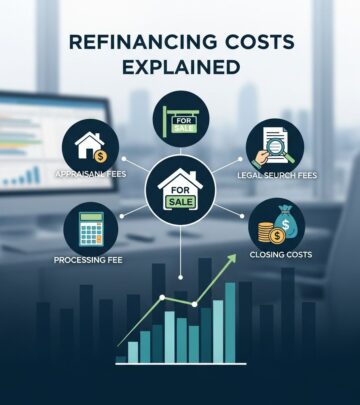
Your refinance closing costs consist of several distinct line items, each serving a specific purpose in the lending process. Here’s a detailed breakdown of common fees you’ll encounter:
| Closing Cost Type | Typical Fee Range |
|---|---|
| Application Fee | Up to $500 |
| Origination and/or Underwriting Fee | $300 – $500 |
| Recording Fee | $20 – $250 (varies by location) |
| Appraisal Fee | $300 – $500 |
| Credit Check Fee | Typically less than $30 |
| Title Services | $300 – $2,000 |
| Survey Fee | $2,300 on average |
| Attorney/Settlement Fee | $500 – $1,000 |
The application fee covers the cost of processing your refinance application. The origination and underwriting fee represents the lender’s compensation for evaluating your financial situation and preparing your loan documents. Recording fees are charged by your local government for updating property records, and these vary significantly by location.
The appraisal fee pays for a professional assessment of your home’s current value, which lenders require to determine the appropriate loan amount. Title services ensure that the property title is clear and that you have legitimate ownership rights. The survey fee, typically the most expensive individual cost, pays for a professional surveyor to measure and map your property boundaries.
Factors That Influence Your Refinance Rate
Beyond closing costs, the interest rate you receive on your new mortgage will significantly impact the true cost of refinancing. Several important factors influence the rate lenders offer you:
Credit Score: Your credit score is one of the most important factors in determining your interest rate. If you have good or excellent credit, lenders will typically offer you better rates. Even small improvements to your credit score before refinancing can result in substantial savings over the life of your loan. Paying down existing debt and making all payments on time in the months leading up to your refinance application can help boost your score.
Choice of Lender: Different lenders have varying approaches to pricing loans and underwriting standards, which directly influences the interest rate they offer. Some lenders specialize in serving borrowers with specific credit profiles, while others focus on different loan products or customer segments. Shopping around with multiple lenders is essential to finding the best rate for your situation.
Type of Refinance: The specific type of refinance you’re pursuing also affects your interest rate. A cash-out refinance, where you borrow more than you owe and receive the difference in cash, typically comes with a higher interest rate than a standard rate-and-term refinance. This is because the lender is taking on additional risk by lending more than your current loan balance.
How Your Monthly Payment May Change
Whether your monthly payments decrease when you refinance depends on several interconnected factors, including the interest rate and the term of your new mortgage. If you currently have a 30-year loan and refinance to a lower interest rate on a new 30-year loan, your payment will almost certainly decrease. The lower rate directly translates to reduced monthly obligations.
However, if you refinance to a shorter loan term, your monthly payment could actually increase even if you secure a lower interest rate. For example, moving from a 30-year loan to a 15-year loan will result in higher monthly payments because you’re paying off the loan in half the time. Conversely, extending your loan term can lower your monthly payment but will increase the total interest you pay over the life of the loan.
Strategies to Save Money on Refinancing
Several proven strategies can help you reduce the costs associated with refinancing and improve your overall financial outcome:
Improve Your Credit Score: Before applying for refinancing, spend several months improving your credit score if possible. Even a modest improvement can qualify you for better interest rates, which can save thousands of dollars over the life of your loan. Pay all bills on time, reduce your credit utilization ratio, and dispute any errors on your credit report.
Compare Multiple Mortgage Offers: Never accept the first refinance offer you receive. Contact multiple lenders and request quotes for your refinance. When comparing offers, look at the annual percentage rate (APR), which includes both the interest rate and all associated fees. This gives you a more complete picture of each loan’s true cost. Many mortgage brokers can help you access a wider range of quotes from different lenders.
Get a Quote from Your Current Lender: Always request a quote from your existing lender, as they may be willing to offer you lower costs or other repeat customer benefits to keep your business. Some lenders provide streamlined refinance programs with reduced fees for existing customers.
Negotiate Closing Costs: Don’t assume that closing costs are fixed and non-negotiable. Many fees, particularly the origination fee, are subject to negotiation. Some lenders may be willing to reduce or waive certain fees to win your business, particularly if you’re refinancing a large loan amount or have excellent credit.
Consider a No-Closing-Cost Refinance: Some lenders offer refinance programs with no upfront closing costs. With this option, you either pay the fees as part of a higher loan balance or accept a higher interest rate. While this eliminates upfront costs, you’ll pay more over the life of the loan through either higher principal or higher interest charges.
Calculating Your Break-Even Point
One of the most critical calculations in determining whether to refinance is finding your break-even point—the moment when your monthly savings exceed the upfront refinancing costs. This calculation helps you determine whether you’ll stay in your home long enough to benefit from the refinance.
Here’s how to calculate your break-even point: First, determine how much your monthly payment will decrease with the new loan. Next, divide your total refinancing costs by this monthly savings amount. The result is the number of months it will take to break even.
For example, suppose your new lower interest rate will decrease your monthly payment by $100, and refinancing costs you $3,000. Dividing $3,000 by $100 gives you 30 months, or 2.5 years. This means you’ll need to stay in your home for at least 2.5 years to recoup your refinancing costs and start realizing savings.
If you’re planning to sell your home or refinance again before reaching your break-even point, it may not make financial sense to refinance now. As a general rule of thumb, you should refinance only if your new interest rate is at least 1 percent lower than your current rate, since refinancing isn’t free and lower savings may not justify the costs.
Real-World Example: Comparing Refinance Options
Consider a homeowner with a $390,000 remaining loan balance who is considering refinancing. Their current 30-year mortgage has an interest rate of 7.23 percent with a monthly payment of $2,179 and total projected interest of $464,305.
If they refinance to a 30-year loan at 6.54 percent, their monthly payment drops to $1,916—a savings of $263 per month. However, the total interest on the new loan would be $500,650. When combined with the $112,667 they’ve already paid on their original loan, their total interest paid would be $613,317.
Alternatively, if they refinance to a 25-year loan at 6.54 percent, their monthly payment would be $2,046—higher than the original but lower than keeping the original loan. The total interest on this refinance would be $424,619. When combined with what they’ve already paid, their total interest would be $537,286. Despite the higher monthly payment, this option saves them $76,031 in total interest compared to the 30-year refinance option.
Frequently Asked Questions
Q: What is the average cost to refinance a mortgage?
The average closing costs for a single-family home refinance are approximately $2,403. However, your actual costs will depend on your loan amount and location. Generally, expect to pay between 2 and 6 percent of your new loan balance in total closing costs.
Q: Can I avoid paying refinance closing costs?
Yes, some lenders offer no-closing-cost refinance programs. However, you’ll either pay those costs through a higher loan balance (meaning you’ll pay interest on the closing costs) or accept a higher interest rate. You’re not truly eliminating the costs; you’re simply paying them differently.
Q: How long does it take to break even on a refinance?
Your break-even timeline depends on your monthly savings and refinancing costs. Divide your total closing costs by your monthly payment savings to determine how many months you need to stay in your home to break even. This typically ranges from 12 to 36 months.
Q: Should I refinance if rates are only slightly lower?
Generally, refinancing makes sense when your new rate is at least 1 percent lower than your current rate. However, this is just a general guideline. You should calculate your specific break-even point to determine if the savings justify the costs, regardless of the rate difference.
Q: Will my monthly payment always be lower if I refinance?
Not necessarily. While refinancing to a lower interest rate typically reduces your monthly payment, extending your loan term can increase your payment, even with a lower rate. Your payment depends on the combination of interest rate and loan term.
References
- How Much Does It Cost To Refinance A Mortgage? — Bankrate. 2025. https://www.bankrate.com/mortgages/how-much-it-costs-to-refinance/
- No-Closing-Cost Refinance: Is It Right For You? — Bankrate. 2025. https://www.bankrate.com/mortgages/is-no-closing-cost-for-you/
- Mortgage Refinancing: What Is It And How Does It Work? — Bankrate. 2025. https://www.bankrate.com/mortgages/how-does-refinancing-a-mortgage-work/
- When Should You Refinance Your Mortgage? — Bankrate. 2025. https://www.bankrate.com/mortgages/when-to-refinance/
- How to get a low-cost mortgage refinance — Bankrate. 2025. https://www.bankrate.com/mortgages/low-cost-refinance/
Similar Articles








Read full bio of Sneha Tete