How Mortgage Interest Rates Are Set and Determined
Understanding the factors that determine your mortgage rate and how to secure the best deal.
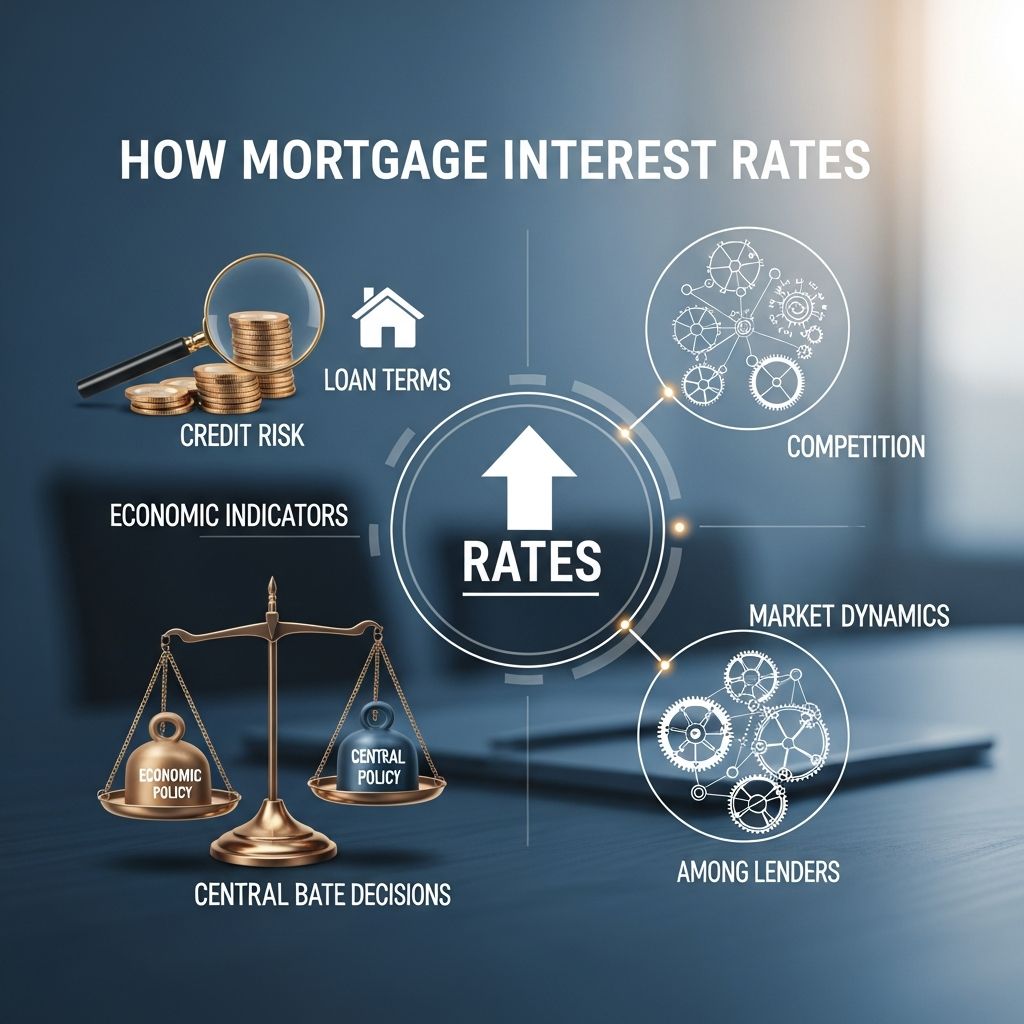
Mortgage interest rates are one of the most important factors in the homebuying process. Whether you’re purchasing your first home or refinancing an existing mortgage, understanding how interest rates are determined can help you secure the best possible deal. The rate you receive depends on a complex interplay of macroeconomic factors, market conditions, lender-specific variables, and your personal financial circumstances.
The Foundation: Treasury Yields and Mortgage-Backed Securities
At the core of mortgage rate determination are two key market indicators: the 10-year Treasury yield and mortgage-backed securities (MBS) prices. These benchmarks serve as the foundation upon which lenders build their loan pricing. Mortgage rates typically move in lockstep with 10-year Treasury yields, meaning when Treasury yields rise, mortgage rates rise, and vice versa. This relationship is so fundamental that lenders must constantly adjust their pricing to maintain adequate profit margins when these yields fluctuate.
Mortgage lenders usually add a margin to the MBS rate to arrive at the rate they charge borrowers for mortgage loans. This spread, or margin, represents the lender’s profit and compensation for the risk they assume when originating a loan. The size of this margin can vary based on market conditions, competition, and the volume of business a lender is experiencing at any given time. For much of 2023 and 2024, the spread between the 10-year Treasury yield and mortgage rates grew to approximately 3 percentage points, significantly higher than the typical 1.5 to 2 percentage point range, primarily due to added risk in the marketplace caused by rapidly rising rates.
The Federal Reserve’s Indirect Influence
A common misconception is that the Federal Reserve directly sets mortgage rates. In reality, the Federal Reserve does not set mortgage rates outright, but its monetary policy decisions do influence them indirectly. When the Federal Reserve adjusts its benchmark federal funds rate—the rate at which banks lend to each other overnight—it affects the overall cost of borrowing in the economy, which in turn influences mortgage rates.
However, the relationship between Fed rate changes and mortgage rate movements is not always straightforward or immediate. When the Fed raised its key benchmark rate in 2022 and 2023, mortgage rates rose correspondingly. Conversely, when the central bank began cutting rates in 2024, mortgage rates didn’t always follow suit. In fact, despite the Fed cutting rates by 100 basis points in late 2024 and an additional 50 basis points in September and October 2025, mortgage rates remained elevated, often averaging above 7 percent for much of the year before declining toward year-end.
Fixed-rate mortgages, which represent the most popular type of home loan in the United States, don’t directly mirror the federal funds rate. Instead, they track the 10-year Treasury yield. Your actual mortgage rate will be higher than the 10-year yield by an amount known as a spread or margin, which compensates lenders for their risk and operating costs.
Market-Driven Factors Affecting Mortgage Rates
Beyond Treasury yields and the Fed’s actions, several market-driven factors influence mortgage rates:
Inflation
When inflation picks up, fixed interest rates generally rise as well. Lenders demand higher rates to compensate for the reduced purchasing power of future loan payments. Conversely, when inflation moderates, there’s typically downward pressure on interest rates.
Supply and Demand Dynamics
Mortgage lenders adjust rates based on business volume and customer demand. When mortgage lenders have excessive business and high demand, they raise rates to decrease demand and manage their workload more efficiently. When business is light or demand is weak, lenders tend to cut rates to attract more customers and maintain healthy loan volume.
The Secondary Mortgage Market
Most lenders don’t keep the mortgages they originate on their books indefinitely. Instead, they bundle the mortgages they underwrite and sell them in the secondary mortgage market to investors as mortgage-backed securities. When investor demand for these securities is high, mortgage rates trend lower because lenders are confident they can sell their loans. When investors aren’t actively buying, lenders may raise rates to attract more borrowers and compensate for reduced secondary market demand.
Borrower-Specific Factors Impacting Mortgage Rates
While the macro factors outlined above establish the baseline mortgage rates you see advertised in surveys and media reports, your personal rate depends significantly on your individual credit profile and financial circumstances. Lenders assess several key factors when determining your specific rate:
Credit Score
Your credit score is one of the most important factors in determining your mortgage rate. A higher credit score indicates a better likelihood you’ll repay the mortgage, which translates to less risk for the lender and a lower rate for you. You can qualify for a conventional loan with a credit score as low as 620, but you’ll be eligible for the best rates if your score is 740 or above. According to mortgage giant Fannie Mae’s loan level price adjustment chart, if you have a credit score of 780 or higher, you’ll have no more than 0.375 percentage points added to your rate on a home purchase loan. However, if your score is below 640, you could have as much as 2.875 percentage points tacked onto your rate.
Down Payment and Loan-to-Value Ratio
Your loan-to-value (LTV) ratio compares the amount you’re borrowing with the purchase price of the home. The larger your down payment, the lower your LTV ratio, and generally, the lower your interest rate. If you’re making a 3 percent down payment, for example, you’d be borrowing 97 percent of the home’s price and have a 97 percent LTV ratio. A smaller down payment increases your risk profile in the lender’s eyes, resulting in a higher rate to compensate for that risk. Conversely, making a substantial down payment of 20 percent or more can qualify you for significantly better rates.
Debt-to-Income Ratio
Your debt-to-income (DTI) ratio compares your monthly debt payments—including the new mortgage payment—with your monthly income. This metric helps lenders ensure you’re not overextended and have adequate income to service all your obligations. Similar to the LTV ratio, if your DTI ratio is lower, you’ll likely get a lower mortgage rate. You can still qualify for a conventional loan with a higher DTI ratio, but for the best rates, most lenders look for a DTI ratio no higher than 36 percent. A higher DTI ratio suggests greater financial stress and increased default risk, which lenders offset through higher interest rates.
Occupancy Status and Property Type
Whether the property will be your primary residence, a secondary home, or an investment property significantly impacts your rate. If the home will be your primary residence, the rate may be lower because owner-occupied properties typically have lower default rates than investment properties. The type of property also matters. Any property type other than a single-family home—such as a condo, manufactured home, or multi-unit dwelling—will generally increase the mortgage rate due to higher risk profiles and potentially more complex financing arrangements.
Lender-Specific Factors
Mortgage rates can vary substantially from lender to lender, even for borrowers with identical financial profiles. This variation is often due to differences in:
Local Competition
Areas with higher competition between lenders typically experience compressed margins and lower mortgage rates. In competitive markets, lenders are forced to offer more attractive rates to win business. Conversely, in markets with fewer lenders, rates may be higher due to reduced competitive pressure.
Operational Efficiency and Business Volume
How efficiently a lender operates—including what it costs them to originate a loan, how much they pay their loan officers, and the strength of their investor network—directly impacts the pricing flexibility they have available. Well-run lenders with low operational costs and strong relationships can offer more competitive rates than lenders with higher overhead and less efficient processes. Additionally, lenders with strong business volume and high loan production may have more flexibility to offer better rates than smaller lenders with inconsistent volume.
Why Different Mortgage Types Have Different Rates
Different types of mortgages charge different rates based on the relative risk to the lender. Fixed-rate loans typically have higher rates than introductory rates on adjustable-rate mortgages (ARMs) because fixed-rate lenders take on the interest rate risk that rates could increase during the loan’s term. With an ARM, the lender can adjust the rate periodically, transferring some of this risk to the borrower after the introductory period expires.
Similarly, the loan term affects the rate. A 15-year mortgage typically has a lower rate than a 30-year mortgage because the lender has less time for rates to move against them and the borrower has less opportunity to default. The shorter time horizon reduces the lender’s risk exposure.
Government-backed FHA, VA, and USDA loans sometimes have lower rates because they carry a government guarantee or insurance that cuts the lender’s risk. This government backing means the lender has recourse if the borrower defaults, making these loans less risky and justifying lower rates.
Understanding Rate Movements and Recent Trends
As of late November 2025, mortgage rates have been declining, with the 30-year fixed rate averaging 6.25 percent and the 15-year fixed rate averaging 5.58 percent. These rates represent the lowest levels seen in much of the year following Federal Reserve rate cuts and moderation in market volatility. However, mortgage rate movements don’t always align perfectly with Fed decisions. After the Fed cut rates in September and October 2025, rates fell from 6.55 percent to 6.25 percent between the first week of September and the last week of October. This demonstrates how multiple factors beyond Fed policy influence mortgage rates simultaneously.
Practical Impact of Rate Changes
Understanding how rates are set becomes especially important when you realize the practical financial impact of even small rate changes. For example, at a 7 percent interest rate, a $250,000 mortgage loan would result in principal and interest payments of approximately $1,663 per month. At 6 percent, the same loan would mean payments of just $1,499 per month—a difference of $164 monthly or nearly $2,000 annually. For larger loan amounts, the effects are even more dramatic, making rate shopping and optimization critically important for homebuyers and refinancers.
Frequently Asked Questions About Mortgage Interest Rates
Q: Why don’t mortgage rates move exactly with Federal Reserve rate changes?
A: Fixed-rate mortgage rates are primarily tied to the 10-year Treasury yield rather than the Federal Reserve’s benchmark rate. While Fed policy influences Treasury yields, the relationship is indirect and markets can move independently based on inflation expectations, economic outlook, and investor demand. Additionally, lenders adjust their margins based on risk, competition, and market conditions, which can offset or amplify the effects of Fed rate changes.
Q: How much can my rate improve if I increase my credit score?
A: According to Fannie Mae’s pricing adjustments, moving from a credit score below 640 to 780 or higher can save you up to 2.5 percentage points on your rate. Even modest improvements in your credit score can result in meaningful savings over the life of your loan.
Q: What’s the relationship between down payment size and interest rate?
A: The larger your down payment, the lower your loan-to-value ratio and generally the lower your interest rate. A 20 percent down payment typically qualifies for better rates than a 3-5 percent down payment because you have more equity in the home from day one, reducing the lender’s risk.
Q: Do all lenders charge the same mortgage rates?
A: No. While all lenders operate from the same market benchmarks (Treasury yields and MBS prices), rates can vary significantly between lenders due to differences in operating costs, local competition, business volume, and investor relationships. Shopping around with multiple lenders can often save you thousands of dollars.
Q: Why is my mortgage rate higher than the advertised rate?
A: Your personal rate reflects the advertised rate plus adjustments based on your credit score, down payment, DTI ratio, occupancy type, and property type. The advertised rate typically represents rates available to borrowers with excellent credit and financial profiles.
Q: What’s the difference between ARM rates and fixed-rate mortgage rates?
A: Fixed-rate mortgages track the 10-year Treasury yield, while ARM rates are often tied to the Secured Overnight Financing Rate (SOFR), which is more directly influenced by Federal Reserve policy. ARMs start with lower introductory rates but adjust periodically, while fixed rates remain constant throughout the loan term.
References
- What Factors Determine And Move Mortgage Rates? — Bankrate. 2025. https://www.bankrate.com/mortgages/how-interest-rates-are-set/
- How does the Federal Reserve affect mortgages? — Bankrate. 2025. https://www.bankrate.com/mortgages/federal-reserve-and-mortgage-rates/
- How Interest Rates Impact The Housing Market — Bankrate. 2025. https://www.bankrate.com/real-estate/interest-rates-housing/
- Mortgage Rates Fall Amid Economic Volatility — Bankrate. 2025-11-25. https://www.bankrate.com/mortgages/analysis/mortgage-rates-november-25-2025/
- Federal Open Market Committee (FOMC) Meeting Summary — Board of Governors of the Federal Reserve System. 2025-10-29. https://www.federalreserve.gov/monetarypolicy/fomccalendars.htm
- Fannie Mae Loan Level Price Adjustment Guide — Federal National Mortgage Association. 2025. https://www.fanniemae.com/
Similar Articles








Read full bio of Sneha Tete