Car Loan Interest Rates: 6 Factors That Affect Your Rate
Understand auto loan interest rates and how they impact your monthly payments and total borrowing costs.
How Interest Rates Work on Car Loans
When you borrow money to purchase a vehicle, the lender charges you interest as the cost of borrowing. Understanding how interest rates work on car loans is crucial for making informed financial decisions and potentially saving thousands of dollars over the life of your loan. Interest represents the percentage of the principal amount that you’ll pay in addition to repaying the loan itself. The higher your interest rate, the more you’ll ultimately pay for your vehicle.
Understanding Interest Rates and APR
The Annual Percentage Rate (APR) is the most important figure to understand when evaluating car loan offers. This rate represents the yearly cost of borrowing expressed as a percentage of the loan amount. Unlike simple interest rates, APR includes not only the interest charges but also any fees associated with the loan, providing a more comprehensive view of the true cost of borrowing.
For example, if you take out a $25,000 car loan with a 5% APR over a 60-month period, you’ll pay significantly more than $25,000 by the end of the loan term due to the accumulated interest charges. The APR makes it easier to compare different loan offers from various lenders, as it accounts for all borrowing costs into a single percentage.
How Car Loan Interest is Calculated
Most car loans use simple interest calculations rather than compound interest. With simple interest, the lender calculates the interest charge based on the remaining balance of the loan, which decreases with each payment you make. This is beneficial to borrowers because you’re not paying interest on interest, only on the principal amount outstanding.
The Monthly Payment Formula
Your monthly car payment is determined by a specific formula that takes into account three primary factors:
- The principal amount borrowed (the loan amount)
- The interest rate (expressed as a monthly rate)
- The loan term (the number of months to repay)
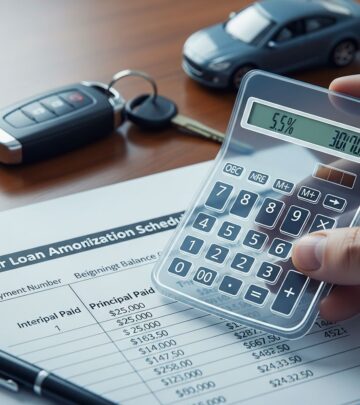
The calculation uses an amortization schedule, which divides your loan into equal monthly payments. Early payments consist largely of interest, while later payments go primarily toward reducing the principal. As you progress through the loan term, the proportion of each payment going toward principal increases while the interest portion decreases.
Factors That Influence Your Car Loan Interest Rate
Your car loan interest rate isn’t arbitrary—lenders base it on several key factors that assess your risk as a borrower. Understanding these factors can help you take steps to improve your rate offer.
Credit Score and Credit History
Your credit score is typically the most significant factor in determining your interest rate. Lenders use credit scores to assess how reliably you’ve paid debts in the past. Borrowers with excellent credit scores (typically 750 and above) qualify for substantially lower interest rates, sometimes 2-3 percentage points lower than those with poor credit. Conversely, individuals with lower credit scores may face rates significantly higher than the market average.
Down Payment Amount
The size of your down payment affects both the loan amount and your interest rate. A larger down payment reduces the principal you need to borrow, lowering your overall interest charges. Additionally, lenders often view a substantial down payment as evidence of financial responsibility and commitment, which can result in a lower interest rate. Most lenders prefer down payments of at least 10-20% of the vehicle’s purchase price.
Loan Term Length
The length of your loan term directly impacts your interest rate and monthly payment. Shorter loan terms (36-48 months) typically come with lower interest rates, while longer terms (72-84 months) usually carry higher rates. Although longer terms result in lower monthly payments, you’ll pay substantially more in total interest over the life of the loan.
Vehicle Age and Type
New vehicles typically qualify for lower interest rates than used cars. Lenders consider new cars less risky because they’re more reliable and have predictable depreciation. Used vehicles, particularly those with higher mileage or older models, often come with higher interest rates. Additionally, luxury vehicles and those with poor safety records may face higher rates than practical, reliable models.
Employment History and Income
Lenders assess your ability to repay the loan by examining your employment history and income level. Stable employment and sufficient income improve your chances of securing a lower rate. Self-employed individuals may face additional scrutiny and potentially higher rates.
Current Market Conditions
Overall economic conditions and Federal Reserve monetary policy influence the rates lenders offer. When the Federal Reserve raises its benchmark interest rates, car loan rates typically increase. Conversely, lower Fed rates often result in more competitive auto loan pricing.
Comparing Interest Rate Offers
Before committing to a car loan, it’s essential to shop around and compare multiple offers. Different lenders—including banks, credit unions, and dealership financing—may offer substantially different rates for the same borrower.
Where to Get Pre-Approved Rates
- Banks: Traditional banks offer car loans with competitive rates for qualified borrowers
- Credit Unions: Often provide lower rates to members with good credit histories
- Online Lenders: Digital lending platforms frequently offer competitive rates and quick approval processes
- Dealership Financing: Dealer financing may offer promotional rates, but these often don’t represent the best available rates
Obtaining pre-approval from multiple lenders allows you to negotiate from a position of strength at the dealership. Armed with approved rates and loan offers, you can often convince the dealership to match or beat competing offers.
The Impact of Interest Rates on Your Total Cost
The difference between a 3% and 7% interest rate on a $30,000 car loan might seem minor, but the impact over a five-year loan term is substantial. Consider this comparison:
| Interest Rate | Monthly Payment | Total Amount Paid | Total Interest Paid | |
|---|---|---|---|---|
| 3% | $549 | $32,940 | $2,940 | |
| 5% | $566 | $33,960 | $3,960 | |
| 7% | $584 | $35,040 | $5,040 |
As this table demonstrates, a 4% rate difference results in over $2,000 in additional interest charges on a $30,000 loan. This underscores the importance of securing the lowest possible interest rate.
Strategies to Secure Lower Interest Rates
Improve Your Credit Score Before Applying
If possible, take time before applying for an auto loan to boost your credit score. Pay down existing debts, ensure all bills are paid on time, and review your credit report for errors. Even a modest improvement in your credit score can result in meaningfully lower interest rates.
Make a Substantial Down Payment
A larger down payment reduces your loan amount and demonstrates financial responsibility to lenders. Aim for at least 20% of the vehicle’s purchase price if possible. This not only lowers your interest rate but also reduces the risk of being underwater on your loan (owing more than the car is worth).
Choose a Shorter Loan Term
Although a longer loan term reduces your monthly payment, a shorter term significantly reduces your total interest charges. If you can afford the higher monthly payment, a 36 or 48-month loan will cost considerably less in interest than a 72 or 84-month term.
Consider a Co-Signer
If your credit isn’t strong, adding a co-signer with better credit can help you qualify for a lower interest rate. The co-signer agrees to be responsible for the loan if you fail to make payments.
Time Your Purchase Strategically
Interest rates fluctuate based on economic conditions and lender competition. Monitoring rate trends and applying when rates are lower can save you money. Additionally, end-of-month and end-of-year periods sometimes offer promotional rates as dealerships work to meet sales targets.
Variable vs. Fixed Interest Rates
Most auto loans feature fixed interest rates, meaning your rate remains constant throughout the loan term. This provides predictability for budgeting and protection against rising rates. Some lenders offer variable-rate auto loans, where the rate adjusts periodically based on market conditions. While variable rates may start lower, they carry the risk of increasing substantially, potentially raising your monthly payment.
Frequently Asked Questions
Q: How can I find the best car loan interest rates?
A: Shop around with multiple lenders including banks, credit unions, and online lenders. Get pre-approval from at least three different sources to compare rates. Check your credit score beforehand and address any errors on your credit report. Use rate comparison tools online to quickly see multiple offers.
Q: What credit score do I need for a good interest rate on a car loan?
A: Generally, a credit score of 700 or higher qualifies you for competitive rates. Scores above 750 typically secure the best available rates. However, you can still obtain financing with scores below 700, though at higher interest rates.
Q: Does the make and model of the car affect my interest rate?
A: Yes, the vehicle type influences your rate. New vehicles typically qualify for lower rates than used cars. Reliable, safe vehicles with strong resale values often receive better rates than those with poor records or high depreciation.
Q: Can I refinance my auto loan to get a lower interest rate?
A: Yes, if your credit score has improved since you obtained your original loan or if market rates have decreased, refinancing may allow you to secure a lower rate. This can reduce your monthly payment or help you pay off the loan faster.
Q: What’s the difference between APR and interest rate?
A: The interest rate is just the cost of borrowing the principal amount. APR includes the interest rate plus any associated fees, giving you a more complete picture of the total borrowing cost. Always compare APRs when evaluating different loan offers.
Q: How much money can I save by putting down a larger down payment?
A: A larger down payment reduces your loan amount directly, which lowers the total interest you’ll pay. Additionally, it may qualify you for a lower interest rate. For example, increasing your down payment from 10% to 20% on a $30,000 vehicle reduces your loan amount by $3,000, potentially saving hundreds in interest.
Q: Is dealer financing ever a good option?
A: Dealer financing offers convenience but rarely provides the best rates. However, dealers sometimes offer promotional rates or incentives. Always compare dealer offers against pre-approved rates from banks and credit unions before deciding.
References
- Consumer Financial Protection Bureau: Auto Loans — U.S. Consumer Financial Protection Bureau. 2024. https://www.consumerfinance.gov/consumer-tools/auto-loans/
- Understanding Interest Rate Calculations on Auto Loans — Federal Reserve System. 2024. https://www.federalreserve.gov/faqs/credit_12566.htm
- How Credit Scores Affect Auto Loan Interest Rates — Experian. 2024. https://www.experian.com/blogs/ask-experian/auto-loans-and-credit-scores/
- Auto Loan Terms and APR Comparison Guide — National Association of Attorneys General. 2024. https://www.naag.org/our-work/center-consumer-protection/
- Vehicle Financing Statistics and Consumer Information — Federal Trade Commission. 2024. https://reportaproblem.ftc.gov/
Similar Articles








Read full bio of Sneha Tete