How Inflation Impacts Your Savings Account Returns
Understand how inflation, interest rates and account choices interact so you can keep your savings growing faster than rising prices.
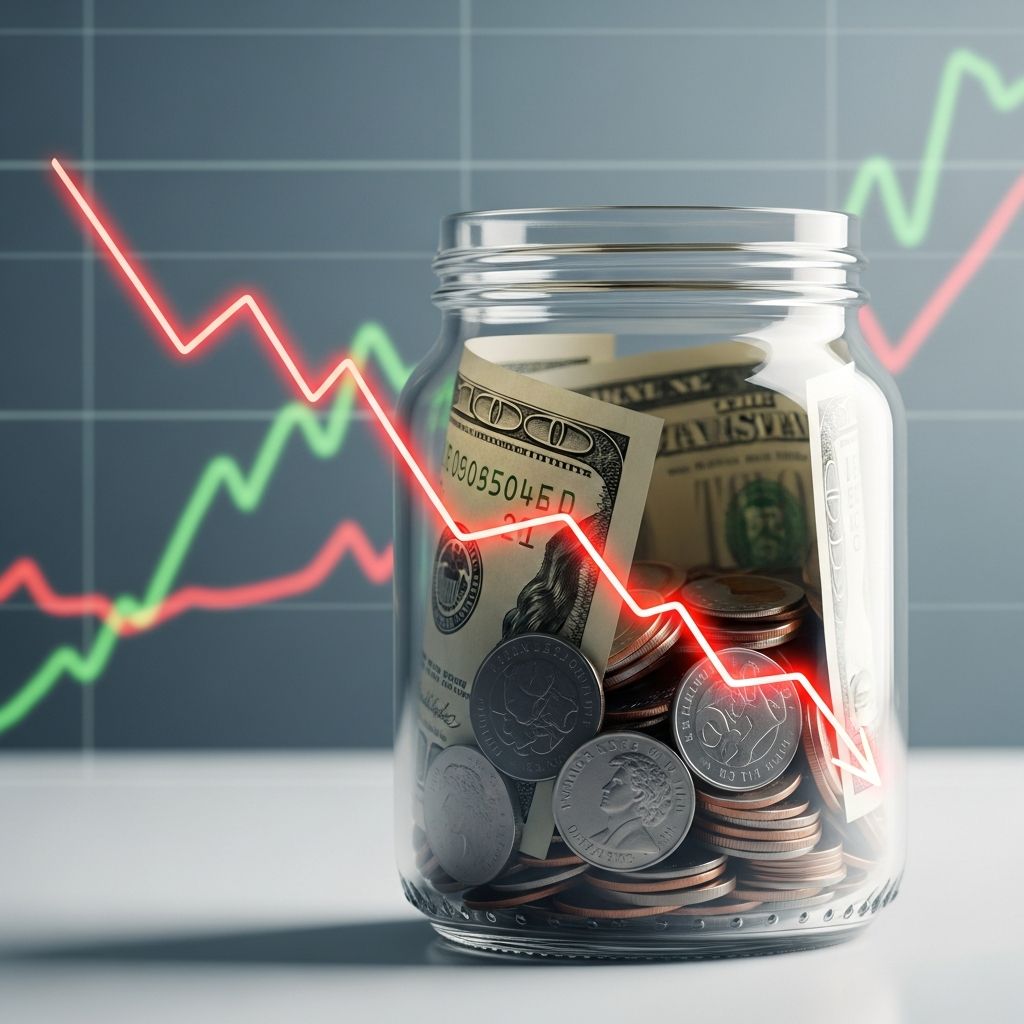
Inflation quietly reduces the value of every dollar you hold, including the money in your savings account. When prices rise faster than the interest you earn, your purchasing power shrinks even if your account balance is growing on paper. Understanding how inflation interacts with savings rates, and how to respond, is essential if you want your cash to keep up with rising costs.
This guide explains how inflation affects savings accounts, what rising or falling rates mean for savers, and what you can do to protect and grow your money over time.
What Is Inflation and Why Does It Matter for Savers?
Inflation is the rate at which the average prices of goods and services increase over time. In the U.S., the most commonly cited measure is the Consumer Price Index (CPI), published monthly by the Bureau of Labor Statistics (BLS). The CPI tracks the cost of a basket of everyday items, such as food, housing, transportation and medical care.
If inflation is 3% over a year, it means that, on average, prices are 3% higher than they were 12 months ago. When your income or savings do not rise at least as fast as inflation, your ability to buy goods and services declines.
How Inflation Erodes Purchasing Power
To see why inflation matters for savings accounts, think in terms of what your money can buy rather than just the number in your account. For example:
- If you keep $10,000 in a savings account that earns 0.4% interest and inflation is 3%, your balance after one year will be about $10,040, but it will buy roughly what $9,709 would have bought a year earlier.
- In real terms, you lost purchasing power even though the account balance went up.
The gap between your savings rate and the inflation rate is the key number to watch.
Nominal vs. Real Return on Your Savings
Your bank statement shows a nominal return – the interest credited to your account before adjusting for inflation. To understand whether your money is truly growing, you must look at the real return, which accounts for inflation.
How to Estimate Real Return
A simple way to approximate your real return is:
Real return ≈ Savings APY − Inflation rate
- If your savings account pays 0.4% and inflation is 2.7%, your real return is approximately −2.3%.
- If a high-yield savings account pays 4.2% and inflation is 2.7%, your real return is about +1.5%.
The second savings option both grows your balance and increases your purchasing power.
| Scenario | APY on Savings | Inflation Rate | Approx. Real Return | Impact on Purchasing Power |
|---|---|---|---|---|
| Traditional savings | 0.40% | 2.70% | −2.30% | Money is losing value |
| High-yield savings | 4.20% | 2.70% | +1.50% | Money grows faster than prices |
How Inflation and Interest Rates Are Connected
Inflation and interest rates are closely linked through the actions of the U.S. Federal Reserve. The Fed’s dual mandate is to promote maximum employment and stable prices. When inflation runs too high, the Fed often raises its benchmark rate, and when inflation cools or growth weakens, it may cut rates.
The Federal Funds Rate and Your Savings Account
The federal funds rate is the interest rate banks charge each other for overnight loans. The Federal Open Market Committee (FOMC) sets a target range for this rate. Changes in the federal funds rate ripple through the economy:
- Higher federal funds rates generally lead to higher rates on loans and, over time, higher yields on savings products.
- Lower federal funds rates typically reduce borrowing costs and often lead to lower yields on savings accounts.
Banks and credit unions adjust the yields on savings accounts, money market accounts, and certificates of deposit (CDs) in response to these shifts, though not always immediately or in lockstep.
What Inflation Means for Different Types of Savings Accounts
Not all savings vehicles respond to inflation and interest-rate moves in the same way. Understanding the differences helps you choose the right account for each financial goal.
Traditional Savings Accounts
Traditional savings accounts at large brick-and-mortar banks often pay very low rates, sometimes close to 0.01% APY in normal conditions, and under 0.5% even when rates are relatively high.
- Pros: High liquidity, simple, widely available, FDIC- or NCUA-insured up to legal limits.
- Cons: Yields frequently fail to keep pace with inflation, leading to a negative real return.
These accounts can work for very short-term needs or as a transaction buffer, but they are rarely optimal for larger balances in an inflationary environment.
High-Yield Online Savings Accounts
High-yield savings accounts (HYSAs), often offered by online banks, typically pay significantly higher rates than traditional savings accounts. When the federal funds rate is elevated, top HYSAs may offer APYs several percentage points above the national average.
- Pros: Higher APYs, low or no monthly fees, FDIC/NCUA insurance, and good flexibility for transfers.
- Cons: Variable rates that can rise or fall as market conditions change; may require online banking comfort.
In periods when inflation is moderate and HYSA rates are strong, these accounts can deliver a positive real return and meaningfully offset price increases.
Money Market Accounts
Money market deposit accounts often blend features of savings and checking, such as limited check-writing or debit access, while sometimes paying competitive yields.
- Pros: Useful for larger balances that may need occasional access; may pay rates similar to HYSAs in some instances.
- Cons: Minimum balance requirements and variable yields that may lag the best online savings accounts.
Certificates of Deposit (CDs)
Certificates of deposit lock in a fixed interest rate for a specific term, such as 3 months, 1 year or 5 years. In 2026, for example, some CDs offer competitive yields similar to or slightly above top HYSAs for certain terms.
- Pros: Guaranteed rate for the term, which can be helpful if you expect rates to fall.
- Cons: Early withdrawal penalties; if inflation rises faster than expected, your fixed rate may lag behind.
CDs can be good for money you are confident you will not need during the term and when you want to lock in a known yield.
Can Savings Accounts Keep Up with Inflation?
Whether your savings keeps pace with inflation depends on the combination of your account’s APY and the prevailing inflation rate.
When Inflation Exceeds Your APY
If your savings APY is below inflation, your real return is negative. For example, the FDIC reports that the average rate on traditional savings accounts is just under 0.40%, while recent inflation has been around 2.7% in early 2026. In this situation:
- Your balance grows slightly, but your money buys less over time.
- Storing large emergency funds or medium-term goals in a very low-yield account can significantly erode purchasing power.
When High-Yield Accounts Narrow the Gap
High-yield accounts and some CDs can narrow or even overcome the inflation gap. For instance, a $40,000 high-yield savings account earning 4.20% APY could generate roughly $1,680 in interest over one year if the rate remained constant, while the same sum in an average savings account would yield only around $156 at 0.39%.
In that scenario, the high-yield account not only grows faster in nominal terms, it may also outpace inflation, depending on the CPI.
Strategies to Protect Your Savings from Inflation
You cannot control inflation, but you can choose where to keep your cash and how to structure your savings. The goal is to preserve liquidity for emergencies while improving your real return where possible.
1. Upgrade to a High-Yield Savings Account
One of the simplest moves is to move cash from a low-rate savings account to a competitive high-yield savings account.
- Compare APYs offered by online banks and credit unions to the national average reported by the FDIC.
- Ensure the institution is FDIC- or NCUA-insured and that your total deposits remain within insurance limits.
Even a difference of a few percentage points can translate into hundreds of dollars in annual interest on a moderate balance.
2. Use a CD Ladder for Part of Your Cash
If you have money you do not need to access immediately, you might consider a CD ladder:
- Divide your savings into equal parts and place them in CDs with staggered maturities (for example, 3, 6, 9 and 12 months).
- As each CD matures, you can either roll it into a new CD or move it back to a high-yield savings account depending on rate trends and your needs.
This approach helps you capture higher fixed rates for part of your savings while preserving periodic access to cash.
3. Segment Savings by Time Horizon
Different goals require different strategies, especially under inflation pressure:
- Short-term (0–1 year): Emergency fund and near-term expenses in high-yield savings or money market accounts for quick access.
- Medium-term (1–5 years): Blend of high-yield savings and CDs, calibrated to when you will need the money.
- Long-term (5+ years): For goals like retirement, consider diversified investments such as stock and bond funds rather than relying on savings accounts alone.
Savings accounts are excellent for safety and liquidity, but they are not designed to deliver high long-term real returns compared to investments.
4. Regularly Review Rates and Inflation
Inflation and interest rates change over time, so the account that made sense last year might not be the best choice today.
- Monitor updates from the Federal Reserve about rate decisions and inflation trends.
- Check your bank’s APY every few months and be prepared to switch if your rate falls well below top offers.
Staying engaged helps you avoid long stretches of low returns that can compound the impact of inflation.
Risks and Trade-Offs to Consider
While moving to higher-yield accounts and CDs can help offset inflation, there are trade-offs to weigh carefully.
- Variable vs. fixed rates: High-yield savings rates are variable and can fall if the Fed cuts rates. CDs offer fixed rates but limit liquidity and may underperform if inflation spikes.
- Liquidity: Emergency funds should remain easily accessible. Do not lock up money you might need quickly solely to chase yield.
- Safety: Focus on FDIC- or NCUA-insured institutions and ensure that balances stay within coverage limits for full protection.
Putting It All Together: A Sample Inflation-Aware Savings Setup
Here is an example of how someone might structure their savings to address inflation while preserving flexibility:
- 3–6 months of essential expenses in a high-yield savings account for emergencies.
- Additional 3–6 months of expenses split between a high-yield savings account and a short CD ladder to improve yield.
- Money for goals 3–5 years out primarily in a mix of high-yield savings and CDs, chosen based on expected need dates.
- Long-term goals funded through investment accounts, while still keeping a solid cash buffer.
This type of structure does not eliminate the impact of inflation, but it reduces the drag by avoiding extremely low-yield accounts and using tools designed to respond better to rate changes.
Frequently Asked Questions (FAQs)
Q: Does inflation always hurt my savings account?
A: Inflation erodes purchasing power, but it does not always mean your savings lose ground. If your savings APY is higher than the inflation rate, your real return is positive and your money is effectively growing faster than prices. Problems arise when your account’s yield is well below inflation for extended periods.
Q: Why do banks pay such different savings rates?
A: Banks set their own deposit rates based on funding needs, business models, and competition. Large brick-and-mortar banks often rely on customer convenience and brand familiarity, so they may offer low rates. Online banks and some credit unions, which have lower overhead costs, may offer substantially higher APYs to attract deposits.
Q: How often should I move my savings to chase better rates?
A: Constantly shifting accounts can be inefficient, but ignoring rates entirely can be costly during inflationary periods. A practical approach is to review your savings accounts at least a few times a year, compare your APYs to national averages and top offers, and make changes when the gap is large enough to matter on your balance.
Q: Are CDs better than savings accounts when inflation is high?
A: CDs can be attractive if they offer a higher rate than savings accounts and you do not need the funds during the term. They also protect you from falling rates by locking in a yield. However, if inflation surprises to the upside and new CDs start paying more, you may be stuck in a lower-rate CD unless you pay an early withdrawal penalty. Many savers use a mix of CDs and high-yield savings to balance these risks.
Q: Should I keep all my money in cash during uncertain times?
A: Keeping an ample emergency fund in cash is important for financial stability, especially in uncertain periods. But holding all long-term savings in cash exposes you to inflation risk and may limit growth. For long-term goals, research from organizations such as the Federal Reserve and major investment providers shows that diversified portfolios of stocks and bonds have historically provided higher real returns than cash over multi-decade periods, albeit with more short-term volatility.
References
- Consumer Price Index Overview — U.S. Bureau of Labor Statistics. 2025-12-12. https://www.bls.gov/cpi/
- National Rates and Rate Caps — Savings — Federal Deposit Insurance Corporation (FDIC). 2025-12-30. https://www.fdic.gov/resources/bankers/national-rates/
- Survey of Professional Forecasters — First Quarter 2026 — Federal Reserve Bank of Philadelphia. 2025-11-15. https://www.philadelphiafed.org/surveys-and-data/real-time-data-research/survey-of-professional-forecasters
- Monetary Policy — Board of Governors of the Federal Reserve System. 2025-10-01. https://www.federalreserve.gov/monetarypolicy.htm
- Understanding Deposit Insurance — Federal Deposit Insurance Corporation (FDIC). 2024-08-20. https://www.fdic.gov/resources/deposit-insurance/
Similar Articles








Read full bio of medha deb