Compound Interest: How It Works And Practical Examples
Unlock the power of compound interest to supercharge your savings and investments for long-term financial growth.

Compound interest is a powerful financial force that can dramatically grow your savings over time or increase the cost of debt if working against you. Unlike simple interest, which only applies to the principal, compound interest earns on both the initial amount and accumulated interest, creating exponential growth.
What Is Compound Interest?
Compound interest is the interest calculated on the initial principal plus all previously accumulated interest. This ‘interest on interest’ effect makes it a cornerstone of wealth building. For instance, a $1,000 deposit at 5% annual interest compounded yearly grows to $1,050 after year one. In year two, interest applies to $1,050, yielding $1,102.50, surpassing simple interest’s linear growth.
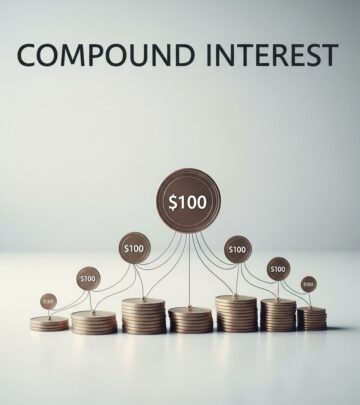
Banks pay compound interest on savings accounts, CDs, and bonds, while lenders charge it on loans and credit cards. The U.S. Securities and Exchange Commission (SEC) highlights its ‘magic’ for young savers: starting with $100 at 5% yields $105 after year one and $110.25 after year two.
Compound Interest vs. Simple Interest
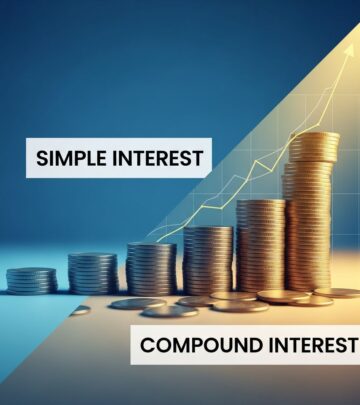
Simple interest is calculated solely on the principal, ignoring prior earnings. For a $6,000 balance at 3.5% over 30 years, simple interest totals $12,300, while compound interest reaches $16,840—a $4,540 difference.
| Year | Simple Interest Balance | Compound Interest Balance |
|---|---|---|
| 1 | $6,210 | $6,210 |
| 10 | $8,100 | $8,464 |
| 30 | $12,300 | $16,840 |
Loans often use simple interest (e.g., auto, student loans), but credit cards compound daily, ballooning balances quickly. Investors favor compound interest for faster growth toward goals like retirement.
How Does Compound Interest Work?
Three key factors drive compound interest: principal, rate, compounding frequency, and time. Higher rates, more frequent compounding (daily vs. annual), and longer periods amplify growth.
- Principal (P): Initial amount invested or borrowed.
- Rate (r): Annual percentage yield (APY) for savers or APR for borrowers.
- Compounding Frequency (n): Times interest applies per year—daily (365) yields more than annually (1).
- Time (t): Years money works, where exponential power shines.
Example: $1,000 at 8% annually. Year 1: $1,080. Year 2: Add $1,000 to $1,080, earn 8% on $2,080 for substantial gains.
Compound Interest Formula
The standard formula is: A = P(1 + r/n)^(nt), where A is final amount, subtract P for interest earned.
- P = Principal
- r = Annual rate (decimal)
- n = Compounding periods per year
- t = Years
Example: $5,000 at 5% compounded monthly (n=12) over 10 years: A = 5000(1 + 0.05/12)^(12*10) ≈ $8,235. Interest: $3,235. Use online calculators or spreadsheets for precision.
Compound Interest Examples
Savings Account: $10,000 at 4% APY compounded monthly grows to $14,802 in 10 years.
CD: $5,000 at 5% for 5 years (annual compounding) = $6,381.
Retirement (401(k)): $200/month at 7% over 30 years = $243,000+ from contributions alone, thanks to compounding.
Debt example: $1,000 credit card balance at 20% APR compounded daily grows to $1,221 in one year if unpaid.
The Power of Compound Interest Over Time
Time is the eighth wonder: $100 at 5% monthly compounding reaches $1,744 in 40 years. Starting early maximizes this—teens investing small amounts can amass fortunes by retirement.
| Age Start | Monthly Contribution | Rate | Balance at 65 |
|---|---|---|---|
| 25 | $100 | 7% | $291,000 |
| 35 | $100 | 7% | $143,000 |
| 45 | $100 | 7% | $67,000 |
Visualize growth: Early compounding dwarfs later large deposits.
Where Compound Interest Works For You
- Savings Accounts/High-Yield Savings: Low risk, FDIC-insured up to $250,000.
- Certificates of Deposit (CDs): Fixed rates, penalties for early withdrawal.
- Money Market Accounts: Check-writing, competitive rates.
- Bonds/Treasuries: Government-backed, predictable compounding.
- Retirement Accounts (IRA, 401(k)): Tax advantages amplify compounding.
- Investments: Stocks/ETFs via compound returns (dividends reinvested).
Where Compound Interest Works Against You
Credit cards (daily compounding at 15-25% APR), payday loans, some mortgages. Minimum payments barely dent principal, extending debt. Pay off high-interest debt first to flip compounding in your favor.
How to Maximize Compound Interest
- Start early and invest consistently (dollar-cost averaging).
- Choose high APY accounts; compare via bankrate.com equivalents.
- Increase contributions annually.
- Reinvest dividends/interest.
- Use tax-advantaged accounts.
- Avoid withdrawals to preserve compounding chain.
Employer matches in 401(k)s provide ‘free’ principal boost.
Frequently Asked Questions (FAQs)
What is the difference between APY and APR?
APY accounts for compounding, showing true earnings. APR does not, often used for loans.
How often is interest compounded?
Daily, monthly, quarterly, or annually—more frequent = faster growth.
Does compound interest apply to investments?
Yes, via compound returns including capital gains/dividends.
Is compound interest guaranteed?
In FDIC-insured accounts/CDs yes; investments carry market risk.
How can I calculate my own compound interest?
Use A = P(1 + r/n)^(nt) or free online calculators from trusted sites.
References
- What Is Compound Interest & How Is It Calculated? — PNC Insights. 2023. https://www.pnc.com/insights/personal-finance/save/what-is-compound-interest.html
- What is compound interest? — Fidelity Investments. 2024-01-10. https://www.fidelity.com/learning-center/trading-investing/compound-interest
- How Does Compound Interest Work? — Securian Financial. 2023. https://www.securian.com/insights-tools/articles/how-compound-interest-works.html
- Simple vs. Compound Interest Explained — Thrivent. 2024. https://www.thrivent.com/insights/investing/simple-vs-compound-interest-explained
- What is compound interest? — Investor.gov (U.S. SEC). 2023-05-15. https://www.investor.gov/additional-resources/information/youth/teachers-classroom-resources/what-compound-interest
Similar Articles








Read full bio of medha deb