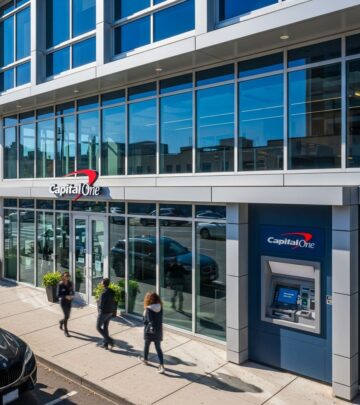
How Does Capital One Make Money? 3 Key Revenue Streams
Explore Capital One's diverse revenue streams and business model strategies.

Capital One Financial Corporation has established itself as one of the largest financial institutions in the United States, with a sophisticated business model that generates substantial revenue through multiple channels. Understanding how Capital One makes money requires examining the company’s diverse revenue streams, business segments, and strategic approach to the financial services industry. The company’s ability to leverage data analytics, technology, and customer relationships has positioned it as a leader in the banking and credit card sectors.
Overview of Capital One’s Business Model
Capital One operates through a multifaceted business model designed to capture value across different customer segments and financial product categories. The company’s mission centers on helping customers succeed by bringing humanity, ingenuity, and simplicity to banking. This philosophy guides the development of products and services that serve diverse market segments, from individual consumers to large commercial enterprises.
The company’s organizational structure comprises three primary business segments: the Credit Card segment, Consumer Banking, and Commercial Banking. Each segment contributes distinctly to the company’s overall revenue and profitability, though the credit card business remains the dominant income driver.
Credit Card Segment: The Primary Revenue Engine
Credit cards represent Capital One’s most significant revenue source, accounting for approximately 65 percent of total company revenue in 2022. This segment includes both consumer and small business credit card offerings across multiple markets, including the United States, Canada, and the United Kingdom. The credit card business generates revenue through various mechanisms that collectively create a substantial income stream.
Interest Income from Credit Cards
The most substantial portion of credit card revenue derives from interest charges on outstanding balances. When customers carry balances on their credit cards, Capital One earns interest income based on the interest rates applied to those balances. The company employs data-driven strategies to determine appropriate interest rates for different customer segments, leveraging machine learning and advanced analytics to assess credit risk and pricing opportunities.
Fee-Based Revenue from Credit Cards
Beyond interest income, Capital One generates significant revenue through various fees associated with credit card services. These fee-based revenue streams include:
- Annual membership fees charged to cardholders
- Late payment fees assessed when customers miss payment deadlines
- Over-limit fees for exceeding credit limits
- Balance transfer fees for moving balances between accounts
- Cash advance fees for obtaining cash using the credit card
- Foreign transaction fees for international purchases
- Interchange fees earned from merchant transactions
These fees collectively contribute billions of dollars to Capital One’s annual revenue and represent a critical component of the credit card business model.
Consumer Banking Segment
The Consumer Banking segment provides Capital One with diversified revenue sources beyond credit cards. This segment encompasses deposit-gathering activities, auto lending, and mortgage services, which collectively account for a meaningful portion of the company’s total revenue and help stabilize earnings across economic cycles.
Deposit Products and Interest Margin
Capital One generates revenue from consumer deposits through interest margin—the difference between the interest rates paid to depositors and the rates earned on loans made using those deposits. Consumer deposits make up over 80 percent of Capital One’s funding base, providing a stable source of capital for lending operations. This deposit base enables the company to offer competitive rates while maintaining profitable spreads on lending activities.
Auto Lending Business
As the largest subprime auto loan lender in the United States, Capital One derives substantial revenue from automobile financing. The auto lending segment encompasses both interest income on loans and various fees associated with origination and servicing. Capital One’s expertise in assessing credit risk through advanced analytics allows the company to profitably serve customers with less-than-perfect credit histories while maintaining appropriate loan loss provisions.
Mortgage Services
Capital One’s mortgage business contributes to revenue through both loan origination activities and ongoing servicing fees. The company generates income from originating mortgages and earns recurring revenue from servicing existing mortgage portfolios, creating multiple revenue touchpoints within this business line.
Commercial Banking Segment
The Commercial Banking segment contributes approximately 20 percent of Capital One’s total revenue and serves middle-market companies, commercial real estate investors, and industrial clients. This segment delivers tailored lending, deposit, and treasury management services designed to meet the complex financial needs of business clients.
Capital One’s commercial banking revenue includes interest income from business loans, deposit fees, and treasury management service charges. The company’s ability to customize financial solutions for specific industries and client needs has enabled it to build a strong commercial banking franchise that generates stable, recurring revenue.
Data Analytics: The Competitive Advantage
A critical differentiator in Capital One’s business model is the company’s pioneering embrace of data analytics and machine learning. Capital One was among the first financial institutions to systematically apply advanced analytics to credit decisions, customer segmentation, and risk management. This data-driven approach has fundamentally shaped how the company operates and generates value.
Capital One’s “Information-Based Strategy” (IBS), initiated by co-founder Rich Fairbank, exemplifies this analytical approach. By segmenting customers into detailed profiles based on credit behavior and other factors, Capital One can tailor credit products and pricing to maximize both customer satisfaction and profitability. According to McKinsey research referenced in industry analyses, businesses leveraging data and analytics in decision-making are 19 times more likely to achieve above-average profitability and 23 times more likely to outperform competitors in customer acquisition.
This analytical capability extends beyond credit decisions to encompass fraud detection, operational efficiency optimization, and customer service personalization. The competitive advantage derived from superior data analytics translates directly into higher profitability and customer loyalty.
Distribution Channels and Customer Engagement
Capital One reaches customers through multiple distribution channels designed to provide convenient access and enhance customer engagement:
- Digital banking platforms and mobile applications
- Physical branch locations in major markets
- Customer service phone lines providing 24/7 support
- Social media platforms for marketing and customer interaction
- Email campaigns for targeted marketing communications
- Online banking portals for account management and transactions
- ATM networks providing convenient cash access
- Financial advisors offering personalized consultation services
These diverse channels enable Capital One to serve customers according to their preferences while gathering additional data that enhances the company’s analytical capabilities.
Revenue Model Monetization Strategies
Capital One employs various monetization strategies beyond simple interest and fee collection. The company utilizes cross-selling techniques to increase revenue from existing customers by offering multiple products and services. Customer loyalty programs encourage retention and increase lifetime value. The company also engages in brokerage activities, wealth management services, and investment management offerings that generate additional fee income from higher-net-worth customers.
Capital One’s approach to private banking for affluent clients creates premium service opportunities and generates wealth management and financial advisory fees. The company’s discount club and membership offerings further diversify revenue sources while creating customer lock-in effects that enhance customer lifetime value.
Cost Structure and Profitability Management
Understanding Capital One’s revenue streams requires equal attention to the company’s cost structure. Major cost categories include loan loss provisions, marketing and advertising expenses, employee salaries and benefits, technology infrastructure development, office and branch leases, regulatory compliance costs, and payment processing fees. The company also incurs significant costs for customer service, data security, fraud prevention, and ongoing training and development.
Capital One’s profitability depends on managing these costs efficiently while maintaining revenue growth. The company’s significant investment in technology infrastructure supports operational efficiency and enables the data analytics capabilities that drive competitive advantage. Strategic cost management, combined with sophisticated revenue optimization, creates the financial performance that makes Capital One attractive to investors.
Secondary Revenue Sources
Beyond the primary business segments, Capital One generates revenue through various secondary sources. Loan origination fees on consumer and commercial loans provide upfront revenue when loans are closed. Merchant processing fees from credit card transaction processing contribute incremental revenue. The company also earns revenue through securitization activities, where credit card receivables are packaged and sold to investors, with Capital One retaining servicing rights and earning servicing fees.
Market Position and Competitive Advantages
Capital One competes against major financial institutions including JPMorgan Chase, Bank of America, Wells Fargo, American Express, and Discover Financial Services. The company’s competitive advantages include strong brand recognition, technological sophistication, analytical capabilities, a diversified product portfolio, and a robust credit card business. These advantages enable Capital One to attract and retain customers while maintaining profitable pricing across its business segments.
Growth Opportunities and Future Revenue Potential
Capital One continues to identify growth opportunities through market expansion, technological innovation, and strategic acquisitions. The company’s expertise in underserved market segments, particularly subprime borrowers, creates opportunities for continued growth. Technological advancement in areas such as artificial intelligence, machine learning, and digital banking platforms creates possibilities for enhanced customer experience and operational efficiency.
Strategic acquisitions enable Capital One to rapidly expand its customer base, product offerings, and geographic reach. The company’s demonstrated ability to integrate acquisitions while maintaining operational efficiency supports continued growth through external expansion.
Frequently Asked Questions
Q: What percentage of Capital One’s revenue comes from credit cards?
A: Credit cards account for approximately 65 percent of Capital One’s total revenue, making it by far the largest revenue generator for the company. This concentration reflects the importance of the credit card business to Capital One’s overall financial performance.
Q: How does Capital One use data analytics in its business?
A: Capital One pioneered the use of advanced data analytics and machine learning in the financial services industry. The company uses these capabilities for credit risk assessment, customer segmentation, pricing optimization, fraud detection, and operational efficiency. This data-driven approach provides competitive advantages in profitability and customer acquisition.
Q: What are Capital One’s main business segments?
A: Capital One operates through three main segments: Credit Cards (65% of revenue), Consumer Banking (including auto loans and mortgages), and Commercial Banking (approximately 20% of revenue). Each segment contributes differently to overall company profitability.
Q: How does Capital One generate revenue beyond interest charges?
A: Capital One generates substantial fee-based revenue from late payment fees, annual membership fees, balance transfer fees, cash advance fees, foreign transaction fees, interchange fees, loan origination fees, and wealth management services. These fees collectively represent a significant portion of total revenue.
Q: What role do consumer deposits play in Capital One’s business model?
A: Consumer deposits comprise over 80 percent of Capital One’s funding base, providing stable capital for lending operations. The company generates revenue from the interest margin between rates paid to depositors and rates earned on loans, creating a profitable banking model.
References
- Capital One Financial’s Business Model Canvas — Vizologi. 2024. https://vizologi.com/business-strategy-canvas/capital-one-financial-business-model-canvas/
- Capital One: Business Model, SWOT Analysis, and Competitors 2024 — Pitchgrade. 2024. https://pitchgrade.com/companies/capital-one
- Research Update: Capital One Financial Corp. — S&P Global Ratings. 2024. https://www.spglobal.com/ratings/en/regulatory/article/-/view/type/HTML/id/3475364
- How Does Capital One Company Work? — SWOT Analysis Example. 2024. https://swotanalysisexample.com/blogs/how-it-works/capitalone-how-it-works
Similar Articles








Read full bio of medha deb