Credit Card APRs: 4 Primary Factors That Determine Your Rate
Uncover the key factors banks use to assign your credit card interest rates and learn strategies to secure lower APRs for smarter borrowing.
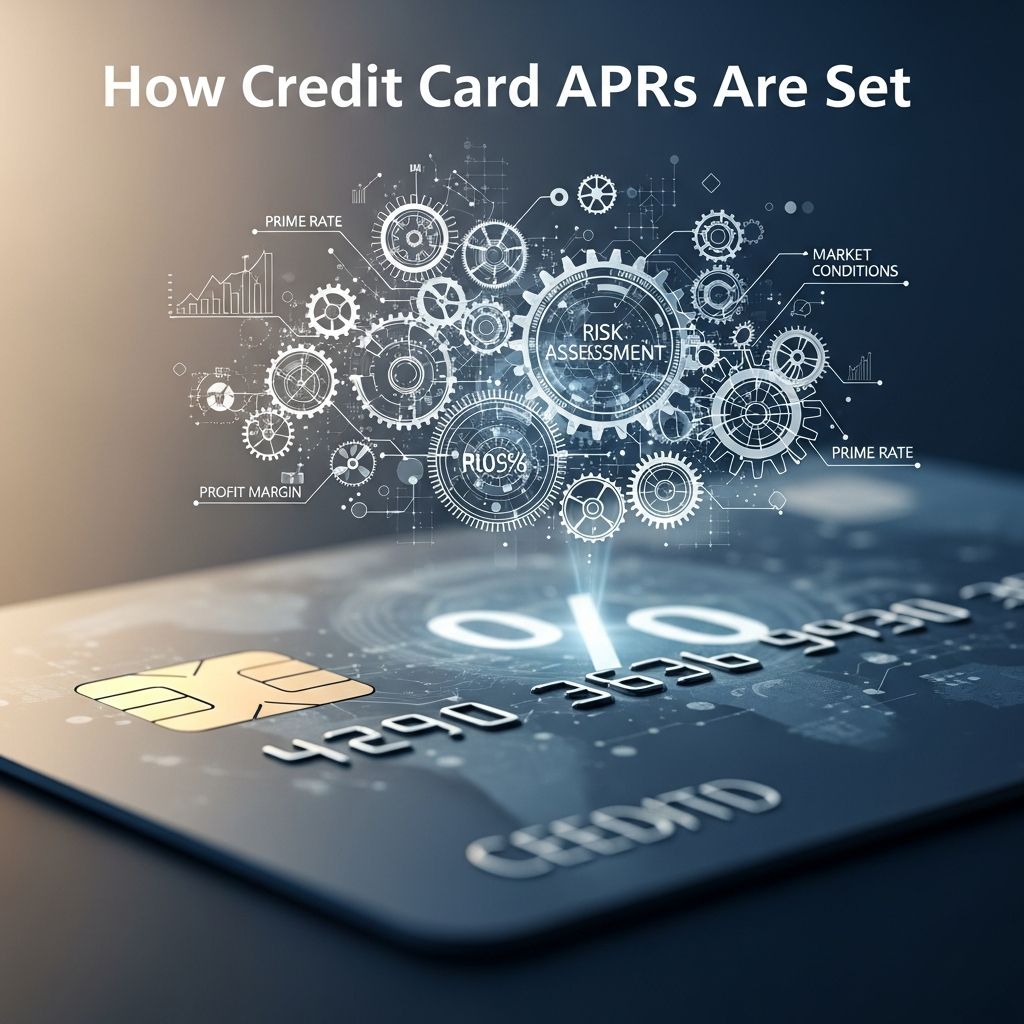
How Credit Card APRs Are Set
Credit card issuers establish
APR
(Annual Percentage Rate) based on a combination of borrower risk assessment, economic benchmarks, and product-specific features. This rate dictates the cost of carrying a balance beyond the grace period.Understanding the Fundamentals of Credit Card APR
The APR quantifies the yearly expense of borrowed funds on a credit card, encompassing interest and sometimes select fees. Unlike simple interest, it’s applied daily to the average daily balance, compounding over time if unpaid. Issuers disclose multiple APRs per card, such as those for purchases, cash advances, or balance transfers, each tailored to transaction risks.
Regulatory mandates require clear APR disclosure in card agreements and statements, enabling comparisons across products. As of recent data, average purchase APRs hover around 20%, though ranges span from under 10% for premium cards to over 30% for high-risk profiles.
Primary Factors Shaping Your Credit Card APR
Issuers employ sophisticated models to assign APRs, prioritizing risk mitigation. Here’s a breakdown of core influencers:
- Credit Score and History: FICO or VantageScore ratings heavily dictate rates. Scores above 740 often secure rates below 15%, while sub-600 scores may exceed 25%. Payment timeliness, debt utilization, and account age refine this assessment.
- Income and Debt-to-Income Ratio: Verified earnings against obligations signal repayment capacity. Higher stable income correlates with lower rates.
- Existing Relationship: Loyal customers with multiple products may receive preferential pricing.
- Credit Utilization: Balances nearing limits (over 30% utilization) prompt higher rates due to perceived risk.
| Credit Score Range | Typical APR Range | Risk Level |
|---|---|---|
| 800+ | 12-15% | Low |
| 740-799 | 15-18% | Moderate |
| 670-739 | 18-22% | Average |
| Below 670 | 22%+ | High |
This table illustrates general correlations; actual rates vary by issuer and market conditions.
Fixed vs. Variable APR: Key Distinctions
Credit cards feature two primary APR structures:
- Fixed APR: Remains constant unless terms are breached, like late payments. Changes require 45 days’ notice. Offers predictability but can still adjust under contract provisions.
- Variable APR: Tied to an index like the U.S. Prime Rate plus a fixed margin (e.g., Prime + 12%). Federal Reserve hikes directly elevate these rates, as seen in recent cycles pushing averages upward.
Most cards use variable rates, exposing users to fluctuations. Promotional APRs, often 0% introductory offers, temporarily override standard rates for 12-21 months on purchases or transfers.
Specialized APR Categories Explained
Beyond standard purchase APRs, cards assign distinct rates:
- Balance Transfer APR: Typically matches or exceeds purchase rates; promotional lows entice debt consolidation.
- Cash Advance APR: Highest tier, often 25%+, with immediate interest accrual sans grace period.
- Penalty APR: Triggers post-late payment or over-limit exceedance, escalating to 29.99%+ until cured, per CARD Act rules.
Statements itemize charges by APR category, aiding transparency.
Step-by-Step Guide to Calculating Credit Card Interest
Interest accrues daily on average daily balances (ADB), calculated as the sum of each day’s balance divided by cycle days. Here’s the process:
- Locate your APR from the statement.
- Compute daily periodic rate (DPR): APR / 365 (or 360 per issuer).
- Multiply DPR by ADB for daily interest.
- Sum over billing cycle days for total charge.
Example: $2,000 ADB, 20% APR, 30-day cycle.
DPR = 0.20 / 365 ≈ 0.000548.
Daily interest = $2,000 × 0.000548 ≈ $1.10.
Monthly total = $1.10 × 30 ≈ $32.96.
For precision, use: Monthly Interest = ADB × (APR/365) × Days.
Market and Economic Influences on APRs
Variable rates track the Prime Rate, set as Federal Funds Rate + 3%. Fed tightening, as in 2022-2023, drove APRs from ~16% to over 20%. Issuer margins (5-20%) buffer profits amid volatility. Cards with rewards carry premiums to offset perks.
Strategies to Secure and Maintain Lower APRs
Proactive steps can optimize rates:
- Boost Credit Score: Pay on time, reduce utilization below 30%, avoid new inquiries.
- Negotiate: Request reductions post-improvements or loyalty; success rates ~50% for strong profiles.
- Shop Competitors: Balance transfer offers with 0% intro APRs consolidate debt cost-effectively.
- Avoid Triggers: Meet minimums to evade penalty APRs; cure within 60 days possible.
- Opt for Fixed if Available: Shields from hikes, though rarer.
Tools like credit monitoring apps track score impacts on potential rates.
Common Pitfalls and How to Avoid High Costs
Grace periods (20-25 days) eliminate interest on timely full payments. Partial pays forfeit this, sparking cycles. High utilization inflates perceived risk, hiking future APRs. Misreading intro offer ends leads to payment shocks. Review agreements annually.
FAQs
What raises my credit card APR suddenly?
Variable changes track prime rate shifts; penalties hit for late payments. Notices precede adjustments.
Does paying interest improve my APR?
No—timely principal payments and low utilization do. Interest is a cost, not a favor.
Is a 15% APR good?
Excellent for average credit; top-tier scores access sub-12%. Compare via issuer tools.
How does APR differ from interest rate?
APR annualizes the effective rate; daily applications make it the practical metric.
Can I remove penalty APR?
Yes, via six on-time payments, reverting to standard rate.
Long-Term Financial Planning with APR Awareness
Mastering APR dynamics empowers debt minimization. Prioritize high-interest payoff via avalanche method, targeting costliest balances first. Pair with budgeting for utilization control. Over time, cultivated creditworthiness unlocks premium cards with perks outweighing rates. Economic vigilance—tracking Fed announcements—anticipates hikes, prompting preemptive action like transfers.
For businesses or high earners, secured cards or charge cards bypass traditional APRs. Always compute total cost: APR × projected balance yields annual expense estimates, guiding decisions.
References
- How to calculate credit card APR charges — Chase Bank. 2023. https://www.chase.com/personal/credit-cards/education/interest-apr/how-to-calculate-credit-card-apr-charges
- Annual Percentage Rate (APR) | Formula + Calculator — Wall Street Prep. 2024. https://www.wallstreetprep.com/knowledge/apr-annual-percentage-rate/
- How Is Credit Card Interest Calculated? — Bankrate. 2025-01-15. https://www.bankrate.com/credit-cards/advice/how-credit-card-interest-is-calculated/
- How Does Credit Card Interest Work? — Santander Bank. 2024. https://www.santanderbank.com/personal/resources/credit-card/how-credit-card-interest-works
- What is APR? Types of APR, How to Calculate & Lower It — Bank of America Better Money Habits. 2024. https://bettermoneyhabits.bankofamerica.com/en/credit/what-is-apr
- Why Is My Credit Card APR So High? — Navy Federal Credit Union. 2025. https://www.navyfederal.org/makingcents/credit-debt/why-is-my-credit-card-apr-high.html
- How APR Works and Your Credit Score Impact — Citizens Bank. 2024. https://www.citizensbank.com/learning/what-is-apr.aspx
Similar Articles








Read full bio of Sneha Tete