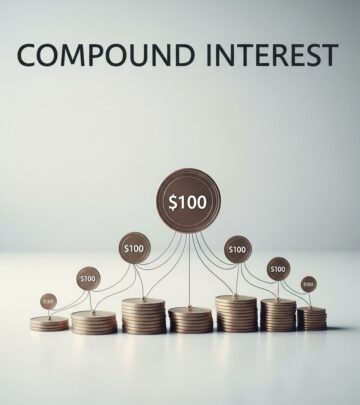
How Compound Interest Works For Your Money
Learn how compound interest grows your savings, why time matters so much, and how to use it to build long-term wealth.

Compound interest is the process where your money earns interest, and then that interest also starts earning interest over time. Instead of growing in a straight line, your balance can grow at an accelerating, almost snowball-like pace when you leave it invested and continue contributing.
Understanding how compound interest works can help you grow your savings, invest for big goals like retirement, and avoid paying more than necessary on debt.
What Is Compound Interest?
Compound interest is interest calculated on both the original amount of money (the principal) and on any interest that has already been added in previous periods. Each time interest is added to your balance, that new, larger balance becomes the base for the next interest calculation.
By contrast, with simple interest, interest is calculated only on the original principal, not on previously earned interest.
Key Features of Compound Interest
- Interest on interest – your earlier earnings generate additional earnings in later periods.
- Exponential growth – the longer the time horizon, the faster the balance tends to grow, assuming a positive return.
- Sensitive to small changes – small differences in rate, time, or contributions can lead to large outcome differences over decades.
Compound Interest vs Simple Interest
| Feature | Simple Interest | Compound Interest |
|---|---|---|
| Calculated on | Original principal only | Principal plus accumulated interest |
| Growth pattern | Linear (straight line) | Exponential (curved, accelerating) |
| Effect over long periods | Moderate increase | Potentially much larger balance |
| Common examples | Certain short-term loans, some bonds | Savings accounts, many investments, credit cards |
How Does Compound Interest Work?
With compound interest, each compounding period (such as monthly or annually), the financial institution or investment calculates interest on your current balance, not just your starting amount. That interest is then added to your balance, creating a new, larger amount for the next calculation.
Basic Example
Suppose you deposit $1,000 into an account earning 5% interest per year, compounded annually.
- After Year 1: You earn 5% of $1,000 = $50, so your balance is $1,050.
- After Year 2: You earn 5% of $1,050 = $52.50, so your balance is $1,102.50.
- After Year 3: You earn 5% of $1,102.50 = $55.13, so your balance is $1,157.63.
Each year, the dollar amount of interest increases because it is calculated on a higher balance.
The Compound Interest Formula
The standard compound interest formula is:
A = P(1 + r/n)^(n × t)
- A = the amount of money after compounding
- P = the principal, or starting amount
- r = annual interest rate (in decimal form)
- n = number of times interest is compounded per year
- t = number of years the money is invested or borrowed
This formula helps you compare savings accounts, investments, and loans by showing how different compounding frequencies and interest rates affect long-term outcomes.
Key Factors That Affect Compound Interest
Several variables have a large impact on how much your money can grow (or how much a debt can cost) when compound interest is involved.
1. Interest Rate
The interest rate is the percentage applied to your balance each compounding period. Even small differences in interest rate can significantly change your final amount over many years.
- Higher rates accelerate growth (or increase cost on debt).
- Lower rates mean slower growth but may be safer or cheaper, depending on context.
2. Time Horizon
The length of time you keep money invested or borrowed is one of the most powerful drivers of compounding. Money that compounds for decades can grow far more than money that compounds for only a few years, even if the initial contributions are the same.
- Starting early gives your money more time to benefit from compounding.
- Time can be more important than the amount you contribute early on.
3. Compounding Frequency
Compounding frequency describes how often interest is added to your balance.
- Annually – once per year
- Semiannually – twice per year
- Quarterly – four times per year
- Monthly – twelve times per year
- Daily – 365 times per year for many banks
More frequent compounding usually leads to a somewhat larger final balance, all else equal.
4. Contributions and Withdrawals
The way you add or remove money also affects compounding:
- Regular contributions boost the balance that is compounding, increasing long-term growth.
- Withdrawals reduce the amount that can earn future interest, slowing growth.
Examples of Compound Interest in Real Life
Compound interest appears in both positive and negative ways in everyday finances, from savings accounts to credit cards.
Compound Interest Working For You
- Savings accounts and CDs – Many bank products pay compound interest, allowing your savings to gradually grow.
- Retirement accounts – Investments in retirement plans, such as employer-sponsored plans or IRAs, may grow through market returns that compound over time.
- Reinvested dividends – When dividends and interest are reinvested, they can generate additional earnings in future periods, increasing compounding.
Compound Interest Working Against You
- Credit cards – If you carry a balance, interest can be charged on your previous balance plus any unpaid interest, causing debt to grow if only minimum payments are made.
- High-interest loans – Some personal loans and other credit products use compounding, making borrowing more expensive over time.
The Power of Starting Early
Because of the exponential nature of compounding, the earlier you begin saving and investing, the more powerful the effect can be. Even modest contributions at a young age can grow into substantial amounts later in life.
Illustrative Scenario
Consider two savers who both earn the same average annual return and contribute the same total amount over time, but one starts earlier than the other. Research examples in retirement planning show that the person who starts earlier can end up with a significantly larger balance, even if they stop contributing sooner.
This difference is due purely to time in the market and the additional years of compounding available to the early saver.
Why Time Matters More Than Timing
- Perfectly timing the market is extremely difficult; consistently investing over time is more realistic.
- Longer time horizons allow your investments to recover from market downturns and continue compounding.
- Starting early reduces the monthly amount you may need to invest to reach a given goal.
Using Compound Interest to Build Wealth
When you understand compound interest, you can intentionally structure your finances to let it work in your favor. This generally means saving regularly, investing for long-term goals, and minimizing high-interest debt.
Strategies To Harness Compound Interest
- Save consistently – Set up automatic transfers into savings or investment accounts so your balance grows without relying on willpower.
- Invest for growth – For long-term goals, consider diversified investments that have historically offered higher returns than basic savings, understanding that higher potential returns typically come with higher risk.
- Reinvest earnings – Whenever possible, reinvest dividends, interest, and capital gains so they can generate additional returns.
- Avoid unnecessary withdrawals – Keeping money invested for longer allows compounding to work more effectively.
- Pay down high-interest debt – Reducing expensive debt removes the negative impact of compounding interest charges on your finances.
Common Myths About Compound Interest
Several misconceptions can keep people from using compound interest effectively.
Myth 1: You Need a Lot of Money to Benefit
Even small, regular contributions can grow significantly over long periods thanks to compounding. Time and consistency often matter more than starting with a large lump sum.
Myth 2: Only Older or Wealthy People Invest
Compound interest can be especially powerful for younger people because they have more time. Starting with small amounts early can potentially yield more than starting with larger amounts much later.
Myth 3: Compounding Is Too Complicated To Use
While the math can look complex, the concept is straightforward: keep money invested, add to it over time, and let earnings generate further earnings. Many banks, brokerages, and government resources offer calculators to help you project growth based on different assumptions.
How To Estimate Compound Growth
Besides the exact formula, there are simple mental tools you can use to get a rough sense of how compound interest may affect your money.
The Rule of 72 (Approximation Tool)
The “Rule of 72” is a quick way to estimate how many years it might take for money to double at a fixed annual rate of return. You divide 72 by the annual interest rate (expressed as a whole number, not a decimal).
- At 6% per year, money may double in about 12 years (72 ÷ 6).
- At 8% per year, money may double in about 9 years (72 ÷ 8).
This rule is an approximation, not a precise calculation, but it highlights how higher rates can dramatically shorten the time required for money to double.
Practical Tips To Make Compound Interest Work For You
To take full advantage of compound interest, align your daily financial habits with your long-term goals.
- Start as early as you can – Even if you can only invest small amounts, begin as soon as possible to gain more compounding years.
- Increase contributions over time – As your income grows, raise your savings or investment rate to accelerate growth.
- Automate your finances – Automatic deposits and investment contributions help ensure consistent investing.
- Limit high-interest debt – Paying off or avoiding high-interest debt frees up more money to invest and prevents compounding from working against you.
- Review periodically – Check your progress and adjust contributions as your goals or circumstances change.
Frequently Asked Questions (FAQs)
Q: What is the simplest way to understand compound interest?
A: Think of compound interest as interest earning more interest. Once interest is added to your balance, that larger balance becomes the starting point for the next interest calculation, causing growth to accelerate over time.
Q: How often is interest usually compounded on savings accounts?
A: Many savings accounts compound interest monthly or daily, although the exact frequency depends on the bank and the specific product. The more frequent the compounding, the more total interest your money may earn, assuming the same nominal rate.
Q: Why does starting to invest early matter so much?
A: Starting early gives your money more years to experience compounding. Research examples in retirement planning show that early savers can end up with much larger balances than later starters, even when they contribute the same total amount, because of the extra time their money spends growing.
Q: Can compound interest make my debts grow faster?
A: Yes. When debt carries compound interest, the unpaid interest can be added to your balance, and future interest is then calculated on that higher amount. This is especially common with revolving credit like credit cards, which can become costly if balances are not paid down.
Q: How can I calculate compound interest on my own?
A: You can use the formula A = P(1 + r/n)^(n × t), where P is the starting amount, r is the annual interest rate in decimal form, n is the number of compounding periods per year, and t is the number of years. Many reputable financial institutions and government sites also offer free, step-by-step compound interest calculators.
References
- What Is Compound Interest? — U.S. Securities and Exchange Commission, Investor.gov. 2024-03-15. https://www.investor.gov/additional-resources/information/youth/teachers-classroom-resources/what-compound-interest
- What Is Compound Interest & How Is It Calculated? — PNC Bank. 2023-08-10. https://www.pnc.com/insights/personal-finance/save/what-is-compound-interest.html
- How To Calculate Compound Interest — Citizens Bank. 2023-05-01. https://www.citizensbank.com/learning/how-to-calculate-compound-interest.aspx
- How Does Compound Interest Work? — Securian Financial. 2022-11-02. https://www.securian.com/insights-tools/articles/how-compound-interest-works.html
- These Two Examples Illustrate the Magic of Compound Interest — HerMoney Media. 2022-06-21. https://hermoney.com/invest/retirement/these-two-examples-illustrate-the-magic-of-compound-interest/
- Solving Compound Interest Problems — Dawid Tarłowski, Jagiellonian University. 2019-01-01. http://www2.im.uj.edu.pl/DawidTarlowski/finance.pdf
Similar Articles








Read full bio of medha deb