How Compound Interest Works For Your Money
Learn what compound interest is, how it grows your money faster over time, and how to use it to build long-term wealth.

Compound interest is one of the most powerful forces in personal finance. When you understand how it works and how to apply it, you can use it to build savings, grow investments, and reach long-term goals faster.
At the same time, compound interest can work against you when it comes to high-interest debt, making balances grow quickly if you only make minimum payments.
This guide walks you through what compound interest is, how it’s calculated, why it accelerates growth over time, and practical ways to use it to your advantage.
What Is Compound Interest?
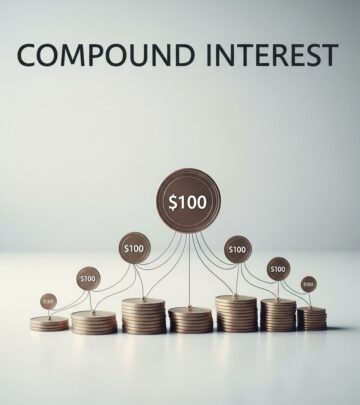
Compound interest is interest calculated not only on your original amount (the principal) but also on the interest that has already been added in previous periods. In simple terms, it is “interest earning interest.”
By contrast, simple interest is calculated only on the original principal, so the interest amount stays the same each period.
Simple vs. Compound Interest
| Feature | Simple Interest | Compound Interest |
|---|---|---|
| What interest is based on | Only the original principal | Principal + accumulated interest |
| Growth pattern | Linear (straight line) | Exponential (curves upward over time) |
| Common examples | Some short-term loans, basic calculations | Savings accounts, CDs, credit cards, many investments |
| Effect over long periods | Slower growth or cost | Much faster growth or cost, depending on whether you are earning or paying it |
Because compound interest builds on itself, even small amounts invested consistently can grow significantly over long periods.
How Does Compound Interest Work?
To see compound interest in action, imagine you deposit money into an account that pays interest and leaves the earnings in the account. Each time interest is added, the base on which future interest is calculated gets bigger.
Basic Example
Suppose you deposit $1,000 in an account that earns 5% interest per year, compounded annually (once per year):
- After 1 year: Interest = 5% of $1,000 = $50. New balance = $1,050.
- After 2 years: Interest = 5% of $1,050 = $52.50. New balance = $1,102.50.
- After 3 years: Interest = 5% of $1,102.50 = $55.13. New balance ≈ $1,157.63.
Each year, the amount of interest gets a little larger because you are earning interest on a bigger balance.
The Compound Interest Formula
Mathematically, compound interest is often expressed with this formula:
A = P(1 + r/n)^(n t)
- A = the amount of money in the account after interest
- P = the initial principal (starting amount)
- r = annual interest rate (as a decimal)
- n = number of compounding periods per year (for example, 12 for monthly)
- t = time in years the money is invested or borrowed
You can use this formula to estimate how much your savings or loan balance might grow over a certain period at a given interest rate and compounding frequency.
Key Factors That Affect Compound Interest
Three main factors determine how quickly compound interest grows your balance over time:
- Interest rate
- Compounding frequency
- Time
1. Interest Rate
The interest rate sets the pace of growth. A higher rate means more interest added each time interest is calculated. Even seemingly small rate differences can create large differences over decades.
For example, over long periods, an investment earning 7% annually can grow to roughly twice as much as one earning about 3.5%, assuming the same time horizon and compounding.
2. Compounding Frequency
Compounding frequency is how often the interest is calculated and added to the balance. Common options include:
- Annually (once per year)
- Semiannually (twice per year)
- Quarterly (four times per year)
- Monthly (12 times per year)
- Daily (365 times per year)
The more often interest is compounded, the slightly faster the balance can grow, because interest is added and then itself begins earning interest more frequently.
3. Time
Time is the most powerful factor. The longer your money stays invested, the more opportunities there are for interest to build on itself.
Starting earlier gives compound interest more years to work, even if your monthly contributions are modest. This is why consistent investing when you are younger is often emphasized for retirement planning.
Real-Life Examples Of Compound Interest
Here are a few practical ways compound interest shows up in everyday financial life.
1. Savings Accounts And CDs
Many bank savings accounts and certificates of deposit (CDs) use compound interest. For example, if you deposit $5,000 into a savings account with a 5% annual interest rate, compounded monthly, and leave it for 10 years, you could earn more than $3,000 in interest over that period, depending on the exact terms and fees.
Online calculators from regulated financial institutions can help you see how different rates and time frames affect your total balance.
2. Investing For Long-Term Goals
Investment accounts, such as retirement accounts invested in diversified stock and bond funds, can also benefit from compounding. Historically, broad equity markets have provided average positive returns over long periods, although returns can vary significantly from year to year and are not guaranteed.
When dividends, interest, and capital gains are reinvested rather than withdrawn, they generate additional earnings, allowing your investments to grow over decades.
3. Credit Cards And Loans
Compound interest is not always a benefit. Many credit cards and some loans use compounding so that if you carry a balance and only make the minimum payments, the total amount you owe can grow quickly. This happens because interest is regularly added to your balance, and then new interest is charged on the larger amount.
Understanding this can motivate you to pay off high-interest debt more aggressively to prevent compound interest from increasing what you owe.
The Power Of Starting Early
One major lesson from compound interest is that starting early often matters more than investing larger amounts later. Time allows your contributions and the returns on those contributions to grow on top of one another.
- When you invest in your 20s or 30s, you can benefit from multiple decades of compounding.
- If you start later, you may need to save more each month or aim for higher returns to reach the same goal.
Financial education resources often show side-by-side examples of two people investing the same total amount but starting at different ages, with the earlier saver ending up with a much larger balance at retirement because their money had more time to grow.
Using Compound Interest To Build Wealth
Compound interest itself is a mathematical principle, but the way you apply it in your financial life is what turns it into a wealth-building tool. Here are practical ways to put it to work:
1. Save And Invest Consistently
Regular contributions, even small ones, can grow significantly over time when combined with compounding:
- Set up automatic transfers to savings or investment accounts.
- Use workplace retirement plans if available, particularly when employer matching contributions are offered.
- Increase your contributions gradually as your income grows.
2. Reinvest Earnings
To fully benefit from compounding, avoid withdrawing interest, dividends, and gains when you are in your accumulation years. Instead, allow those earnings to stay invested so they can generate their own earnings.
3. Give Your Money Time
The longer your money remains invested, the more powerful compounding becomes. This means:
- Invest with a long-term perspective for goals such as retirement or education.
- Avoid interrupting compounding by frequently moving in and out of investments for short-term reasons.
4. Control High-Interest Debt
Because compound interest can rapidly increase what you owe on high-interest debt, consider strategies like:
- Paying more than the minimum on credit cards.
- Prioritizing repayment of debts with the highest interest rates.
- Avoiding new high-interest borrowing when possible.
FAQs About Compound Interest
Q: Why is compound interest considered so powerful?
A: Compound interest is powerful because it creates exponential growth. Over long periods, the interest you earn itself generates additional interest, which can lead to much larger balances than simple interest, especially when combined with regular contributions and time.
Q: How often should interest be compounded to get the best growth?
A: More frequent compounding (such as monthly or daily) can increase growth slightly compared with annual compounding at the same stated rate. However, over long periods, the main drivers of growth are the interest rate, the amount you invest, and how long you leave the money invested.
Q: Does compound interest guarantee I will reach my financial goals?
A: Compound interest is a tool, not a guarantee. For savings accounts and fixed-rate products, your interest rate and compounding rules are typically defined in advance. For market-based investments, returns can fluctuate from year to year, and there is always a risk of loss. Using realistic assumptions and regularly reviewing your plan can help you stay on track.
Q: How can I estimate how long it will take my money to double?
A: A common shortcut is the “rule of 72,” which divides 72 by the annual interest rate (as a whole number) to estimate the number of years it might take for money to double under compound growth. For instance, at an annual rate of about 6%, it would take roughly 12 years (72 ÷ 6 ≈ 12). This is a rough rule of thumb, not a precise calculation.
Q: Is compound interest taxed?
A: In many cases, interest from savings accounts, CDs, and certain investments is taxable in the year it is earned, even if you leave it in the account. Tax-advantaged accounts, such as some retirement accounts, may allow earnings to grow tax-deferred or, in some cases, tax-free. Specific tax treatment depends on your local laws and account type, so consulting official tax guidance or a qualified professional is important.
References
- What is compound interest? — U.S. Securities and Exchange Commission, Investor.gov. 2023-05-16. https://www.investor.gov/additional-resources/information/youth/teachers-classroom-resources/what-compound-interest
- What Is Compound Interest & How Is It Calculated? — PNC Bank. 2024-01-10. https://www.pnc.com/insights/personal-finance/save/what-is-compound-interest.html
- These Two Examples Illustrate the Magic of Compound Interest — HerMoney. 2023-02-21. https://hermoney.com/invest/retirement/these-two-examples-illustrate-the-magic-of-compound-interest/
- How Does Compound Interest Work? — Securian Financial. 2022-11-03. https://www.securian.com/insights-tools/articles/how-compound-interest-works.html
- How To Calculate Compound Interest — Citizens Bank. 2023-07-12. https://www.citizensbank.com/learning/how-to-calculate-compound-interest.aspx
- Compound interest introduction — Khan Academy. 2015-09-01. https://www.khanacademy.org/economics-finance-domain/core-finance/interest-tutorial/compound-interest-tutorial/v/introduction-to-compound-interest
- Solving Compound Interest Problems — Dawid Tarłowski, Jagiellonian University. 2018-01-01. http://www2.im.uj.edu.pl/DawidTarlowski/finance.pdf
Similar Articles








Read full bio of medha deb