How Bitcoin Mining Works: Process, Rewards, and Hardware
Understand Bitcoin mining: blockchain validation, proof-of-work, rewards, and mining hardware requirements.
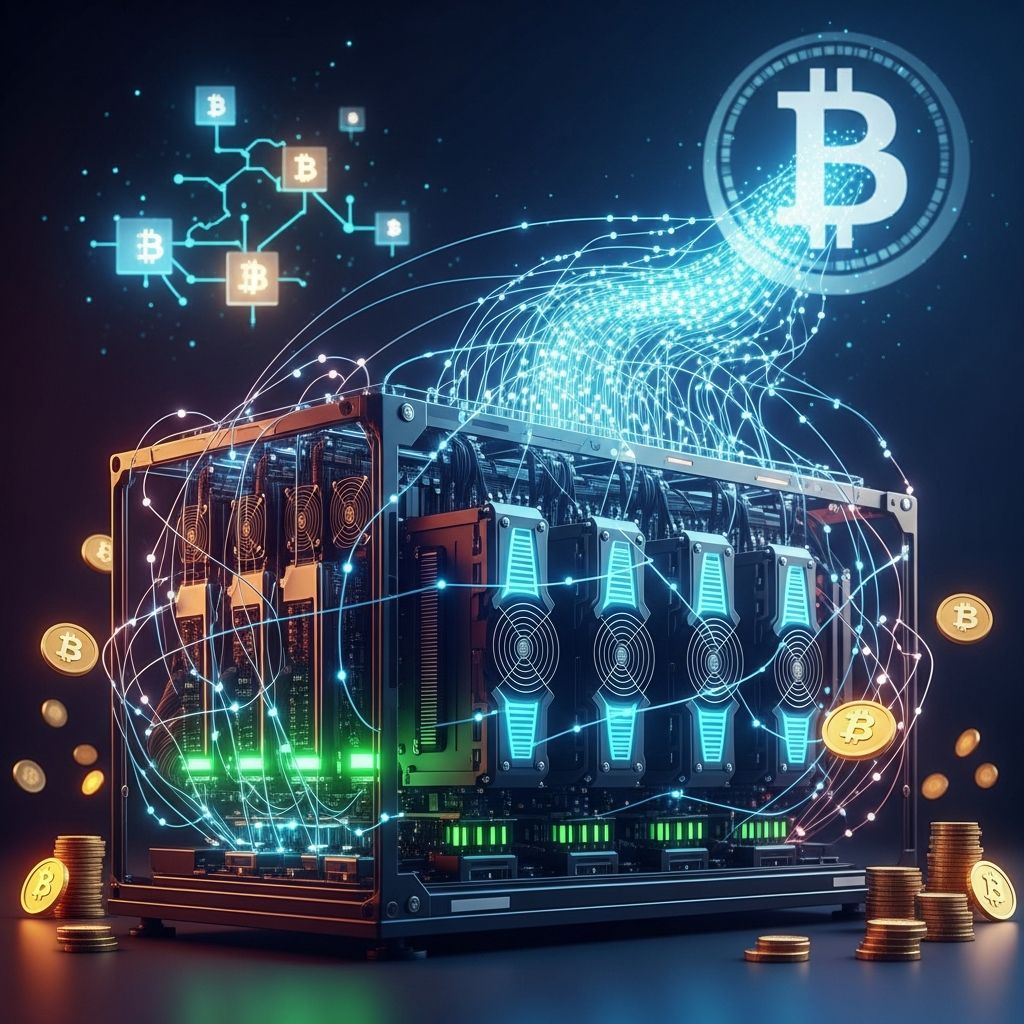
Bitcoin mining is a fundamental process that keeps the Bitcoin network secure, validates transactions, and introduces new bitcoins into circulation. Despite its complex technical nature, understanding the basics of Bitcoin mining is essential for anyone interested in cryptocurrency. This guide explains how Bitcoin mining works, the technology behind it, mining rewards, and the equipment required to participate in this competitive industry.
What Is Bitcoin Mining?
Bitcoin mining is the process by which new transactions are validated and added to the Bitcoin blockchain, while simultaneously creating new bitcoins as a reward for miners. Unlike traditional currency creation by central banks, Bitcoin relies on a decentralized network of miners who compete to solve complex mathematical puzzles. When a miner successfully solves a puzzle and validates a block of transactions, they receive newly created bitcoins plus transaction fees.
Mining serves dual purposes in the Bitcoin ecosystem:
- Transaction Validation: Miners verify that transactions are legitimate and haven’t been previously spent (preventing double-spending)
- Network Security: The computational difficulty of mining makes it economically impractical for bad actors to alter the blockchain
- New Coin Generation: Miners earn new bitcoins through the block reward, which gradually decreases over time
Understanding Proof-of-Work
Bitcoin mining operates on a consensus mechanism called Proof-of-Work (PoW). This system requires miners to expend computational resources to validate transactions and maintain the network. Proof-of-Work ensures that each participant must invest real-world resources (electricity and hardware) to participate, making the network resistant to attacks.
In Proof-of-Work, miners compete to solve a cryptographic puzzle by performing billions of calculations. The first miner to solve the puzzle gets to add the next block of transactions to the blockchain and receives the corresponding reward. This competition ensures that no single entity can control the network, as they would need to control more than 50% of the total computing power—an economically prohibitive feat.
The Bitcoin Mining Process: Step-by-Step
The Bitcoin mining process involves several key steps:
1. Transaction Collection
When a Bitcoin user initiates a transaction, it is broadcast to the network and placed in a memory pool (mempool). Miners select transactions from this pool to include in their candidate block. Typically, miners prioritize transactions with higher fees to maximize their earnings.
2. Creating the Block Header
Miners gather selected transactions and create a block that includes:
- A reference to the previous block (creating the chain)
- A timestamp of when the block was created
- A Merkle root (a hash representing all transactions in the block)
- A nonce (a number used only once, which miners modify to solve the puzzle)
- A difficulty target
3. Solving the Cryptographic Puzzle
Miners attempt to find a nonce value that, when combined with the block header and hashed using the SHA-256 algorithm, produces a result that meets the network’s difficulty target. This requires testing countless nonce values through trial and error. The first miner to find a valid nonce broadcasts their solved block to the network.
4. Block Validation
Other network nodes verify that the solved block is valid according to Bitcoin’s rules. If the block is valid, it is added to the blockchain, and other miners begin working on the next block.
5. Reward Distribution
The winning miner receives a block reward consisting of newly created bitcoins plus transaction fees from all transactions included in the block.
Mining Difficulty and Adjustment
The Bitcoin network automatically adjusts mining difficulty every 2,016 blocks (approximately every two weeks) to maintain a consistent block time of approximately 10 minutes. This adjustment is crucial for several reasons:
- Network Stability: Maintains predictable transaction confirmation times regardless of total network mining power
- Supply Consistency: Ensures new bitcoins are created at a predictable rate
- Security: As hardware improves, increased difficulty maintains the computational barrier against attacks
When more miners join the network or use more powerful hardware, mining difficulty increases. Conversely, if miners leave or older hardware becomes obsolete, difficulty decreases. This self-adjusting mechanism is fundamental to Bitcoin’s resilience and long-term viability.
Mining Rewards and the Bitcoin Halving
Miners earn rewards through two mechanisms:
Block Reward
Each time a miner successfully validates a block, they receive a predetermined amount of newly created bitcoins. This reward started at 50 bitcoins per block and is programmed to halve approximately every four years (every 210,000 blocks).
The halving schedule works as follows:
- 2009-2012: 50 BTC per block
- 2012-2016: 25 BTC per block
- 2016-2020: 12.5 BTC per block
- 2020-2024: 6.25 BTC per block
- 2024 onwards: 3.125 BTC per block
This halving mechanism ensures that the total supply of Bitcoin will never exceed 21 million coins, creating a built-in deflationary model.
Transaction Fees
In addition to the block reward, miners collect transaction fees from every transaction included in their block. As the block reward diminishes with each halving, transaction fees become increasingly important for mining profitability and incentivizing network participation.
Mining Hardware and Equipment
Bitcoin mining has evolved dramatically since the network’s inception. Early miners used standard computer CPUs, but mining has become increasingly specialized and energy-intensive.
Evolution of Mining Hardware
CPU Mining: In Bitcoin’s early years, mining could be performed on personal computers using standard processors. However, the increasing difficulty made CPU mining obsolete within several years.
GPU Mining: Graphics Processing Units (GPUs) offered significantly better performance than CPUs for mining. Miners utilized graphics cards to increase computational power and mining efficiency. GPUs remained viable for a few years before being superseded by specialized hardware.
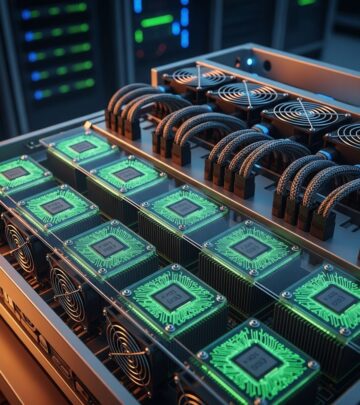
ASIC Mining: Application-Specific Integrated Circuits (ASICs) are computers specifically designed and optimized exclusively for Bitcoin mining. ASICs deliver dramatically superior hash rates compared to GPUs while consuming less electricity per hash. Modern ASIC miners are thousands of times more powerful than early GPU rigs.
Current ASIC Technology
Contemporary Bitcoin mining relies almost exclusively on ASIC hardware. Leading manufacturers include Bitmain (Antminer series), Canaan (Avalon series), and MicroBT (Whatsminer series). These devices range from smaller units for hobbyist miners to massive industrial-grade machines for large mining operations.
Key specifications for modern ASIC miners include:
- Hash Rate: Measured in terahashes per second (TH/s), indicating computational power
- Power Consumption: Typically measured in watts, directly affecting profitability through electricity costs
- Efficiency Ratio: Hash rate per watt of power consumed, a critical profitability metric
- Price: Initial hardware investment, which can range from hundreds to thousands of dollars
Mining Pools
Individual mining has become increasingly impractical for most participants due to the astronomical difficulty of solving blocks independently. Mining pools allow multiple miners to combine their computational resources and share rewards based on contributed computing power.
In a mining pool, participants:
- Combine hash power with other miners to increase collective probability of finding blocks
- Receive proportional rewards based on shares contributed to the pool
- Pay pool operators a percentage fee (typically 1-5%) for coordinating and distributing rewards
- Enjoy more consistent and predictable income compared to solo mining
Major mining pools control significant portions of the network hash rate, creating concerns about centralization. However, miners can switch pools relatively easily, distributing power across different operators.
Mining Profitability and Economics
Bitcoin mining profitability depends on several interconnected factors:
Key Profitability Variables
- Bitcoin Price: Higher prices increase reward value; lower prices may make mining unprofitable
- Mining Difficulty: Increased difficulty reduces per-miner rewards
- Electricity Costs: The single largest operating expense for miners; varies significantly by geographic region
- Hardware Efficiency: Newer, more efficient ASIC models provide advantages over outdated equipment
- Hardware Cost: Initial capital investment in ASIC miners
- Pool Fees: Percentage charged by mining pools
Profitable mining typically requires access to cheap electricity, usually available in regions with abundant hydroelectric power, geothermal energy, or natural gas. Many mining operations locate in Iceland, Canada, El Salvador, Kazakhstan, and other regions with low energy costs.
Environmental Considerations
Bitcoin mining consumes substantial quantities of electricity, raising environmental concerns. The network’s total energy consumption has grown significantly alongside Bitcoin’s value and adoption. However, the proportion of renewable energy used in Bitcoin mining has increased substantially, with some estimates suggesting 40-50% of mining power comes from renewable sources.
The environmental debate continues as the technology evolves, with developers exploring more energy-efficient consensus mechanisms for future cryptocurrency networks.
Frequently Asked Questions
Q: Can I mine Bitcoin with my personal computer?
A: In Bitcoin’s early years, yes, but today it is virtually impossible. Current mining difficulty and ASIC specialization make personal computers thousands of times too slow to mine profitably. You would spend far more on electricity than you would earn in bitcoins.
Q: How long does it take to mine one Bitcoin?
A: This varies dramatically based on hardware power and difficulty. Solo mining could take years or even decades for individual miners. In mining pools, participants might receive fractional bitcoin rewards weekly or daily, but acquiring a full bitcoin depends on their hash rate contribution.
Q: What happens when all bitcoins are mined?
A: When the 21 millionth bitcoin is mined (estimated around 2140), the block reward becomes zero. Miners will earn income exclusively from transaction fees. This transition incentivizes continued network participation and transaction validation.
Q: Is Bitcoin mining legal?
A: Bitcoin mining is legal in most countries, including the United States and European nations. However, regulations vary by jurisdiction. Some countries have restricted or banned cryptocurrency mining, so checking local regulations before beginning is essential.
Q: What is the difference between mining and validating?
A: Mining involves solving computational puzzles to validate new blocks and earn rewards. Validating refers to checking transactions and blocks according to Bitcoin’s rules. All miners validate transactions, but not all network participants mine.
Q: Can mining attacks compromise Bitcoin security?
A: A 51% attack, where an entity controls over half the network’s hash rate, could theoretically compromise Bitcoin. However, the immense cost of acquiring and operating this computing power makes such attacks economically irrational. Bitcoin’s security depends on this economic incentive structure.
References
- Bitcoin: A Peer-to-Peer Electronic Cash System — Satoshi Nakamoto. 2008-10-31. https://bitcoin.org/bitcoin.pdf
- Understanding Bitcoin Mining — Bitcoin.org. Accessed 2025-11-29. https://bitcoin.org/en/how-it-works
- The Complete Beginner’s Guide to Mining Bitcoin — CoinDesk. 2024. https://www.coindesk.com/learn/bitcoin-mining-explained
- Bitcoin Network Hashrate and Difficulty Statistics — Blockchain.com. 2025-11-29. https://www.blockchain.com/explorer/charts/hash-rate
- ASIC Miners and Mining Economics — U.S. Commodity Futures Trading Commission (CFTC). 2023. https://www.cftc.gov/
- Renewable Energy and Bitcoin Mining Sustainability — International Energy Agency (IEA). 2024. https://www.iea.org/
Similar Articles








Read full bio of medha deb