How 401(k) Matching Works (And How To Maximize It)
Learn how 401(k) employer matching works, why it’s often called free money, and how to use it to accelerate your retirement savings.
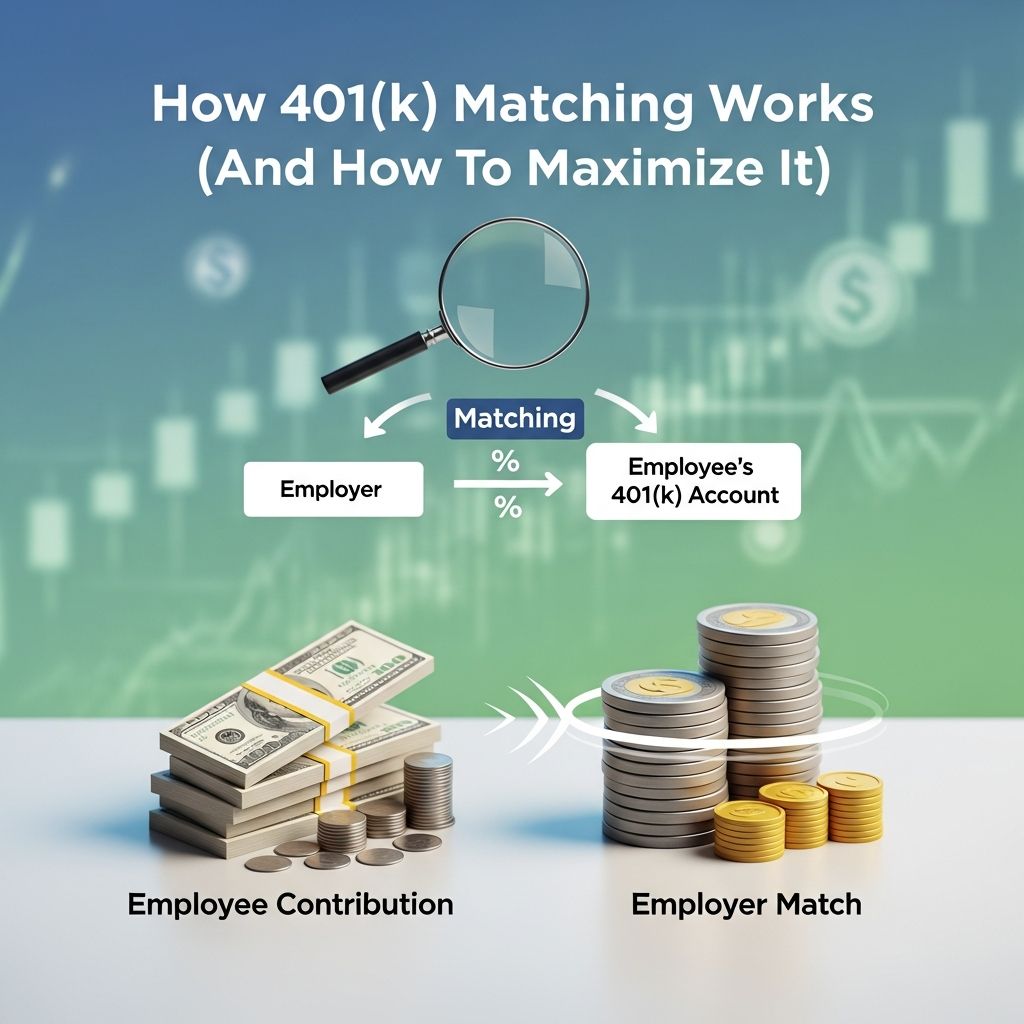
401(k) matching is one of the most powerful, yet often misunderstood, benefits many employers offer. When you participate in your workplace retirement plan and contribute part of your paycheck, your employer may also contribute money to your account based on how much you put in. In practice, this is often described as free money because you receive an immediate return simply for contributing to your plan.
Understanding exactly how 401(k) matching works, the rules that apply, and how to make the most of it can dramatically improve your long-term retirement savings. This guide walks through what matching is, the most common types of match formulas, how vesting works, contribution limits, and specific steps you can take to maximize every dollar of employer match available to you.
What is 401(k) matching?
A 401(k) match is an employer contribution to your workplace retirement plan that is tied to how much you personally contribute. If you put money in, the company may also put money in, up to a specified limit and based on a formula in the plan document.
Key characteristics of 401(k) matching include:
- Conditional on your contribution: You must contribute from your own pay to receive the match.
- Formula-based: The employer specifies a percentage of your salary and a percentage of your contribution that it will match.
- Subject to plan rules: The formula, waiting periods, and eligibility rules differ by employer.
Most employers are not legally required to offer matching, but a substantial share choose to do so because it helps attract and retain employees and supports retirement readiness.
Why 401(k) matching is often called “free money”
401(k) matching is often described as free money because it is an additional benefit you receive on top of your salary when you contribute to your plan. You do not have to repay the match, and it can grow tax-advantaged within your retirement account over time.
Here is why it is so valuable:
- Immediate return: With dollar-for-dollar matching, if you contribute 3% of your pay and your employer matches 3%, you instantly double that portion of your contribution.
- Compounding growth: The extra employer dollars are invested along with your own contributions, potentially compounding over decades.
- Low effort, high impact: Once you set your contribution rate, the matching funds are added automatically each pay period as long as you are eligible.
In many cases, taking full advantage of the match is one of the simplest ways to dramatically increase the total amount going toward your retirement each year.
Common 401(k) matching formulas
Employers can structure their match in multiple ways. The plan’s Summary Plan Description (SPD) or benefits guide will spell out the exact formula. Three of the most common match approaches are partial, full, and combination matching.
1. Partial 401(k) matching
With a partial match, your employer matches a percentage of the money you contribute, up to a certain percentage of your salary. For example, an employer might match 50% of what you contribute, up to 6% of your pay.
Example:
- Salary: $100,000
- Employer match: 50% of contributions up to 6% of salary
- If you contribute 6% ($6,000), your employer contributes 3% ($3,000).
In this setup, 9% of your salary ends up in your retirement account, but only 6% comes from you. If you contribute less than 6%, you leave part of the match on the table.
2. Full (dollar-for-dollar) 401(k) matching
With a full or dollar-for-dollar match, your employer contributes 100% of the amount you put in, up to a specific percentage of your income. For example, your employer might match 100% of your contributions up to 4% of salary.
Example:
- Salary: $100,000
- Employer match: 100% up to 4% of salary
- If you contribute 4% ($4,000), your employer also contributes 4% ($4,000).
In this case, you effectively double that slice of your contribution, getting an instant 100% return on the matched portion.
3. Combination 401(k) matching
Some employers use a combination match, where a portion of your contribution is matched dollar-for-dollar up to a level, and an additional portion is matched at a lower rate.
Example combination formula:
- Match 100% of the first 3% of salary you contribute, plus
- Match 50% of the next 2% of salary you contribute.
For someone earning $100,000:
- Contribute 5% ($5,000) to get the full match.
- Employer contributes $3,000 for the first 3% and $1,000 for the next 2%, for a total match of $4,000.
Quick comparison of match types
| Match Type | Typical Formula | Max Employer Match (on $100k salary) |
|---|---|---|
| Partial | 50% of your contributions up to 6% of pay | 3% of pay ($3,000) |
| Full | 100% of your contributions up to 4% of pay | 4% of pay ($4,000) |
| Combination | 100% of first 3% + 50% of next 2% | 4% of pay ($4,000) |
401(k) contribution limits and how matching fits in
The IRS sets annual limits on how much you can contribute to your workplace retirement plan and how much can be contributed in total (you plus your employer). These limits are adjusted periodically for inflation and affect how much match you may receive.
Employee contribution limits
The IRS sets a yearly limit on employee elective deferrals to 401(k), 403(b), and similar plans. Workers age 50 and older are allowed an additional “catch-up” contribution on top of the standard limit.
Because these limits can change over time, always verify the current year’s numbers using IRS guidance or your employer’s plan materials.
Total contribution limits (you + employer)
There is also a separate IRS limit on the total contributions made to your account each year from all sources, including your contributions, employer matching, and any other employer contributions (such as profit sharing). The total generally cannot exceed a specific dollar amount or 100% of your compensation, whichever is less.
Important note: employer matching contributions do not count toward your individual elective deferral limit, but they do count toward the overall annual additions limit.
How vesting affects your 401(k) match
Even though the employer match shows up in your account, you may not immediately have full ownership of those matched funds. Instead, many plans use a vesting schedule. Vesting determines how much of the employer contributions you can keep if you leave the company.
Types of vesting schedules
- Immediate vesting: You own 100% of employer contributions as soon as they are made. If you change jobs, you keep the full match.
- Cliff vesting: You become 100% vested after a specified number of years of service. If you leave before that date, you may forfeit some or all of the match.
- Graded vesting: You gradually earn ownership of employer contributions over time, such as 20% per year over five years.
Your contributions are always 100% yours, but the employer match may be partially or entirely forfeited if you leave before you are fully vested.
Why vesting matters when changing jobs
Vesting can influence the timing of a job change. For example, if you are close to a vesting milestone, waiting until you reach it could mean keeping significantly more of the employer match. Plan documents and annual benefit statements will indicate your current vested percentage and when you will be fully vested.
Traditional vs. Roth 401(k) and how matching is treated
Many employers now offer both traditional 401(k) and Roth 401(k) options. These differ mainly in how contributions and withdrawals are taxed.
- Traditional 401(k): Contributions are usually made pre-tax, lowering your taxable income today. Withdrawals in retirement are taxed as ordinary income.
- Roth 401(k): Contributions are made after tax, but qualified withdrawals in retirement are generally tax-free.
Employer matching contributions are almost always made to a traditional account, even if you direct your own contributions to a Roth 401(k). That means employer match dollars are contributed pre-tax and will be taxed when you withdraw them in retirement.
Recent retirement legislation has expanded the ability of plans to offer Roth-style employer contributions, but adoption depends on the individual employer’s plan design and may not yet be widely available.
How to calculate your 401(k) match
To understand your match, you need three pieces of information:
- Your annual salary.
- Your employer’s match formula.
- Your chosen contribution percentage.
Basic steps:
- Convert the match formula into a maximum match percentage of your salary.
- Multiply that percentage by your salary to find the maximum employer dollars you can receive.
- Ensure your contribution rate is at or above the percentage needed to unlock the full match.
Example: your employer matches 50% of contributions up to 6% of pay.
- Maximum match = 3% of salary (50% of 6%).
- If you earn $60,000, the most your employer will contribute is $1,800.
- To get this full match, you must contribute at least 6% of your salary ($3,600).
Strategies to maximize your 401(k) match
Because matching contributions offer such a powerful boost, many financial experts encourage employees to prioritize getting at least the full employer match before directing additional savings elsewhere.
Here are practical steps to make the most of this benefit:
1. Contribute at least enough to get the full match
Your first goal is to set your contribution percentage at or above the level required to receive the maximum employer match. If you are currently contributing less, consider gradually increasing your contribution rate over time until you reach that threshold.
2. Use automatic escalation if your plan offers it
Many plans allow you to enroll in automatic escalation, where your contribution rate increases by a set percentage each year (for example, 1%) until you reach a target level. This can help you move from a lower starting percentage up to the match threshold and beyond without having to manually adjust your contributions.
3. Time your increases with raises
When you receive a raise or bonus, consider increasing your 401(k) contribution rate at the same time. Redirecting part of the raise into your retirement plan can boost your savings and employer match while keeping your take-home pay relatively stable.
4. Aim for a total savings rate above the match
While capturing the full match is a key milestone, many retirement experts suggest targeting a total retirement savings rate (your contributions plus employer contributions) of around 10% to 15% of your gross income, depending on your age, goals, and when you started saving.
Example: if your employer matches 4% of your salary, you might aim to contribute at least 11% to reach a combined rate of 15%.
5. Review your plan annually
Plan rules, match formulas, and IRS limits can change. Review your employer’s benefits information and your contribution elections at least once a year, and anytime you change jobs, to ensure that you continue to capture the full matching amount available.
What if your employer does not offer a match?
Not all employers offer a match, and some may offer a retirement plan without any employer contributions. Even if you do not receive a match, contributing to a 401(k) or similar plan can still provide tax advantages and a convenient, automatic way to save for retirement.
If there is no match available, you might:
- Still contribute enough to benefit from pre-tax or Roth tax treatment.
- Consider contributing to an individual retirement account (IRA) in addition to or instead of your workplace plan, depending on your situation.
- Revisit your savings rate periodically to ensure you are on track for your retirement goals.
Frequently Asked Questions (FAQs)
Q: Is a 401(k) match really free money?
A: In practice, yes. A 401(k) match is an extra benefit on top of your salary that your employer contributes when you invest in your retirement plan. You do not repay it, and once vested, it is fully yours, though it remains subject to investment risk and normal withdrawal rules.
Q: Should I always contribute enough to get the full match?
A: Many financial professionals consider getting the full match a high priority because it is an immediate, risk-free boost to your savings. Barring high-interest debt or urgent financial emergencies, contributing at least enough to receive the full match is often a strong starting goal.
Q: Does the employer match count toward my annual 401(k) contribution limit?
A: Employer matching contributions do not count toward your personal elective deferral limit, but they do count toward the overall annual additions limit for your account, which includes all contributions from you and your employer combined.
Q: What happens to my employer match if I leave my job?
A: You always keep your own contributions, but the amount of employer match you keep depends on your vesting status. If you are fully vested, you keep all employer contributions; if partially vested, you keep only the vested share; if not yet vested under a cliff schedule, you may forfeit all employer match.
Q: Can I get a match on Roth 401(k) contributions?
A: You can receive a match when you contribute to a Roth 401(k), but the match itself is typically deposited into a traditional (pre-tax) 401(k) sub-account. That means those employer dollars will be taxed upon withdrawal in retirement, even though your Roth contributions may be withdrawn tax-free if requirements are met.
References
- Financial Experts Explain How 401(k) Matching Is One of the Simplest Ways to Invest — Black Enterprise. 2024-09-25. https://www.blackenterprise.com/financial-experts-explain-how-401k-matching-is-one-of-the-simplest-ways-to-invest/
- How to Maximize 401(k) Matching Funds — Quick and Dirty Tips. 2024-01-10. https://www.quickanddirtytips.com/articles/howtomaximize401kmatchingfunds/
- Retirement Topics – 401(k) and Profit-Sharing Plan Contribution Limits — Internal Revenue Service (IRS). 2024-01-01. https://www.irs.gov/retirement-plans/plan-participant-employee/retirement-topics-401k-and-profit-sharing-plan-contribution-limits
- FAQs about Retirement Plans and ERISA Requirements — U.S. Department of Labor, Employee Benefits Security Administration. 2023-06-15. https://www.dol.gov/general/topic/retirement
Similar Articles








Read full bio of Sneha Tete