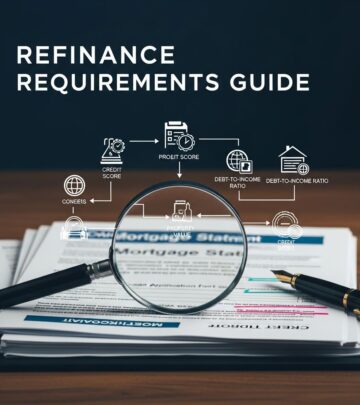
Home Equity Requirements for Refinancing in 2026
Understanding equity thresholds and qualification standards for refinancing your mortgage

When considering a refinance, one of the most fundamental questions homeowners ask is how much equity they need to build in their property before qualifying. The answer depends on several interconnected factors, including the type of refinance you’re pursuing, your credit profile, income stability, and the lender’s specific guidelines. Understanding these requirements upfront can help you determine whether refinancing makes sense for your financial situation and timeline.
The Foundation: What Home Equity Really Means
Home equity represents the difference between your property’s current market value and the amount you still owe on all mortgages and liens secured against it. If your home is worth $400,000 and you have a $250,000 mortgage balance, you have $150,000 in equity. This equity serves as your financial cushion in the refinancing process, giving lenders confidence that you have genuine skin in the game and reducing their risk exposure.
The equity requirement acts as a protective mechanism for both borrowers and lenders. When you have substantial equity, you’re less likely to walk away from your obligation during financial hardship, and lenders have more collateral to recover if circumstances go wrong. This mutual interest alignment shapes the equity thresholds that have emerged across the lending industry.
Standard Equity Benchmarks for Conventional Refinancing
The most commonly cited equity requirement for conventional refinancing is maintaining at least 20% equity in your home after the transaction closes. This benchmark translates to a loan-to-value (LTV) ratio of 80% or lower, which has become the gold standard across the mortgage industry. When your LTV stays at or below 80%, you demonstrate sufficient ownership stake to qualify under conventional programs without paying additional mortgage insurance premiums.
Meeting this 20% equity threshold offers tangible advantages beyond simply qualifying for refinancing. Lenders typically offer their most competitive interest rates to borrowers who maintain this equity level, as they perceive minimal default risk. Additionally, you avoid private mortgage insurance (PMI), which can add hundreds of dollars annually to your loan payments. For borrowers considering a cash-out refinance—where you tap accumulated equity to receive funds—maintaining 20% equity afterward becomes non-negotiable under conventional guidelines.
However, the 20% threshold represents a minimum floor, not a ceiling. Borrowers with more substantial equity positions often qualify for even better rates and terms, creating a graduated benefit structure that rewards homeowners who have built stronger equity positions over time.
Government-Backed Loan Programs and Flexible Equity Standards
Federal Housing Administration (FHA) and Veterans Affairs (VA) loan programs operate under different equity parameters that can open refinancing opportunities for borrowers who fall short of conventional benchmarks.
FHA Refinancing Parameters
FHA refinancing allows borrowers to maintain an LTV up to 80% of the appraised home value without needing to carry the standard 20% equity cushion. This flexibility makes FHA refinancing attractive for borrowers with modest equity positions. However, FHA loans require mortgage insurance premium (MIP) payments—both an upfront cost and ongoing annual premiums—which adds to the total borrowing expense. Despite this insurance requirement, FHA programs remain valuable for borrowers focused on achieving better interest rates or restructuring their loan terms.
VA Refinancing Advantages
VA loans present perhaps the most generous equity framework for eligible veterans. These programs allow LTV ratios up to 90%, meaning borrowers can access refinancing with only 10% equity in their homes. This substantial flexibility reflects the federal government’s commitment to supporting veterans in managing their housing finances. VA refinances do require a one-time VA funding fee, but this cost can be rolled into the new loan amount, requiring no out-of-pocket expense at closing. For cash-out refinances, VA loans allow borrowing up to 90% of the home’s appraised value, providing unprecedented flexibility in accessing accumulated equity.
Beyond Equity: The Complete Qualification Picture
Credit Score Requirements
Credit scores serve as a primary indicator of your borrowing reliability and payment history. Most conventional refinancing programs require a minimum credit score of 620, though lenders typically reserve their best interest rates for borrowers with scores of 740 or higher. FHA programs accommodate lower credit scores, sometimes accepting scores as low as 580, though many lenders implement their own overlays requiring scores of 620 or better. VA programs generally don’t establish official minimum credit score requirements, but most lenders internally set thresholds around 620 to 640 in practice.
The relationship between credit score and interest rate operates on a sliding scale. A borrower with a 760 credit score might receive a rate that’s 0.5% to 1% lower than someone with a 640 score on the identical loan type. This differential can translate to tens of thousands of dollars in savings over the life of a 30-year mortgage.
Debt-to-Income Ratio Considerations
Your debt-to-income (DTI) ratio measures your total monthly debt obligations divided by your gross monthly income. This metric reveals whether your income stream can comfortably support both your existing debts and the new refinanced mortgage payment. Most conventional refinancing programs cap DTI at 43%, though some borrowers with compensating factors might stretch to 50%. FHA programs typically allow flexibility between 43% and 50% depending on the borrower’s complete financial picture. VA programs use a different methodology called residual income analysis but generally work to similar thresholds around 41%.
Calculating your DTI provides clarity about refinancing feasibility before submitting an application. If your monthly debts total $2,500 and gross income is $6,000, your DTI equals approximately 42%—positioning you comfortably within conventional parameters but with limited room for additional debt obligations.
Employment and Income Documentation
Lenders require documentation of stable, verifiable income before approving any refinance. This typically involves providing recent pay stubs, W-2 forms from the previous two years, and current year tax returns. Self-employed borrowers face additional scrutiny, often needing to provide two years of tax returns and sometimes accountant-prepared profit-and-loss statements. Employment stability also matters—recent job changes can complicate approval, though job changes within the same industry or field generally don’t create problems. Most lenders prefer to see at least two years of continuous employment history before approving refinancing.
Minimum Mortgage Seasoning Requirements
Lenders impose seasoning requirements dictating how long you must own your current mortgage before qualifying to refinance. For conventional refinancing, most programs require at least 12 months of mortgage history, demonstrating you’ve made consistent on-time payments. FHA and VA programs typically allow refinancing after just 6 months of mortgage seasoning, accelerating your timeline if circumstances warrant faster action. These requirements exist partly to prevent fraud and partly to ensure borrowers have demonstrated payment reliability on their current mortgage.
Home Appraisal and Value Assessment
All refinancing transactions require a current home appraisal to establish your property’s present market value. This appraisal directly impacts your refinancing options by determining the LTV calculation. If your home has appreciated significantly since your purchase or last appraisal, you may have built more equity than expected, unlocking additional refinancing options. Conversely, if your home’s value has declined or remained flat in a sluggish market, you might have less equity than anticipated, potentially disqualifying you from certain programs or requiring modifications to your refinancing strategy.
The appraisal process typically takes 7 to 10 days and costs between $300 and $500, depending on your home’s value and location. This investment provides essential information about your actual equity position and forms the basis for all LTV calculations the lender will perform.
Cash-Out Refinancing and Equity Preservation
When pursuing a cash-out refinance—borrowing more than you currently owe to access accumulated equity as cash—the equity preservation requirement becomes critical. You’ll typically need to maintain at least 20% equity after extracting cash under conventional programs. If your home is worth $300,000 and you currently owe $180,000, you have $120,000 in equity. A conventional cash-out refinance would allow you to borrow up to $240,000 (80% LTV), meaning you could access $60,000 in cash while preserving $60,000 in remaining equity.
This structure protects both parties. For lenders, maintaining equity after a cash-out refinance ensures you still have substantial financial motivation to continue payments. For borrowers, preserving equity prevents the trap of becoming underwater on your mortgage if property values decline or unexpected financial pressures emerge.
Comparing Refinancing Options: A Practical Framework
| Loan Type | Maximum LTV | Minimum Credit | Maximum DTI | Equity Preserved |
|---|---|---|---|---|
| Conventional | 80% | 620 (740+ best rates) | 43-50% | 20% |
| FHA | 80% | 580 (620+ typical) | 43-50% | 20% |
| VA | 90% | 620-640 (typical) | ~41% (residual income) | 10% |
Strategies for Improving Your Refinancing Position
If your current equity position falls short of refinancing requirements, several strategies can help you move toward qualification. Making additional principal payments accelerates equity building, directly improving your LTV ratio. Paying down high-interest consumer debt reduces your DTI ratio, expanding your borrowing capacity. Addressing credit report errors through dispute processes can improve your credit score, unlocking better rates and terms. Waiting for your home to appreciate in a rising market can organically increase your equity without personal financial strain.
For borrowers who’ve recently experienced job changes or career transitions, timing becomes strategic. Waiting until you’ve established two years of employment history in your new position significantly improves approval odds and often results in better rate offers. Similarly, postponing refinancing until after recent mortgage payments demonstrate your reliability can strengthen your application.
Frequently Asked Questions About Refinancing Equity Requirements
Can I refinance with less than 20% equity?
Yes, but with limitations. VA loans allow refinancing with as little as 10% equity. FHA programs can work with borrowers at 20% equity, though mortgage insurance becomes mandatory. Conventional refinancing with less than 20% equity requires paying PMI, which adds cost. Some specialized non-QM lenders offer programs with more flexible equity requirements, though rates may be higher.
How quickly can equity accumulate in my home?
Equity builds through two mechanisms: monthly mortgage payments (which pay down principal) and home appreciation (which increases value). Early mortgage years emphasize interest payment, so principal reduction moves slowly. After 5-7 years, principal payments accelerate. Market appreciation depends entirely on local conditions but typically ranges from 2-4% annually in stable markets.
Does my home need a recent appraisal before refinancing?
Yes, all refinancing requires a current appraisal. This establishes your home’s present value, which determines your LTV ratio and overall refinancing eligibility. If you’ve had a recent appraisal within 3-6 months, some lenders might accept it, but most require a new appraisal ordered specifically for the refinancing transaction.
What happens if my home’s value has declined?
Declining home values reduce your equity, potentially disqualifying you from refinancing or requiring modified terms. If underwater (owing more than your home is worth), conventional refinancing becomes unavailable. Some lenders offer specialized programs for negative equity situations, but options are limited and rates typically higher.
Can I refinance if I’m behind on payments?
Refinancing while delinquent on your mortgage is virtually impossible. Lenders require at least 12 months of on-time payments before approving refinancing. If you’re struggling with payments, contact your lender about loan modification or forbearance programs before pursuing refinancing.
Conclusion: Planning Your Refinancing Timeline
Understanding your home’s equity position and the complete landscape of refinancing requirements enables informed decision-making about your mortgage strategy. While the standard 20% equity threshold guides conventional refinancing, multiple pathways exist for borrowers with different equity levels, credit profiles, and financial circumstances. Evaluating your current position against established benchmarks—equity percentage, credit score, DTI ratio, employment stability, and appraisal value—provides clarity about your readiness to refinance and the timeline for achieving refinancing goals.
By systematically addressing each qualification component and exploring program options that align with your specific situation, you position yourself to secure refinancing terms that meaningfully improve your financial circumstances while maintaining the equity cushion necessary for long-term housing stability.
References
- Cash-Out Refinance | Requirements & Limits 2026 — The Mortgage Reports. 2026. https://themortgagereports.com/68932/cash-out-refinance-guide-rules-rates-requirements
- Can You Refinance a HELOC? Your Complete Guide for 2026 — Amerisave. 2026. https://www.amerisave.com/learn/can-you-refinance-a-heloc-your-complete-guide-for
- 2026 HELOC and Home Equity Loan Requirements — Rate.com. 2026. https://www.rate.com/mortgage/resource/heloc-and-home-equity-loan-requirements
- HELOC Requirements, 2026: What You Need to Know — Freedom Mortgage. 2026. https://www.freedommortgage.com/learn/home-equity/heloc-requirements
- Home loan refinancing guide for 2026 — Mortgage Equity Partners. 2026. https://mortgageequitypartners.com/home-loan-refinancing-guide-for-2026/
Similar Articles








Read full bio of Sneha Tete