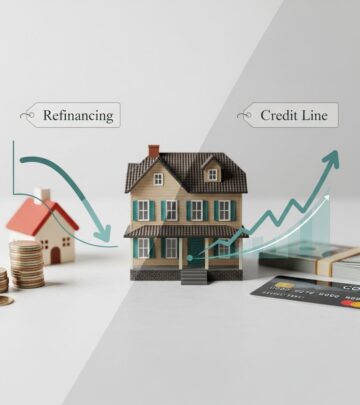
Home Equity Refinancing for Debt Payoff: A Complete Guide
Explore whether using your home equity to eliminate high-interest debt is the right financial move for your situation.

Managing multiple debts with varying interest rates can create significant financial stress and burden household budgets. For homeowners seeking relief from high-interest obligations, leveraging home equity through mortgage refinancing presents a potentially powerful solution. This strategy involves replacing an existing mortgage with a new loan that exceeds the current balance, allowing you to use the difference to pay down or eliminate other outstanding debts. However, this approach carries substantial implications that deserve careful evaluation before proceeding.
Understanding the Mechanics of Home Equity Refinancing
A home equity refinancing strategy works by having you borrow more than your current mortgage balance. This additional borrowed amount—often called a cash-out refinance—provides funds you can direct toward credit cards, medical bills, personal loans, or other obligations. For example, if you owe $250,000 on your mortgage but your home is worth $400,000, you might refinance for $300,000, receiving $50,000 in cash to eliminate debts.
The primary appeal lies in the dramatic difference between interest rates. Credit card rates frequently exceed 20 percent, with some reaching 30 percent or higher. In contrast, mortgage rates typically remain substantially lower, making this conversion financially attractive on the surface. When you consolidate high-interest debts into a lower-interest mortgage, the monthly savings can be considerable.
Financial Advantages of This Refinancing Strategy
Interest Rate Reduction and Long-Term Savings
The most compelling advantage involves the interest rate differential. Replacing credit card debt carrying 20-25 percent annual rates with mortgage financing at 5-7 percent annually can result in substantial savings over time. This reduction directly lowers your overall cost of borrowing and can free significant resources from interest payments toward principal reduction.
Simplified Monthly Payment Structure
Managing multiple creditors with different due dates, minimum payments, and terms creates administrative complexity and increases the likelihood of missed payments. Consolidating these obligations into a single monthly mortgage payment eliminates this cognitive burden and reduces the chance of accidentally defaulting on any account. This streamlined approach makes budgeting more straightforward and helps maintain payment discipline.
Potential Credit Score Improvement
Your credit utilization ratio—the percentage of available credit you’re actively using—significantly impacts credit scores. Paying off credit cards through refinancing lowers this ratio substantially, which can improve your credit profile over time. Additionally, eliminating multiple monthly payments and consolidating debt can signal improved financial management to credit reporting agencies.
Tax Benefits and Deduction Opportunities
Mortgage interest is tax-deductible under current federal law, provided the borrowed funds were used for qualifying purposes like home purchase, construction, or substantial improvement. This tax advantage creates additional savings beyond the interest rate reduction, though you should consult a tax professional about your specific circumstances.
Predictable Repayment Schedule
Unlike credit cards with variable rates that can fluctuate based on market conditions and issuer decisions, fixed-rate mortgages provide certainty. You know precisely how much you’ll pay each month and when your debt obligation ends, enabling accurate long-term financial planning.
Significant Risks and Disadvantages to Consider
Home Collateral and Foreclosure Risk
The most critical distinction between this strategy and other debt consolidation methods involves converting unsecured obligations into secured debt. Credit card debt doesn’t threaten your home if you default; mortgage debt does. Should you become unable to afford the new monthly payment due to job loss, medical emergency, or other financial disruption, lenders can foreclose and you could lose your residence.
Substantial Upfront Costs
Refinancing involves closing costs—fees for loan origination, appraisal, title services, legal work, and other processing expenses. These costs typically range from 2 to 6 percent of the total loan amount. On a $300,000 refinance, this translates to $6,000 to $18,000 in immediate expenses. You must ensure the interest savings justify these upfront costs; otherwise, you’re reducing your net benefit.
Extended Repayment Timelines and Additional Interest
Most mortgage refinances extend repayment to 30 years, stretching obligations you might have eliminated within 3-7 years on credit cards. This extended timeline means you’ll pay considerably more total interest despite the lower rate. Additionally, if you refinance partway through your existing mortgage (for instance, after five years of a 30-year loan), your total repayment period extends correspondingly.
Home Equity Depletion
Equity represents your true ownership stake in your home—the difference between its market value and what you owe. Taking equity out through cash-out refinancing reduces this crucial financial safety net. In extreme cases, if your home’s value declines while you’ve eliminated equity, you could end up “underwater,” owing more than your property is worth.
Temptation for Additional Debt Accumulation
Paying off credit cards frees up available credit limits. Without addressing underlying spending behaviors, this newfound credit capacity often leads to “reloading” debt—accumulating new balances on recently cleared credit cards. You could end up with both a larger mortgage and new credit card debt simultaneously, worsening your financial position rather than improving it.
Reduced Flexibility in Financial Hardship
Should your financial situation deteriorate significantly and bankruptcy becomes necessary, having consolidated unsecured debts into a mortgage constrains your options. Traditional bankruptcy might allow you to discharge credit card obligations without losing your home, but a mortgage remains a secured claim that could still result in foreclosure.
Evaluating Whether This Strategy Fits Your Situation
| Factor | Favorable Indicator | Warning Sign |
|---|---|---|
| Interest Rate Gap | 20%+ credit card rates versus 5-7% mortgage rates | Rates are similar or mortgage rates exceed credit card rates |
| Debt Amount | Significant balance relative to income that strains monthly budget | Small amount you could pay off within 2-3 years anyway |
| Income Stability | Secure employment with reliable, increasing income | Uncertain job prospects or recent income reduction |
| Financial Discipline | History of meeting obligations and controlled spending | Repeated debt accumulation or payment difficulties |
| Home Equity | Substantial equity built over years of payments | Minimal equity or recently purchased property |
| Closing Costs | Interest savings exceed 2-6% upfront expenses within 2-3 years | Break-even analysis shows savings too far in future |
Calculating Your Actual Financial Benefit
Before committing to refinancing, perform detailed calculations comparing scenarios. Calculate your current monthly debt payments and total interest paid if you continue on your current trajectory. Then calculate the new mortgage payment, total interest over the loan’s life, and closing costs. Subtract the closing costs from your total projected savings—this is your genuine financial benefit. If this number is negative or requires more than five years to break even, refinancing may not make sense.
Consider also whether you could pay off your debt within a shorter timeframe through accelerated payments or lifestyle adjustments. Sometimes the discipline required to manage debt elimination directly addresses underlying financial behaviors more effectively than shifting where your debt lives.
Alternative Approaches to Explore
Before pursuing home equity refinancing, investigate alternatives. Personal consolidation loans typically carry higher rates than mortgages but lower rates than credit cards, without putting your home at risk. Balance transfer credit cards offer 0 percent introductory rates for 6-12 months if you have decent credit. Negotiating directly with creditors to reduce rates or establish payment plans requires no new borrowing. These options may provide sufficient relief without the downsides of home equity extraction.
Critical Behavioral Considerations
This strategy only succeeds if you simultaneously address spending patterns that created the debt initially. Refinancing provides breathing room; it doesn’t cure the underlying problem. Before pursuing this route, honestly assess whether you can maintain controlled spending once credit lines are cleared. If not, you risk compounding your situation by accumulating both consolidated mortgage debt and new credit card balances.
Key Takeaways for Decision-Making
- Home equity refinancing can reduce interest rates from 20%+ on credit cards to 5-7% on mortgages, generating substantial savings
- Monthly payment consolidation simplifies financial management and reduces missed payment risk
- Closing costs of 2-6% must be justified by long-term interest savings to ensure genuine financial benefit
- Extended repayment periods mean paying more total interest despite lower annual rates
- Converting unsecured debt to secured debt puts your home at foreclosure risk if payments become unaffordable
- Success requires addressing spending behaviors that created the debt; otherwise, reaccumulation risk is substantial
- Home equity depletion reduces your financial safety net and wealth-building progress
- Alternatives like consolidation loans or balance transfers may provide benefits without home risk
Frequently Asked Questions
How much can I borrow through a cash-out refinance?
Lenders typically allow you to borrow up to 80-90 percent of your home’s current market value, minus what you currently owe on your mortgage. A home appraised at $400,000 with an $200,000 mortgage might support a $320,000 refinance (80% LTV), providing $120,000 in cash.
Will refinancing hurt my credit score initially?
Yes, the application process involves a hard inquiry that briefly lowers your score by a few points. However, closing old accounts and lowering credit utilization can improve it substantially afterward, often resulting in net score improvement within 3-6 months.
Can I refinance if I have poor credit?
Most conventional lenders require credit scores around 620-640 minimum. Poor credit results in higher mortgage rates, potentially eliminating your interest-saving advantage. Some government programs (FHA, VA) have slightly lower minimums. Improving your credit first may result in better refinance terms.
What if home values decline after I refinance?
If your home’s value drops significantly, you could owe more than it’s worth (being underwater). This doesn’t immediately force you to pay the difference, but it limits your flexibility to move, refinance again, or sell without absorbing a loss.
How long does the refinancing process take?
Typically 30-45 days from application to closing, though timelines vary. During this period, you remain obligated to pay existing debts; don’t stop payments or accumulate new debt.
References
- Debt Consolidation Mortgage Refinance: Pros, Cons, and Options — Freedom Mortgage. 2025. https://www.freedommortgage.com/learn/refinancing/debt-consolidation-refinance
- Pros and Cons of Debt Consolidation Mortgage Refinance — DSLD Mortgage. 2025. https://www.dsldmortgage.com/blog/pros-and-cons-of-debt-consolidation/
- Debt Consolidation Refinancing: Pros, Cons & Risks — Marimari Mortgage. 2025. https://www.marimarkmortgage.com/blog/refinance/debt-consolidation-refinancing-pros-cons-makes-sense
- Debt Consolidation Mortgage: Should I Get One? — LendingTree. 2025. https://www.lendingtree.com/home/refinance/debt-consolidation-mortgage-refinance/
- Pros and Cons of Debt Consolidation — Mutual of Omaha Mortgage. 2025. https://www.mutualmortgage.com/article/pros-and-cons-of-debt-consolidation/
- Pros and Cons of Consolidating Debt with a Mortgage Refinance — Money Management International. 2025. https://www.moneymanagement.org/blog/pros-and-cons-of-consolidating-debt-with-a-mortgage-refinance
- Pros and Cons of a Debt Consolidation Mortgage Refinance — AP Mortgage. 2025. https://www.apmortgage.com/blog/pros-and-cons-of-a-debt-consolidation-mortgage-refinance
- Mortgage Refinance to Consolidate Credit Card Debt — Equifax. 2025. https://www.equifax.com/personal/education/credit-cards/articles/-/learn/mortgage-refinance-consolidate-credit-card-debt/
Similar Articles








Read full bio of Sneha Tete