Home Construction Loans Explained
Discover how construction loans fund your dream home build, from application to final mortgage conversion with step-by-step guidance.
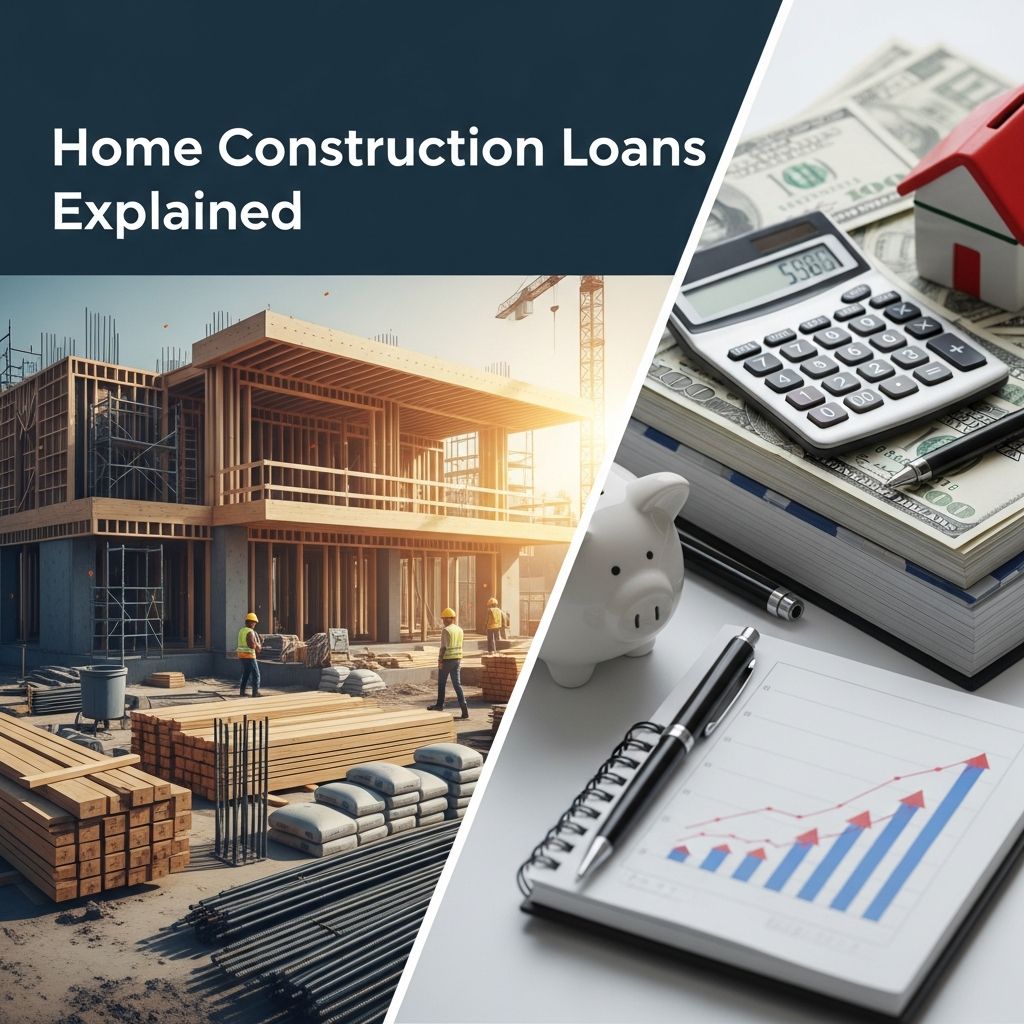
Home construction loans provide short-term financing specifically designed to cover the costs of building a new residence from the ground up. These loans differ from traditional mortgages by releasing funds in phases aligned with construction progress, minimizing interest on unused amounts while ensuring quality oversight through inspections.
Defining Construction Loans for Residential Builds
A construction loan funds land acquisition, labor, materials, permits, and other expenses tied to erecting a custom home. Unlike standard home loans that finance existing properties, these are temporary, typically lasting 12 months, with interest-only payments during the build phase. Upon completion, they often convert to long-term mortgages, streamlining the process for borrowers.
Lenders mitigate risks by disbursing funds via a ‘draw schedule’—predetermined releases after verifying milestones like foundation pouring or framing completion. This staged approach protects all parties, confirming work quality before advancing capital.
Primary Types of Construction Financing
Two main variants dominate the market: construction-only and construction-to-permanent loans. Each suits different borrower needs based on timeline preferences and cost tolerance.
- Construction-Only Loans: These cover building costs exclusively, requiring a separate permanent mortgage application post-construction. Borrowers face two closings, doubling fees (typically 2-6% of loan amount each time), but offer flexibility if market rates drop.
- Construction-to-Permanent Loans (Single-Close): Ideal for efficiency, these merge construction and long-term financing into one loan with a single closing. The rate locks at initial approval, converting automatically to principal-and-interest payments upon completion, saving on duplicate costs.
| Feature | Construction-Only | Construction-to-Permanent |
|---|---|---|
| Closings | Two | One |
| Closing Costs | Paid twice (2-6% each) | Paid once |
| Rate Lock | New application needed | Locked at start |
| Best For | Rate shoppers | Streamlined process |
Qualification Criteria and Prerequisites
Securing approval demands strong financials and detailed project documentation. Lenders prioritize credit scores of at least 620, though 700+ unlocks better terms. Debt-to-income ratios should stay under 45%, with reserves covering 6-12 months of payments post-build.
Down payments range from 5-20%, higher for riskier projects. Essential submissions include:
- Proof of income, assets, and debts.
- Detailed blueprints, line-item budget, and timeline.
- Signed contract with a licensed, insured builder pre-approved by the lender.
- Land ownership docs or purchase agreement.
Appraisals gauge the future completed value, factoring lot worth, plans, and local comps to confirm loan viability.
Navigating the Application Journey
The process spans 30-60 days from submission to funding, varying by lender efficiency and project complexity. Here’s a phased breakdown:
Initial Application and Pre-Approval
Start online with financial details and project overview. Lenders issue conditional approval swiftly, contingent on full docs and appraisal.
Documentation and Underwriting
Supply builder contracts, schedules, budgets, and plans. Underwriters scrutinize feasibility, credit, and finances.
Appraisal and Final Review
Professionals appraise based on projected value, taking 2-3 weeks. Final conditions clear for closing.
Loan Closing
Sign docs, pay down payment/closing costs (2-5% of loan), and secure title insurance. Funds release, construction commences.
Funding Mechanism: Draws and Inspections
No lump-sum payout here—funds draw in stages matching milestones. Builders request advances; lenders dispatch inspectors to verify progress before release, usually within 7-10 days.
Common draw schedule:
- Site Prep/Foundation (30-60 days): Clearing, excavation, pour. Interest-only on drawn amount (~$300-500/month example).
- Framing/Rough-Ins (Next 60 days): Structure, roofing, plumbing/electrical. ‘Dried-in’ milestone confirms weather-tightness.
- Interiors/Exteriors: Drywall, fixtures, siding.
- Final Completion: Landscaping, punch list. Final inspection triggers conversion.
Borrowers pay interest solely on disbursed balances, keeping costs low early on.
Timeline from Start to Occupancy
Total build time averages 9-12 months, plus 1-3 months pre-construction planning.
- Pre-Construction (1-3 months): Applications, permits, pre-approval.
- Active Build (6-10 months): Phased draws, inspections.
- Transition (1 month): Final walkthrough, conversion, move-in.
Delays from weather, permits, or supply chains can extend terms; some loans offer extensions for fees.
Costs Beyond Principal: What to Budget
Expect 1-2% higher rates than conventional mortgages due to risk. Additional expenses:
- Closing costs: 2-5% ($5K-$15K on $300K loan).
- Interest-only payments: Variable on draws.
- Inspections/Appraisals: $500-$1,500 total.
- Builder fees, permits: Project-specific.
Construction-to-permanent avoids double closings, potentially saving thousands.
Pros and Cons of Pursuing Construction Financing
| Advantages | Disadvantages |
|---|---|
| Custom home design control | Higher rates/down payments |
| Interest only on used funds | Complex process/paperwork |
| Single-close efficiency option | Timeline risks/delays |
| Potential equity build during construction | Two closings possible |
Strategies for Success and Risk Mitigation
Partner with vetted builders holding licenses/insurance. Secure permits early, pad budgets 10-20% for overruns, and communicate weekly with lenders. Monitor draws closely to ensure subcontractor payments, avoiding liens.
Shop multiple lenders—banks, credit unions offer competitive terms. Consult financial advisors on tax implications, like interest deductibility during build.
Frequently Asked Questions
Can first-time buyers get construction loans?
Yes, with solid credit/income, though higher down payments apply. Pre-approval strengthens builder negotiations.
What if construction overruns the budget?
Contingency funds help; extensions or refinances possible, but added costs accrue.
Do I need owned land?
Not always—loans can bundle land purchase, appraised as part of total value.
How are payments structured during construction?
Interest-only on drawn funds, monthly, based on prime rate plus margin.
What credit score is required?
Minimum 620, ideally 700+ for best rates.
Final Steps to Homeownership
Construction loans empower dream homes but demand preparation. From application to keys in hand, meticulous planning yields rewarding results. Research lenders, align teams, and track progress for smooth execution.
References
- Your Construction Loan Process Roadmap — The Federal Savings Bank. 2023. https://www.thefederalsavingsbank.com/Blog/your-construction-loan-process-roadmap/
- How Does A Construction Loan Work? — LendingTree. 2024-10-15. https://www.lendingtree.com/home/mortgage/how-construction-loans-work/
- How Do Home Construction Loans Work? — Truliant Federal Credit Union. 2024. https://www.truliantfcu.org/borrow/construction-loans/how-do-home-construction-loans-work
- How Do Construction Loans Work? — Gate City Bank. 2024. https://www.gatecity.bank/education/articles/how-do-construction-loans-work/
- What Are Construction Loans And How Do They Work? — Bankrate. 2025-03-01. https://www.bankrate.com/mortgages/construction-loans-explained/
- What is a construction loan, and how does it work? — Rocket Mortgage. 2024. https://www.rocketmortgage.com/learn/construction-loans
Similar Articles








Read full bio of Sneha Tete