History of the Gold Standard: From Origins to End
Explore how the gold standard shaped monetary systems and influenced global economies for centuries.
Understanding the Gold Standard: A Complete Historical Overview
The gold standard represents one of the most significant monetary systems in human economic history. This system established a direct link between a nation’s currency and a specific amount of gold, creating a framework that governed international commerce, trade, and financial stability for nearly two centuries. Understanding the gold standard’s evolution requires examining its origins, implementation across different nations, its operational mechanisms during various periods, and the reasons for its eventual abandonment in favor of modern fiat currency systems.
At its core, the gold standard was a commitment by participating countries to fix the prices of their domestic currencies in terms of a specified amount of gold. National money and other forms of money, including bank deposits and notes, were freely convertible into gold at the fixed price. This mechanism created what economists and historians consider one of the most disciplined monetary systems ever devised, though it also imposed significant constraints on government spending and economic policy flexibility.
The Origins and Early Adoption of the Gold Standard
The United Kingdom became the first major nation to formally embrace the gold standard. England adopted a de facto gold standard in 1717 when the master of the mint, Sir Isaac Newton, strategically overvalued the guinea in terms of silver, effectively establishing gold as the preferred medium of exchange. The nation subsequently formalized this commitment with an official gold standard adoption in 1819, setting a precedent that would influence global monetary policy for generations to come.
The United States took a different initial approach. In the early years following American independence, the young nation relied on foreign coins, particularly Spanish silver dollars, as its primary currency. This changed in 1792 when Treasury Secretary Alexander Hamilton launched the first Coinage Act, fundamentally unifying the American financial system. The Coinage Act of 1792 established the United States Mint, which produced, circulated, and regulated coinage throughout the nation. This act also designated the U.S. dollar as the nation’s official unit of money and established the gold-to-silver ratio at 15-to-1, meaning one ounce of gold was valued at 15 times one ounce of silver.
Initially, both gold and silver served as backing for American currency in what became known as a bimetallic standard. However, this arrangement created practical problems in the marketplace. When the official 15-to-1 ratio diverged from market rates, arbitrage opportunities emerged, causing one metal to accumulate while the other disappeared from circulation.
The Transition to Pure Gold Standard
Recognizing the complications inherent in maintaining a bimetallic system, Congress passed the Coinage Act of 1834, which increased the gold-to-silver ratio to 16-to-1. This adjustment shifted the economic incentives, causing gold to flow back into the United States while silver began to leave circulation. Coincidentally, the California Gold Rush of 1849, combined with Australian gold discoveries in 1851, significantly increased the world’s gold supply, further reinforcing gold’s dominance as the preferred monetary standard.
The United States technically remained on a bimetallic standard through the mid-nineteenth century, though gold had become the de facto standard. The transition became official with the Coinage Act of 1873, passed under President Ulysses S. Grant, which formally demonetized silver and ended the bimetallic standard entirely. This legislation, which supporters called the “Crime of 1873,” sharply decreased the money supply in the United States and remains controversial among economic historians to this day.
The United States officially committed to the gold standard on a de jure basis in 1900 when Congress passed the Gold Standard Act, which relegated silver to use only in small denomination coins. From that point forward, the dollar’s value was fixed at $20.67 per ounce of gold, a price point that would remain stable until 1933.
The Global Expansion of the Gold Standard
The international adoption of the gold standard accelerated during the latter part of the nineteenth century. In 1871, newly unified Germany, benefiting from substantial reparations received from France following the Franco-Prussian War, transitioned from its fragmented silver-based currencies to a gold-backed system. Germany’s decision to embrace gold proved tremendously influential. The combination of Germany’s economic power, coupled with the established dominance of the United Kingdom and the attraction of accessing London’s financial markets, encouraged other nations to adopt similar systems.
France, Belgium, Italy, Switzerland, Denmark, Sweden, Norway, the Netherlands, and Japan rapidly followed suit, creating what became known as the international gold standard. The period from 1873 to 1914 is recognized by economists as the “classical gold standard” era. By 1900, virtually all countries except China and a few Central American nations had adopted gold-based monetary systems, creating an unprecedented level of international monetary coordination and stability.
This global adoption reflected genuine economic benefits. Countries operating under the gold standard experienced remarkable economic growth, often referred to during America’s experience as the “Gilded Age.” The discipline imposed by the gold standard—where currencies remained convertible to physical gold on demand—created powerful incentives for balanced government budgets and prudent fiscal management.
How the Gold Standard Operated
The mechanics of the gold standard operated through several interconnected mechanisms. Under the pure classical gold standard system, every piece of paper currency, including gold certificates and Treasury notes, could be exchanged for physical gold on demand at a fixed price. This convertibility requirement fundamentally constrained monetary policy and government spending.
The system created automatic mechanisms for maintaining international trade equilibrium. When one nation experienced trade deficits, gold would flow out of the country to settle international debts. This outflow of gold automatically contracted the money supply, which would typically reduce prices and increase export competitiveness, eventually restoring trade balance. Conversely, trade surpluses would bring gold inflows, expanding the money supply and raising prices, which would eventually reduce export demand and restore equilibrium.
This automatic adjustment mechanism eliminated the need for active government intervention in currency markets and created confidence in the stability of exchange rates. International commerce could proceed with minimal currency risk, as the fixed gold content of each currency ensured predictable exchange rates between nations.
The Challenges and Collapse of the Classical Gold Standard
The gold standard system functioned relatively smoothly throughout the late nineteenth and early twentieth centuries until World War I disrupted international commerce and capital flows. While the classical gold standard ended in 1914 with the outbreak of the war, periodic attempts were made during the interwar period to restore it. The gold standard that was eventually reestablished proved far more fragile than its predecessor.
The most significant blow to the international gold standard came during the Great Depression of the 1930s. As the economic crisis deepened, countries faced a difficult choice between maintaining their gold standard commitments and pursuing expansionary policies to combat unemployment and deflation. Britain abandoned the gold standard in 1931 in the face of massive gold and capital outflows. This departure by the world’s financial leader accelerated the system’s unraveling.
In the United States, President Franklin D. Roosevelt responded to the economic crisis by taking unprecedented action. On April 5, 1933, Roosevelt signed Executive Order 6102, which made private gold ownership illegal throughout the nation. All Americans were required to sell their gold bullion and coins to the government at a fixed price of $20.67 per ounce, with severe penalties including up to 10 years in prison for those caught “hoarding gold.” This nationalization of gold fundamentally altered the relationship between citizens and their government’s monetary system.
The Quasi-Gold Standard Era and Final Abandonment
Rather than completely abandoning gold, Roosevelt’s administration established what became known as a quasi-gold standard, which persisted from 1933 until 1971. Under this modified system, the U.S. dollar remained convertible into gold, but only for official international transactions between governments and central banks, not for ordinary citizens.
The dollar’s role in international finance became increasingly important during this period. Following World War II, the Bretton Woods Conference of 1944 established a new international monetary framework where other nations’ currencies were pegged to the dollar, and the dollar itself remained convertible to gold at the fixed rate of $35 per ounce. This system created a modified gold standard that facilitated postwar reconstruction and international trade.
However, the Bretton Woods system proved difficult to maintain as economic conditions evolved. As the United States spent heavily on foreign military commitments and domestic programs during the 1960s, the supply of dollars ballooned significantly. This expansion raised serious questions about whether the U.S. government truly possessed sufficient gold reserves to honor its commitment to exchange dollars for gold at the agreed-upon rate of $35 per ounce.
Other nations, particularly France under President Charles de Gaulle, began to doubt American credibility. In the mid-1960s, France aggressively exchanged its official dollar reserves for gold, rapidly depleting American gold reserves. These pressures mounted throughout the late 1960s and early 1970s until the situation became unsustainable.
On August 15, 1971, President Richard Nixon suspended gold convertibility, effectively ending even the quasi-gold standard. This action struck what many consider the “final nail in the coffin” of the gold standard. The dollar was subsequently devalued in terms of its gold content, and the international monetary system transitioned entirely to fiat currencies—money that possesses value by government decree rather than by backing in precious metals.
Key Milestones in Gold Standard History
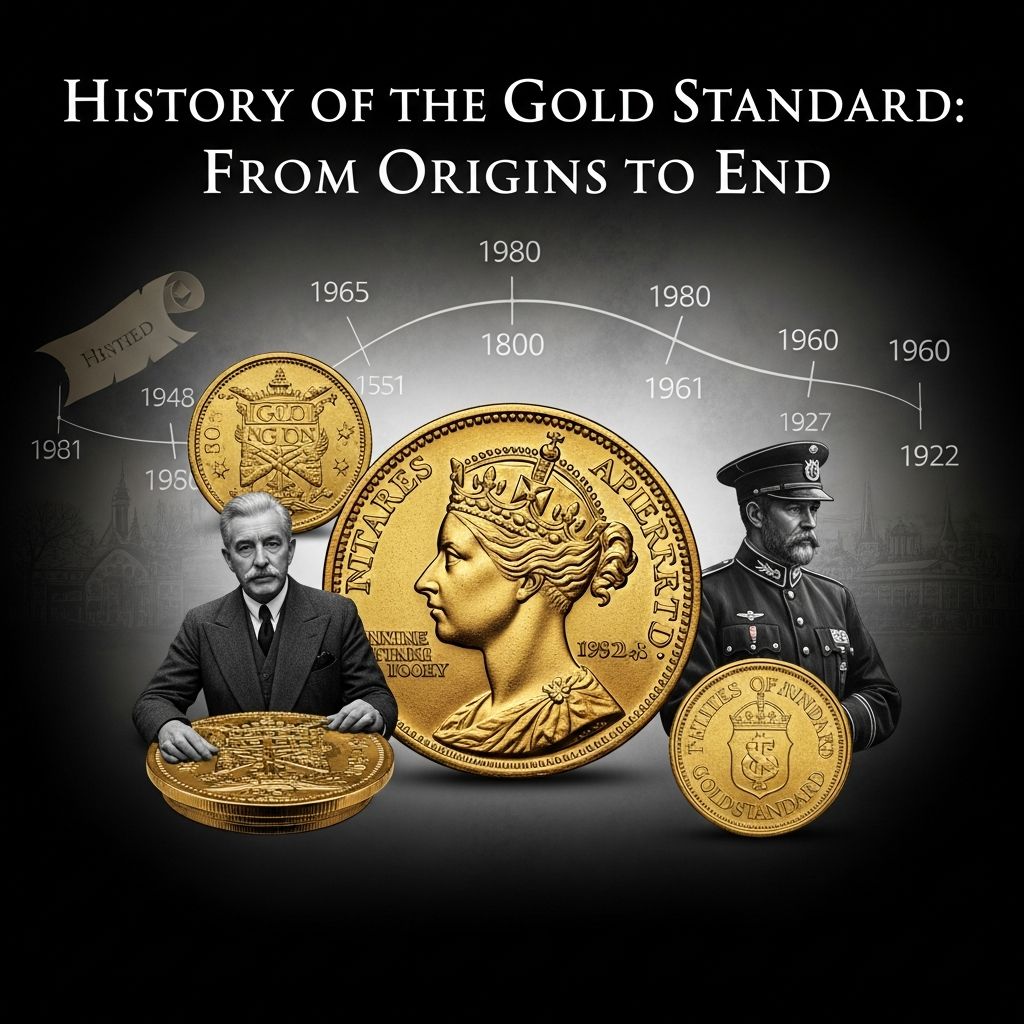
Understanding the gold standard’s evolution requires knowledge of its critical turning points. The following timeline highlights the most significant events:
1717: England establishes a de facto gold standard through Sir Isaac Newton’s overvaluation of gold against silver.
1792: The United States passes the Coinage Act, establishing the U.S. Mint and setting the gold-to-silver ratio at 15-to-1.
1834: Congress adjusts the gold-to-silver ratio to 16-to-1, effectively shifting the U.S. to a de facto gold standard.
1873: The United States formally demonetizes silver with the Coinage Act of 1873, establishing a pure gold standard.
1871-1900: Global adoption of the gold standard accelerates, with Germany leading the transition, followed by most major economic powers.
1900: The United States passes the Gold Standard Act, formally committing to gold on a de jure basis.
1914: The classical gold standard ends with the outbreak of World War I.
1933: President Franklin D. Roosevelt nationalizes privately held gold and establishes a quasi-gold standard.
1944: The Bretton Woods Conference establishes a modified gold standard with the dollar as the anchor currency.
1971: President Richard Nixon suspends gold convertibility, ending all vestiges of the gold standard.
The Legacy and Impact of the Gold Standard
The gold standard’s nearly two-century history profoundly influenced how nations manage their monetary systems. The discipline it imposed demonstrated the importance of financial credibility and the constraints on government spending. The automatic adjustment mechanisms it created showed how market forces could maintain international equilibrium without active policy management.
However, the gold standard’s eventual collapse revealed its limitations during times of economic stress. The system’s inflexibility prevented governments from pursuing countercyclical monetary policies during recessions and depressions. Critics argue that rigid adherence to gold standard principles contributed to the severity of the Great Depression, as central banks prioritized maintaining gold convertibility over expanding money supplies to combat economic contraction.
The transition to fiat currency systems granted governments greater flexibility in managing monetary policy but removed the constraint that the gold standard imposed on inflation and government spending. Modern monetary policy reflects this trade-off: greater flexibility but requiring stronger institutional frameworks and policy discipline to prevent currency depreciation and inflation.
Frequently Asked Questions About the Gold Standard
What exactly was the gold standard?
The gold standard was a monetary system where countries fixed the value of their currency to a specific amount of gold and allowed conversion of currency into physical gold at that fixed price.
Why did countries abandon the gold standard?
Countries abandoned the gold standard because it prevented them from implementing flexible monetary policies during economic crises, and because maintaining the required gold reserves became increasingly difficult as economies grew and populations expanded.
Could the gold standard be reestablished today?
While some economists advocate for a return to gold-based systems, most central banks and economists believe the modern global economy is too complex and too large to operate effectively under a gold standard, which would severely constrain monetary policy flexibility.
What was the Bretton Woods system?
The Bretton Woods system, established in 1944, was a modified gold standard where the U.S. dollar served as the world’s reserve currency, backed by American gold reserves, and other currencies were pegged to the dollar.
How did the gold standard affect inflation?
The gold standard generally maintained low inflation rates because the supply of money was constrained by the availability of physical gold, preventing governments from creating excessive amounts of currency.
References
- History of the Gold Standard in America — Vaulted. 2025. https://vaulted.com/nuggets/history-of-the-gold-standard-in-america/
- Gold Standard — Michael D. Bordo, Econlib. 2025. https://www.econlib.org/library/Enc/GoldStandard.html
- What is the Gold Standard System? — World Gold Council. 2025. https://www.gold.org/history-gold/the-classical-gold-standard
- Gold Standard — Wikipedia. 2025. https://en.wikipedia.org/wiki/Gold_standard
- Brief History of the Gold Standard in the United States — U.S. Congress. 2025. https://www.congress.gov/crs_external_products/R/PDF/R41887/R41887.2.pdf
- Roosevelt’s Gold Program — Federal Reserve History. 2025. https://www.federalreservehistory.org/essays/roosevelts-gold-program
Similar Articles








Read full bio of medha deb