History of Recessions in the United States
Explore major U.S. recessions from 1797 to present, their causes, impacts, and economic lessons.
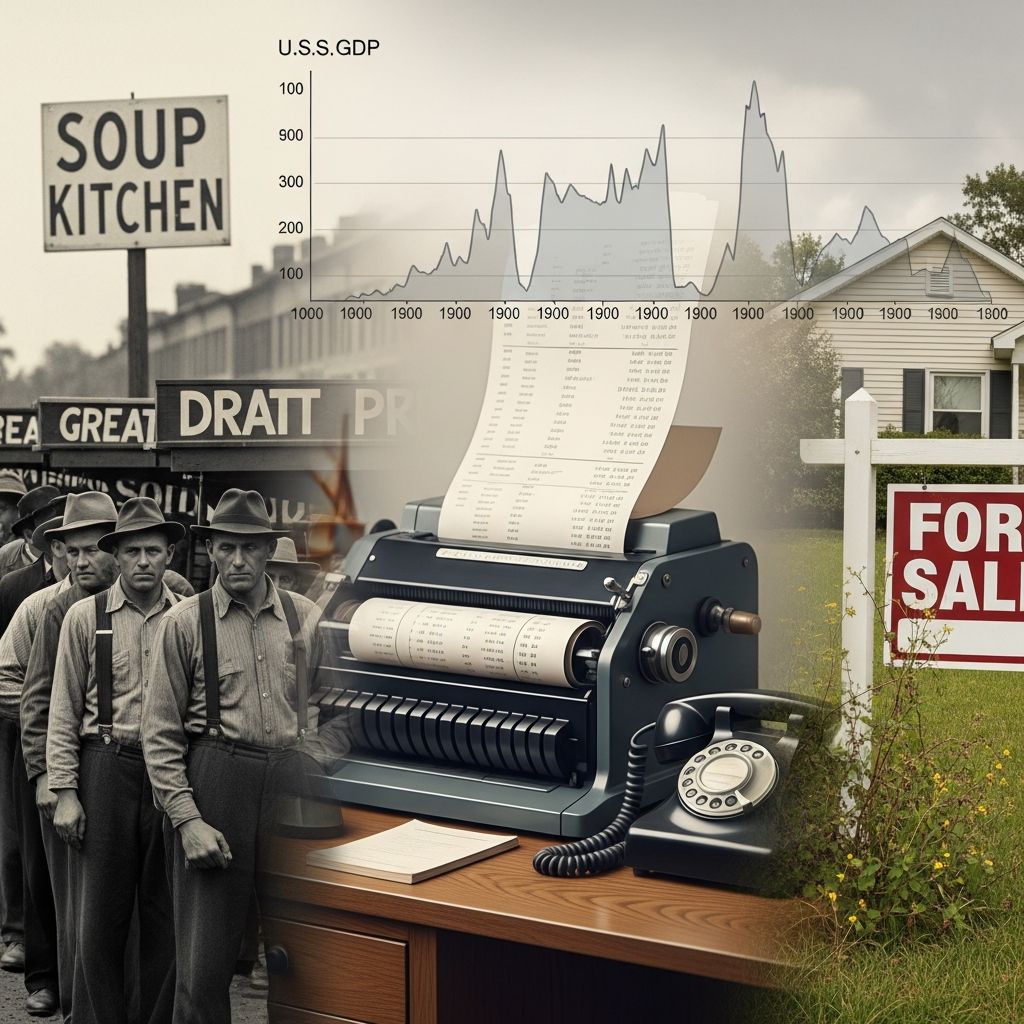
Throughout American economic history, recessions have played a crucial role in shaping the nation’s financial landscape. These periods of economic contraction, marked by declining GDP, rising unemployment, and reduced consumer spending, have occurred with varying frequency and severity. Understanding the history of U.S. recessions provides valuable insights into economic cycles, policy decisions, and the resilience of the American economy.
What Defines a Recession?
A recession is officially defined as a period of economic decline typically lasting at least two consecutive quarters of negative GDP growth. However, in practice, the National Bureau of Economic Research (NBER) determines recession dates based on multiple economic indicators including employment, industrial production, and income levels. Recessions differ from depressions, which are more severe and prolonged economic downturns characterized by massive unemployment and deflation.
Early American Recessions (1797-1900)
The United States has experienced numerous recessions since the nation’s founding, with the earliest documented economic downturns dating back to the late 18th century. These early recessions were often triggered by speculation, banking panics, and external trade disruptions.
The Long Depression (1873-1879)
One of the most significant economic contractions in American history was the Long Depression, which lasted approximately six years from 1873 to 1879. This severe recession began with a stock market crash in Europe, where investors began liquidating their holdings in American projects, particularly railroad bonds. The banking firm Jay Cooke and Company, which had overextended itself in railroad financing, collapsed, triggering a chain reaction of business failures across the nation. During this period, approximately 18,000 U.S. businesses declared bankruptcy, including 89 railroads and at least 100 banks. This recession underscored the dangers of speculative investment and inadequate banking regulation, issues that would continue to plague the American economy.
The Great Depression and Its Aftermath (1929-1938)
The Great Depression represents the most catastrophic economic collapse in American history, fundamentally altering economic policy and public expectations of government intervention in the economy.
The Great Depression (1929-1933)
Triggered by the stock market crash of October 1929, the Great Depression lasted nearly four years and devastated the American economy. The collapse was precipitated by excessive speculation, margin buying, and the unsustainable accumulation of debt throughout the 1920s. As stock prices plummeted, consumer confidence evaporated, leading to sharp decreases in spending and investment. Unemployment reached catastrophic levels, peaking at approximately 25 percent by 1933. Industrial production declined by roughly 47 percent, and thousands of banks failed, wiping out the savings of millions of Americans. The Depression’s impact extended far beyond economic statistics, creating widespread homelessness, hunger, and social unrest that lasted throughout the 1930s.
The Roosevelt Recession (1937-1938)
Just as the American economy appeared to be recovering from the Great Depression, a secondary downturn occurred from May 1937 to June 1938. Sometimes called “the recession within the Depression,” this contraction was largely attributed to the premature tightening of fiscal and monetary policy by the Roosevelt administration. Real GDP fell 11 percent, and industrial production declined 32 percent during this period. Many economists believe the administration’s effort to balance the federal budget and reduce New Deal spending inadvertently triggered this relapse. The recession demonstrated that recovery from severe economic trauma requires sustained supportive policies, a lesson that would inform economic responses to future crises.
Post-World War II Recessions (1945-1970)
The period following World War II witnessed several recessions as the American economy transitioned from wartime production to peacetime activity and faced new inflationary pressures.
The Post-War Recession (1945)
As World War II ended in 1945, the American economy faced a significant challenge: transitioning from massive wartime government spending to peacetime production. A decline in military expenditures led to reduced GDP and rising unemployment. Additionally, a wave of labor strikes and union-related work stoppages disrupted production and economic output during this period. However, contrary to many economists’ predictions, this recession proved to be relatively mild and short-lived, lasting only eight months. The economy’s resilience during this transition period surprised many analysts and helped establish confidence in the post-war American economy.
The 1948-1949 Recession
An 11-month recession from November 1948 to October 1949 resulted from multiple economic pressures. President Harry Truman’s “Fair Deal” social reform programs increased government spending, while the Federal Reserve simultaneously implemented monetary tightening to combat rising inflation. These conflicting policy directions created economic uncertainty and reduced business investment. Though generally considered a minor recession, unemployment peaked at 7.9 percent in October 1949, affecting millions of workers and highlighting the challenges of balancing inflation control with economic growth.
The 1953-1954 Recession
Following the end of the Korean War, the American economy contracted for 10 months from July 1953 to May 1954. The post-war economic pullback combined with Federal Reserve monetary tightening created recessionary conditions. Additionally, the 1951 separation of the Federal Reserve from the U.S. Treasury affected monetary policy coordination. Unemployment peaked at 6.1 percent four months after the recession officially ended, reflecting the lag between economic turnaround and employment recovery.
The 1957-1958 Recession
The Federal Reserve’s contractionary monetary policy aimed at cooling an overheated economy triggered a significant economic downturn from August 1957 to April 1958. An unexpected influenza outbreak in Asia, later known as “the Asian Flu,” reduced labor supply and disrupted production precisely when the Federal Reserve was raising interest rates. GDP fell 4.1 percent in the final quarter of 1957 and dropped an additional 10 percent at the start of 1958. Unemployment reached 7.5 percent in July 1958, and the stock market experienced a sharp correction. The Eisenhower administration responded by implementing stimulus measures while the Federal Reserve lowered interest rates to 1.75 percent, helping restore growth within eight months.
The 1960-1961 Recession
This 10-month recession from April 1960 to February 1961 spanned two presidential administrations. President Dwight D. Eisenhower initially faced the economic contraction, but John F. Kennedy inherited the recession following his 1960 electoral victory, partially based on economic concerns about the incumbent administration’s handling of the downturn. The recession highlighted the political dimensions of economic cycles and the importance of economic conditions in electoral outcomes.
The 1969-1970 Recession
From December 1969 to November 1970, the American economy contracted for nearly a year. Despite relatively modest GDP decline of 0.6 percent, unemployment reached 6.1 percent in December 1970. Rising inflation resulting from increased government deficits and heavy spending on the Vietnam War necessitated Federal Reserve interest rate increases. The recession demonstrated how military spending and inflation management could create conflicting economic pressures, a tension that would characterize economic policy throughout the 1970s.
The Stagflation Era (1973-1975)
The oil shock recession from November 1973 to March 1975 introduced Americans to “stagflation”—the troubling combination of stagnant economic growth and persistent inflation. The Organization of the Petroleum Exporting Countries (OPEC) quadrupled oil prices following the 1973 Middle East conflict, while stock market crashes added to economic uncertainty. Inflation reached double-digit levels even as economic growth stalled, creating a dilemma for policymakers. Traditional monetary tightening would combat inflation but worsen the recession, while stimulus would reduce unemployment but fuel inflation further. This recession lasted 16 months and demonstrated the limitations of conventional economic policy in addressing combined inflation and recession pressures.
The Modern Era: Recessions from 1980 to Present
The final decades of the 20th century and early 21st century witnessed recessions of varying severity, reflecting both domestic policy decisions and global economic interconnections.
Recent Recession Patterns
Since 1980, the United States has experienced several significant recessions, each with distinct causes and characteristics. These modern recessions have generally been shorter and less severe than their historical counterparts, partially reflecting more sophisticated monetary policy tools and early warning systems. However, the 2007-2009 Great Recession demonstrated that severe financial crises remain possible in modern economies.
The Great Recession (2007-2009)
The Great Recession stands as the worst economic downturn since World War II, lasting from December 2007 to June 2009. Triggered by the collapse of the housing market and subsequent financial sector crisis, this recession saw U.S. GDP fall 4.3 percent from its peak to its trough. Unemployment soared from 5 percent at the end of 2007 to 10 percent in October 2009, representing nearly 9 million job losses. The financial crisis threatened the stability of major financial institutions, prompting unprecedented government intervention through bank bailouts and emergency lending facilities. The recession’s effects persisted long after its official end, with unemployment remaining elevated for years and millions of families losing homes to foreclosure.
Key Statistics and Patterns
Since records began in the 1850s, the United States has experienced 34 economic recessions. The longest recession in American history—the Long Depression—lasted 65 months from October 1873 to March 1879. In contrast, modern recessions have generally been shorter, with average durations declining over time as economic policy tools have improved. The frequency and severity of recessions have also varied considerably, with some decades experiencing multiple downturns while others enjoyed extended expansions.
Causes of Recessions: Common Themes
Throughout American economic history, several recurring causes emerge:
– Speculative bubbles and asset price collapses: Excessive speculation in railroads, stocks, housing, and other assets has repeatedly triggered severe recessions- Monetary policy mistakes: Both excessive tightening to combat inflation and inadequate tightening that allows inflation to spiral have caused recessions- Supply shocks: Oil price shocks, pandemics, and wars have disrupted production and employment- Banking system failures: Inadequate bank regulation and supervision have repeatedly triggered financial crises- Fiscal policy errors: Both excessive stimulus and premature consolidation have contributed to recessions
Lessons from Recession History
The history of American recessions offers several important lessons. First, economic cycles remain inherent to market economies despite improved policy tools. Second, the severity and duration of recessions depend significantly on policy responses, as demonstrated by the contrast between the prolonged Great Depression and the relatively quick recovery from many recent recessions. Third, financial regulation and banking system stability prove crucial to preventing severe economic downturns. Fourth, coordination between fiscal and monetary policy enhances recession prevention and mitigation. Finally, expectations and confidence play important roles in recession dynamics, as negative sentiment can become self-fulfilling.
Frequently Asked Questions
Q: What is the difference between a recession and a depression?
A: A recession is typically defined as two consecutive quarters of negative GDP growth, while a depression is a more severe, prolonged economic contraction characterized by massive unemployment, deflation, and widespread business failures. The Great Depression was far more severe than typical recessions.
Q: How long do recessions typically last?
A: Modern recessions typically last between 6 and 18 months, though historical recessions were often longer. The longest U.S. recession lasted 65 months from 1873 to 1879, while most recent recessions have been relatively brief.
Q: Can recessions be prevented?
A: While recessions cannot be entirely eliminated from market economies, their severity and duration can be substantially mitigated through appropriate monetary and fiscal policy responses. Improved economic monitoring and policy coordination have reduced recession frequency and severity in recent decades.
Q: Who determines when a recession officially begins and ends?
A: In the United States, the National Bureau of Economic Research (NBER) officially dates the beginning and end of recessions based on multiple economic indicators including GDP, employment, production, and income levels.
Q: How do recessions affect ordinary people?
A: Recessions typically cause job losses, reduced hours, wage stagnation, and increased financial stress for workers and their families. Home values may decline, retirement savings may be depleted, and access to credit becomes more difficult during recessions.
References
- The History of U.S. Recessions: 1797-2020 — SoFi Learning. Accessed November 2025. https://www.sofi.com/learn/content/us-recession-history/
- A History of U.S. Recessions (1857-2024) — Self Financial. Accessed November 2025. https://www.self.inc/info/history-of-us-recessions/
- A Brief History of U.S. Recessions — Weatherly Asset Management. Accessed November 2025. https://www.weatherlyassetmgt.com/a-brief-history-of-u-s-recessions/
- List of recessions in the United States — National Bureau of Economic Research. https://www.nber.org/research/data/us-business-cycle-expansions-and-contractions
- Dates of U.S. recessions as inferred by GDP-based recession indicator — Federal Reserve Economic Data (FRED). https://fred.stlouisfed.org/series/JHDUSRGDPBR
- Recessions and Depressions — Federal Reserve History. https://www.federalreservehistory.org/topics/recessions-and-depressions
Similar Articles








Read full bio of medha deb