Historical CD Rates by Year: 1967 to 2025
Track CD rate trends from 1967 to 2025 and understand how economic events shaped savings rates.
Understanding Historical CD Rates: A 50-Year Analysis
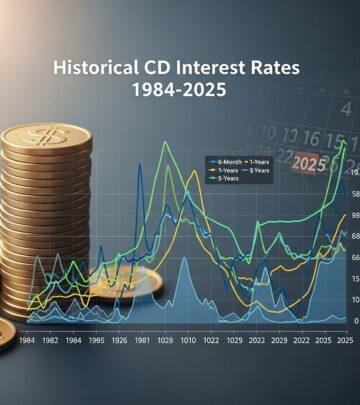
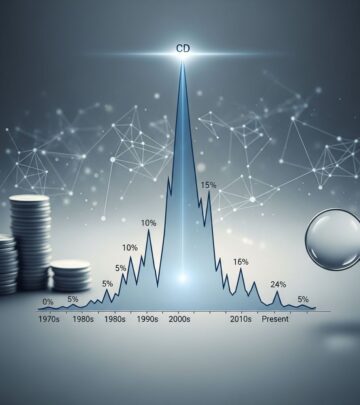
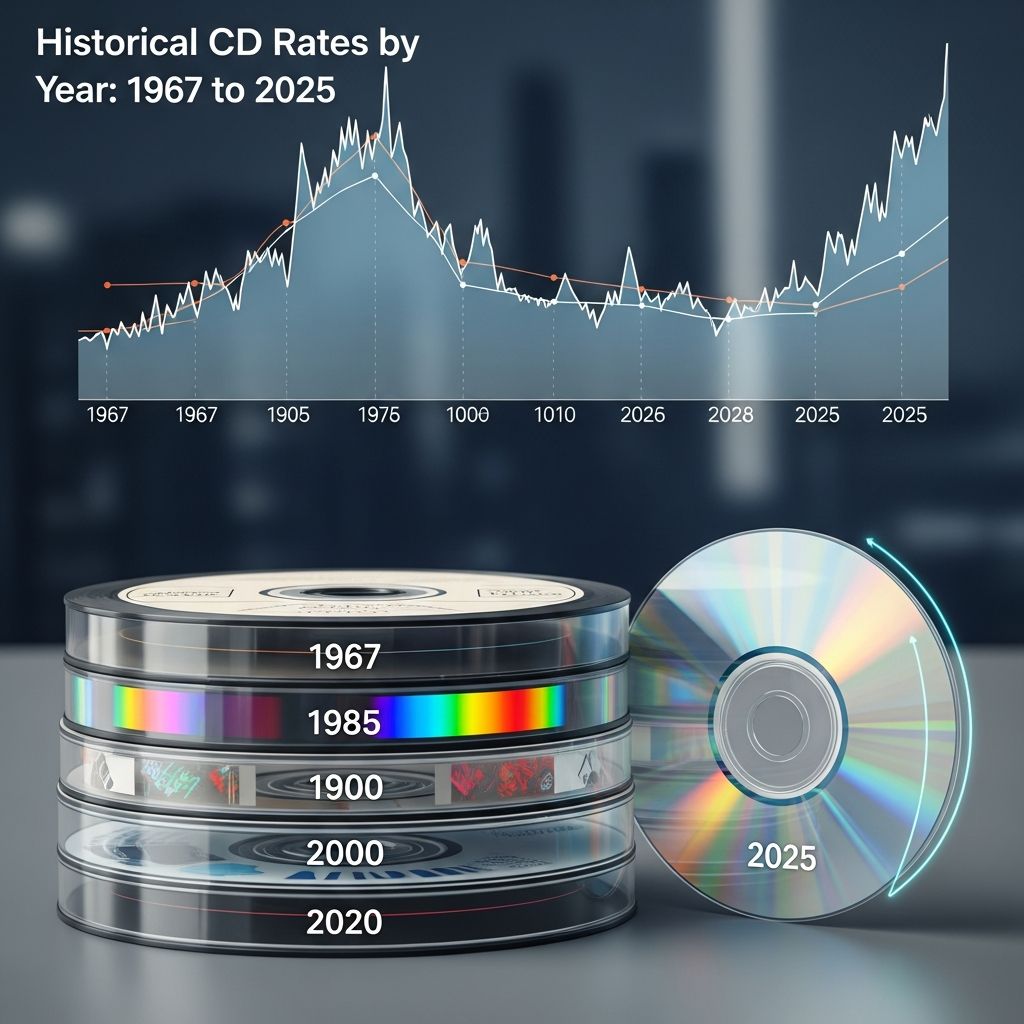
Certificate of Deposit (CD) rates have experienced dramatic fluctuations over the past five decades, reflecting broader economic conditions and Federal Reserve policy decisions. Since 1967, the average yield on three-month CDs—considered a key CD indicator because of its sensitivity to prevailing interest rates—has ranged from a remarkable high of 18.5% in the early 1980s to rates just above zero for extended periods during the 2010s and early 2020s. Understanding this historical context provides valuable insight into current rate environments and helps savers make informed financial decisions.
CD rates follow predictable patterns that align closely with federal monetary policy. As banks adjust their deposit rates in response to Federal Reserve decisions, savers experience corresponding changes in their potential returns. Shorter-term CDs are more sensitive to changes in the federal funds rate than longer-term CDs, making three-month and six-month CDs useful barometers for overall economic activity.
Key Takeaways from Decades of CD Rate History
Several important patterns emerge when examining CD rates across five decades:
– CD rates closely track the federal funds rate set by the Federal Reserve- Shorter-term CDs respond more dramatically to interest rate changes than longer-term products- CD rates reached historic peaks in the early 1980s when the Federal Reserve raised rates to combat stagflation- Modern CD rates remain significantly lower than historical averages despite recent increases- An inverted yield curve has recently reversed traditional CD rate structures, with shorter-term CDs offering higher yields
The 1960s: The Beginning of Our Historical Record
The historical CD rate data begins in 1967, capturing the tail end of a relatively stable economic period. Interest on three-month CDs bottomed out around 5% APY in 1967, then steadily climbed to approximately 8% as the 1960s drew to a close. This 5% baseline might seem modest by today’s standards, but it represented a reasonable return for savers during this era. The relatively consistent rates of this period reflected moderate inflation and stable monetary policy before the economic turbulence of the following decade.
The 1970s: Stagflation and Rising Rates
The 1970s opened with three-month CD rates hovering around 8% APY, comfortably ahead of the 6% inflation rate that savers faced at the time. However, this comfortable situation quickly deteriorated. The decade became characterized by stagflation—a toxic combination of high inflation and slow economic growth that challenged policymakers and punished savers.
The pattern of short-term CD rates outpacing inflation continued only until 1974, when inflation spiked above 11%. Although CD rates rose in response, climbing to nearly 10% APY by late 1974, they failed to keep pace with inflation. This meant savers suffered negative real returns on their CDs, losing purchasing power even while earning what appeared to be attractive nominal interest rates. The lessons of the 1970s demonstrated the critical importance of inflation-adjusted returns—what matters is not what the bank pays you, but what that payment can actually purchase.
The 1980s: Peak CD Rates and Volcker’s Inflation Fight
The early 1980s witnessed the most dramatic CD rates in modern history, reaching double-digit returns that seem almost unimaginable to today’s savers. CD rates peaked at 18.5% in the early 1980s as the Federal Reserve, under Chairman Paul Volcker, dramatically spiked the federal funds rate to combat the rampant inflation inherited from the previous decade. These extraordinary rates reflected the Fed’s determination to break the back of inflation expectations, even at the cost of severe economic pain.
While these rates were attractive to savers, they came at tremendous economic cost. The Federal Reserve’s aggressive rate increases triggered a severe recession, with unemployment reaching double digits. Savers who had locked in these high rates on multi-year CDs, however, enjoyed substantial real returns as inflation fell sharply. For those who could afford to tie up their money, the early 1980s represented a golden age for CD investing.
The 1990s: Declining Rates and Economic Expansion
Following the successful inflation-fighting efforts of the late 1980s, CD rates began a gradual decline through the 1990s. A period of relatively cheap capital ensued, setting the stage for an era-defining economic boom in the 1990s. Three-month CD rates eventually regained the 5% level and bounced around just above it for a few years, reflecting the Fed’s accommodative monetary policy stance during this period of strong economic growth.
The 1990s represented a sweet spot for many savers—rates remained above 5%, providing genuine purchasing power protection, while the broader economy expanded rapidly. Technology investment surged, unemployment fell to historic lows, and consumer confidence soared. For savers who maintained CDs during this period, returns were respectable and real.
2000s: The Tech Bust and Housing Boom
CD rates collapsed in the economic recession of the early 2000s, following the bursting of the technology bubble. Three-month CD rates fell sharply as the Federal Reserve lowered interest rates to stimulate economic growth. However, rates recovered somewhat during the mid-2000s housing boom, with three-month CD rates briefly exceeding 5% again before the financial crisis struck.
Except for this brief period just before the Great Recession of the late 2000s, CD rates never again broke 5%. This moment in 2006-2007 would prove to be a pivotal turning point—the last time savers would see five-percent returns on standard CDs for more than a decade.
2010-2019: The Lost Decade for Savers
From 2010 onward, the average three-month CD rate remained near zero, reflecting the Federal Reserve’s response to the Great Recession. In September 2009, following the global financial crisis, the average one-year CD paid less than 1% APY, while five-year CDs offered only about 2.2% APY. By June 2013, the situation had deteriorated further, with average yields on one-year and five-year CDs reaching just 0.24% and 0.77% APY respectively.
This decade presented genuine hardships for savers and retirees dependent on CD income. Inflation, while modest by historical standards, still eroded the purchasing power of these minimal returns. The period from June 2020 to June 2021 saw average one-year CD rates fall to just 0.17% APY, down from 0.41% APY. The Fed’s near-zero interest rate policy, maintained to support economic recovery, essentially eliminated returns for savers seeking safety and stability.
2022-2023: The Return of Higher CD Rates
In early 2022, CD rates began climbing as the Federal Reserve commenced its most aggressive interest rate hiking campaign in decades. Inflation, which had surged to levels not seen since the 1980s, prompted the Fed to raise rates 11 times in 2022 and 2023, incentivizing banks to pay more on the best CDs. Average CD rates shot upward in subsequent years, offering savers genuine returns for the first time in over a decade.
By September 2023, one-year CDs averaged 1.92% APY while five-year CDs averaged 1.29% APY. APYs peaked in late 2023 before seeing some declines as banks anticipated the Fed would lower its benchmark rate in 2024. As the pandemic drew to a close and inflation continued to challenge the economy, the Fed raised the Federal Reserve rate, subsequently increasing CD rates back to levels not seen since the mid-2000s.
2024-2025: Stabilization and Modest Declines
CD rates have decreased from their current-cycle peak in November 2023 in anticipation of and after the Fed’s decision to cut rates three times in 2024. Persistent inflation and a slowing labor market influenced this move. However, top CD rates and savings accounts remain outpacing inflation at current levels.
CD yields stabilized during the first and second quarters of 2025 after the Federal Open Market Committee voted in its first three meetings of the year to maintain the federal funds rate at its current target range of 4.25-4.5%. The national average one-year CD yield stood at 2% APY as of June 2025, compared with an average yield of 2.08% around a year earlier, while the national average five-year CD yield was 1.72% APY.
As of November 2025, the average one-year CD is 1.93% APY, with the most competitive banks offering APYs of up to 4.25% on one-year CDs. Current annual inflation rates stand at 2.9%, meaning that even at average rates, CDs continue to provide modest real returns above inflation.
Understanding the Factors Behind Rate Fluctuations
Several key factors drive historical and current CD rate movements. The Federal Reserve’s monetary policy decisions serve as the primary driver—when the Fed raises or lowers its benchmark interest rate, banks typically adjust CD rates accordingly. Economic conditions, including inflation and employment trends, influence Fed decisions and thus CD rates. Additionally, economic outlook and yield curve dynamics affect whether banks offer higher rates on shorter-term or longer-term CDs.
An interesting recent development involves the inverted yield curve. Normally, the longer the CD term, the higher the rate offered as compensation for tying up funds longer. However, this trend has been upended in the current rate environment since November 2022. One-year CDs have higher rates on average than three-year and five-year CDs—a phenomenon that reflects investors’ expectations about future economic conditions and uncertainty about inflation.
Comparing Historical Periods: CD Rates Across Decades
| Decade | Average 3-Month CD Rate | Key Economic Context |
|---|---|---|
| Late 1960s | ~5-8% APY | Stable growth period |
| 1970s | ~8-10% APY | Stagflation; rates lag inflation |
| Early 1980s | Peak of 18.5% APY | Volcker inflation fight |
| 1990s | ~5-6% APY | Economic expansion |
| 2000-2007 | Variable; peaked above 5% | Tech bust recovery to housing boom |
| 2010-2019 | ~0.2-2% APY | Post-recession low-rate environment |
| 2022-2023 | ~1.92-2.5% APY | Fed rate hiking cycle |
| 2024-2025 | ~1.7-2% APY | Rate stabilization period |
Frequently Asked Questions About Historical CD Rates
Q: Why were CD rates so high in the early 1980s?
A: The Federal Reserve raised interest rates dramatically to combat stagflation, with the federal funds rate reaching over 20%. Banks passed these high rates to CD customers, resulting in CD rates reaching 18.5%—the highest levels in modern history.
Q: Will CD rates ever return to 5% or higher again?
A: While current rates near 5% at competitive banks represent the highest in recent years, returning to sustained levels of 8-10% or higher would require significantly higher inflation and corresponding Fed rate increases—a scenario most economists consider unlikely in the near term.
Q: Why do CD rates track the federal funds rate?
A: Banks use the federal funds rate as a benchmark for their lending and deposit rates. When the Fed raises rates, it becomes more expensive for banks to borrow, so they raise CD rates to remain competitive for deposits. The relationship is indirect but consistent.
Q: Why are shorter-term CDs sometimes paying more than longer-term CDs?
A: This inverted yield curve phenomenon reflects expectations of falling rates in the future. Banks and investors expect lower rates ahead, so they require higher compensation to lock in money for longer periods today. It reverses the traditional pattern where longer CDs pay more.
Q: Are current CD rates beating inflation?
A: Yes, with current inflation at 2.9% and competitive one-year CDs offering up to 4.25% APY, CDs currently provide real returns above inflation. However, this represents a recent improvement after years of negative real returns during the 2010s.
References
- Historical CD Rates by Year: 1967 to 2025 — Money Crashers. 2025. https://www.moneycrashers.com/historical-cd-rates-years-charts/
- Historical CD Interest Rates 1984-2025 — Bankrate. 2025. https://www.bankrate.com/banking/cds/historical-cd-interest-rates/
- Historical CD Rates 1980-2025: Highs, Lows and the Stories Behind — NerdWallet. 2025. https://www.nerdwallet.com/banking/learn/historical-cd-rates
- National Rates and Rate Caps – November 2025 — Federal Deposit Insurance Corporation. 2025. https://www.fdic.gov/national-rates-and-rate-caps
- Selected Interest Rates (Daily) – H.15 — Federal Reserve Board. 2025. https://www.federalreserve.gov/releases/h15/
Similar Articles








Read full bio of medha deb