Historical CD Interest Rates: 4-Decade Trends And 2025 Rates
Explore four decades of CD rate trends: from double-digit yields in the 1980s to today's competitive rates.
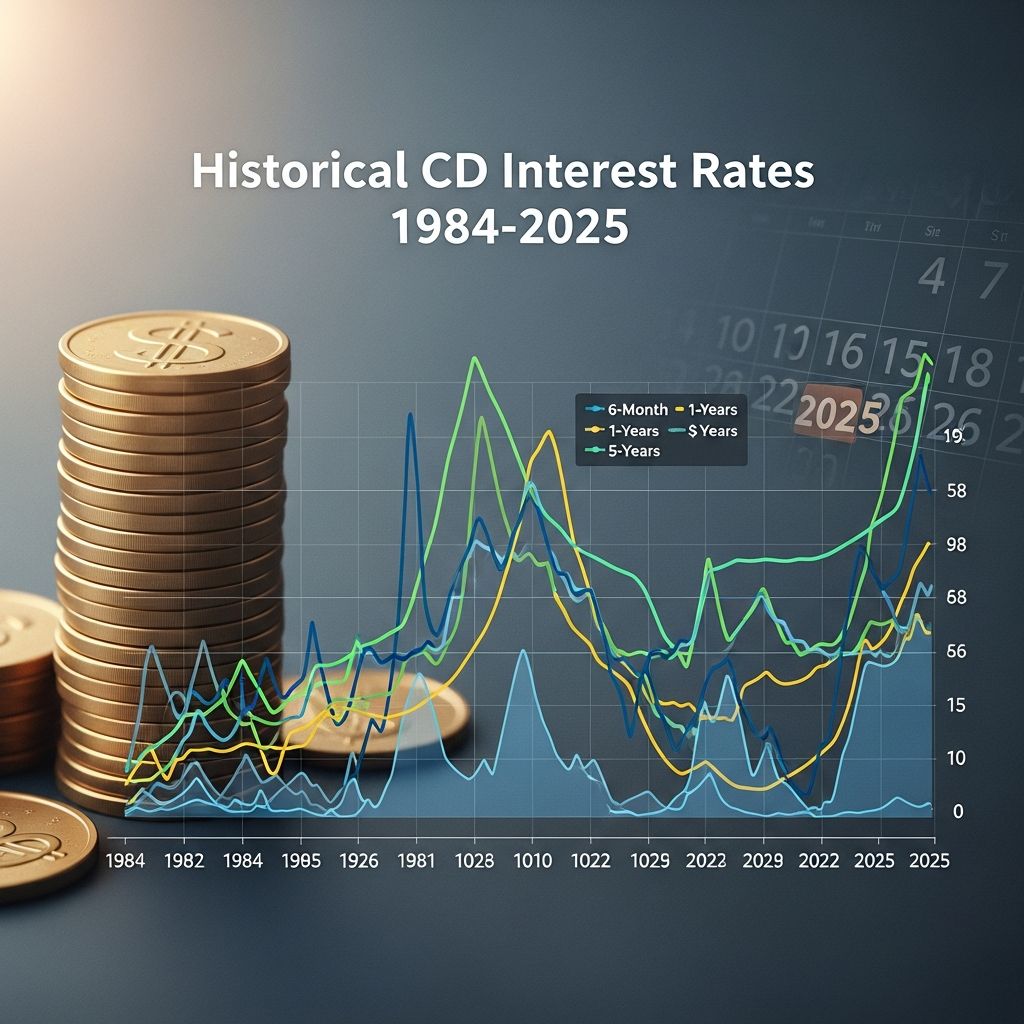
Understanding Historical CD Interest Rates: Four Decades of Market Evolution
Certificate of Deposit (CD) rates have experienced dramatic shifts over the past four decades, reflecting broader economic conditions, inflation trends, and Federal Reserve policy decisions. Nearly 40 years ago, certificates of deposit were considered exceptional investment vehicles, with the average annual percentage yield (APY) on one-year CDs exceeding 11 percent. Today, the landscape looks markedly different. As of November 28, 2025, the average one-year CD yields approximately 1.93 percent APY, though the most competitive banks continue to offer rates reaching up to 4.25 percent. Understanding this historical context provides valuable perspective for savers seeking to optimize their CD investments in the current market environment.
The 1980s: Record-Breaking CD Rates and High Inflation
The 1980s represent a unique period in CD market history, characterized by extraordinarily high interest rates driven primarily by elevated inflation. During this decade, savers had access to double-digit yields that seem almost unimaginable by today’s standards. The U.S. economy faced two recessions in the early 1980s, which created conditions for historically elevated rates.
The peak occurred in early May 1981, when three-month CDs paid approximately 18.3 percent APY according to data from the St. Louis Federal Reserve. This remarkable rate reflected the Federal Reserve’s aggressive monetary policy stance aimed at combating runaway inflation that had reached concerning levels.
However, while savers benefited from these elevated CD yields, the underlying economic reality presented challenges. High inflation meant the cost of goods and services was rising rapidly, which reduced the purchasing power of savers despite their attractive interest earnings. This phenomenon illustrates a fundamental economic principle: nominal interest rates must be examined in the context of inflation rates to understand real returns.
The 1990s: Rate Decline and Economic Stabilization
Following another short recession in the early 1990s, economic conditions improved substantially and inflation fell significantly compared to the previous decade. CD rates declined alongside inflation as the economy stabilized and grew more consistently. The overall decade was characterized by solid economic performance, which meant the Federal Reserve didn’t need to maintain the aggressive monetary policy that had defined the 1980s.
This period demonstrated how closely CD rates track broader economic conditions and Federal Reserve policy. As inflation concerns receded and the economy expanded, the yields offered on CDs normalized to more moderate levels. By the end of the 1990s and into the early 2000s, rates had fallen considerably from their 1980s peaks.
The 2000s: The Financial Crisis and Historic Lows
The trajectory of CD rates took a dramatic turn in the 2000s, particularly following the onset of the global financial crisis. In September 2009, following the devastating effects of the financial crisis, the average one-year CD paid less than 1 percent APY. Even longer-term five-year CDs offered only about 2.2 percent APY. This represented a stark contrast to the double-digit yields of the previous decades.
The Federal Reserve responded to the financial crisis by implementing unprecedented monetary stimulus measures, including slashing its benchmark interest rate to near-zero levels. This aggressive easing aimed to encourage borrowing and spending to revive the economy. However, the policy had significant implications for savers, as banks had little incentive to offer competitive CD rates when they had access to cheap Federal Reserve funding.
CD Rates from 2010 to 2019: Recovery and Gradual Improvement
Following the global financial crisis, CD rates fell to historic lows in U.S. history. The Federal Reserve’s efforts to stimulate the economy left many banks flush with cash, meaning they didn’t need to boost rates on CDs to obtain money for lending. This created an extended period of depressed CD yields for savers.
During this challenging period, yields reached historic lows. In June 2013, average yields on one-year and five-year CDs stood at just 0.24 percent APY and 0.77 percent APY, respectively. These rates barely kept pace with inflation, making CDs an unattractive option for many savers seeking meaningful returns.
However, conditions began to improve as the Federal Reserve gradually increased its benchmark interest rate between December 2015 and 2018. This policy shift, known as rate normalization, allowed CD yields to begin rising. Banks could now justify offering higher rates on CDs as the opportunity cost of funds increased. Toward the end of the 2010s, savers finally began to see meaningful improvements in available CD rates, though they remained modest compared to historical standards.
The COVID-19 Pandemic: A Return to Historic Lows
Just as CD rates were beginning to recover from their post-financial crisis lows, the COVID-19 pandemic prompted the Federal Reserve to return to emergency monetary policy measures. In response to the pandemic’s economic shock, the Fed slashed rates back to near-zero levels, and CD yields plummeted accordingly.
From June 2020 to June 2021, the average one-year CD dropped dramatically from 0.41 percent APY to just 0.17 percent APY. Five-year CDs similarly declined from 0.6 percent APY to 0.31 percent APY. These rock-bottom rates reflected the extraordinary measures taken to support economic activity during the pandemic’s peak uncertainty.
In the wake of the COVID-19 pandemic, average yields for all CD terms, including five-year CDs, plunged below 1 percent APY. This represented another challenging period for savers seeking income from their conservative investments.
The 2022-2023 Rate Hike Cycle and CD Rate Recovery
Beginning in early 2022, CD rates started climbing back up with the onset of aggressive Federal Reserve rate hikes. The Fed implemented 11 rate increases in 2022 and 2023 to combat post-pandemic inflation that had reached multi-decade highs. This policy shift created a favorable environment for CD investors for the first time in years.
The recovery accelerated significantly, with rates shooting up in subsequent years. In September 2023, one-year CDs averaged 1.92 percent APY and five-year CDs averaged 1.29 percent APY. These improvements reflected the Fed’s commitment to raising its benchmark rate, which incentivized banks to charge more on loans while also paying out more on the best high-yield savings accounts and CDs.
APYs peaked in late 2023 before seeing some declines as banks anticipated the Fed would lower its benchmark rate in 2024. This shifting outlook caused banks to reduce the rates they offered on new CDs, as they anticipated lower borrowing costs going forward.
Current Market Conditions: November 2025
As of November 28, 2025, the CD market reflects a transitional period in monetary policy. The national average one-year CD yield stands at 1.93 percent APY, with the most competitive banks offering rates up to 4.25 percent. The national average three-year CD yield is 1.65 percent APY, while the five-year CD yield averages 1.69 percent APY.
Interestingly, since February 2023, the one-year CD average has been higher than the five-year CD average, representing an inversion from historical norms. This reflects expectations that the Federal Reserve will continue to lower rates over time, making longer-term CDs less attractive at their current yield levels.
The Federal Reserve had already lowered rates by 0.25 percentage points at its September 2025 meeting, following the beginning of an easing cycle in late 2024 after the post-pandemic period of multi-decade-high rates in 2023. Because CD rates usually move in the same direction as Fed rates, CD rates are forecast to decline through the end of 2025.
Key Factors Driving CD Rate Fluctuations
Inflation and Purchasing Power: Inflation has been the primary driver of CD rate changes throughout history. During high-inflation periods like the 1980s, the Federal Reserve raises rates aggressively to combat rising prices, which increases CD yields. Conversely, during low-inflation periods, rates remain modest as the need for monetary tightening diminishes.
Federal Reserve Policy: The Fed’s benchmark interest rate has an indirect but significant effect on CD rates. Banks use this rate as a reference point when determining what rates to offer on savings products. When the Fed raises rates, CD rates typically follow. When it lowers rates, CD yields decline in response.
Economic Conditions: Recessions and financial crises typically trigger emergency monetary policy measures that suppress interest rates. Conversely, periods of robust economic growth and low unemployment allow for more normalized or elevated rate environments.
Banking Sector Liquidity: When banks have abundant access to capital (as they did during the post-financial crisis period), they have little incentive to offer competitive CD rates. However, when capital becomes scarcer, banks must compete aggressively for deposits, leading to higher CD yields.
Comparing CD Rates Across Different Terms
Current market data reveals important differences between CD rates offered for different time periods. The following table displays the competitive rates available for various CD terms as of November 2025:
| CD Term | National Average APY | Top Competitive Rate |
|---|---|---|
| 6-Month CD | Not specified | 4.20% |
| 1-Year CD | 1.93% | 4.25% |
| 3-Year CD | 1.65% | 3.95% |
| 5-Year CD | 1.69% | 3.87% |
This comparison demonstrates significant disparity between national average rates and the best available rates from competitive institutions. Savers willing to research and compare CD offerings from multiple banks can substantially improve their returns by choosing the institutions offering the highest yields.
The Long Shadow of Major Economic Events
During and long after the Great Recession, which took place from December 2007 to June 2009, CD yields demonstrated prolonged aftershocks. Yields on one-year CDs hovered below 0.50 percent APY for nearly eight years, demonstrating how extended the recovery period was for CD investors. Similarly, one-year CD rates were close to zero once again for roughly two years during the COVID-19 pandemic.
These extended periods of depressed yields illustrate an important reality: major financial crises don’t just affect rates for a few months. Instead, the ripple effects persist for years as the economy recovers and the Federal Reserve gradually normalizes policy. Savers who locked in longer-term CDs during the crisis periods eventually benefited from being unable to access better rates elsewhere, but those with maturing CDs faced extended periods of suboptimal returns.
What the Historical Record Tells Modern Savers
The historical record of CD rates from 1984 to 2025 reveals several important lessons for today’s savers. First, the dramatic volatility of rates over time emphasizes the impact of inflation and monetary policy on investment returns. Second, major economic events create both challenges and opportunities for savers willing to pay attention to market conditions.
Third, the relationship between Fed policy and CD rates remains consistent across decades, making it worthwhile to monitor Federal Reserve communications and economic forecasts when planning CD purchases. Finally, the disparity between national average rates and top competitive rates suggests that rate shopping remains essential for maximizing CD returns, regardless of the overall rate environment.
Frequently Asked Questions About CD Rates
Q: Why were CD rates so much higher in the 1980s?
A: CD rates were extraordinarily high in the 1980s because inflation had reached very high levels, and the Federal Reserve responded with aggressive rate increases to combat rising prices. High inflation drives up nominal interest rates across the economy, including CD yields, though real returns must account for the inflation rate.
Q: How do Federal Reserve rate changes affect CD rates?
A: The Federal Reserve’s benchmark interest rate has an indirect effect on CDs. Banks use the Fed rate as a reference point for pricing their deposit products. When the Fed raises rates, banks typically increase CD yields to remain competitive. When the Fed lowers rates, CD yields decline accordingly.
Q: Should I choose a shorter-term or longer-term CD right now?
A: The choice depends on your expectations for interest rates and your liquidity needs. Currently, one-year CDs offer higher average yields than five-year CDs, suggesting that shorter-term CDs may be preferable if rates are expected to decline further. However, longer-term CDs lock in rates for extended periods.
Q: What is the difference between the national average CD rate and top competitive rates?
A: The national average represents the typical rate offered across many banks, while top competitive rates are offered by institutions seeking to attract deposits. Shopping around can help you find rates significantly higher than the national average, sometimes by more than 2 percentage points.
Q: How have CD rates changed since the pandemic?
A: CD rates have increased significantly since the pandemic lows. The Federal Reserve’s rate hikes in 2022 and 2023 pushed CD yields to their highest levels since before the financial crisis, though current rates remain well below the double-digit yields of the 1980s.
References
- Historical CD Interest Rates 1984-2025 — Bankrate. November 28, 2025. https://www.bankrate.com/banking/cds/historical-cd-interest-rates/
- Current CD Rates For November 2025 — Bankrate. November 29, 2025. https://www.bankrate.com/banking/cds/current-cd-interest-rates/
- Board of Governors of the Federal Reserve System: Historical Rates — Federal Reserve. https://www.federalreserve.gov/datadownload/
- National Bureau of Economic Research: U.S. Business Cycle Expansions and Contractions — NBER. https://www.nber.org/research/data/us-business-cycle-expansions-and-contractions
- Federal Reserve Economic Data (FRED): Interest Rate Data — Federal Reserve Bank of St. Louis. https://fred.stlouisfed.org/
Similar Articles








Read full bio of Sneha Tete