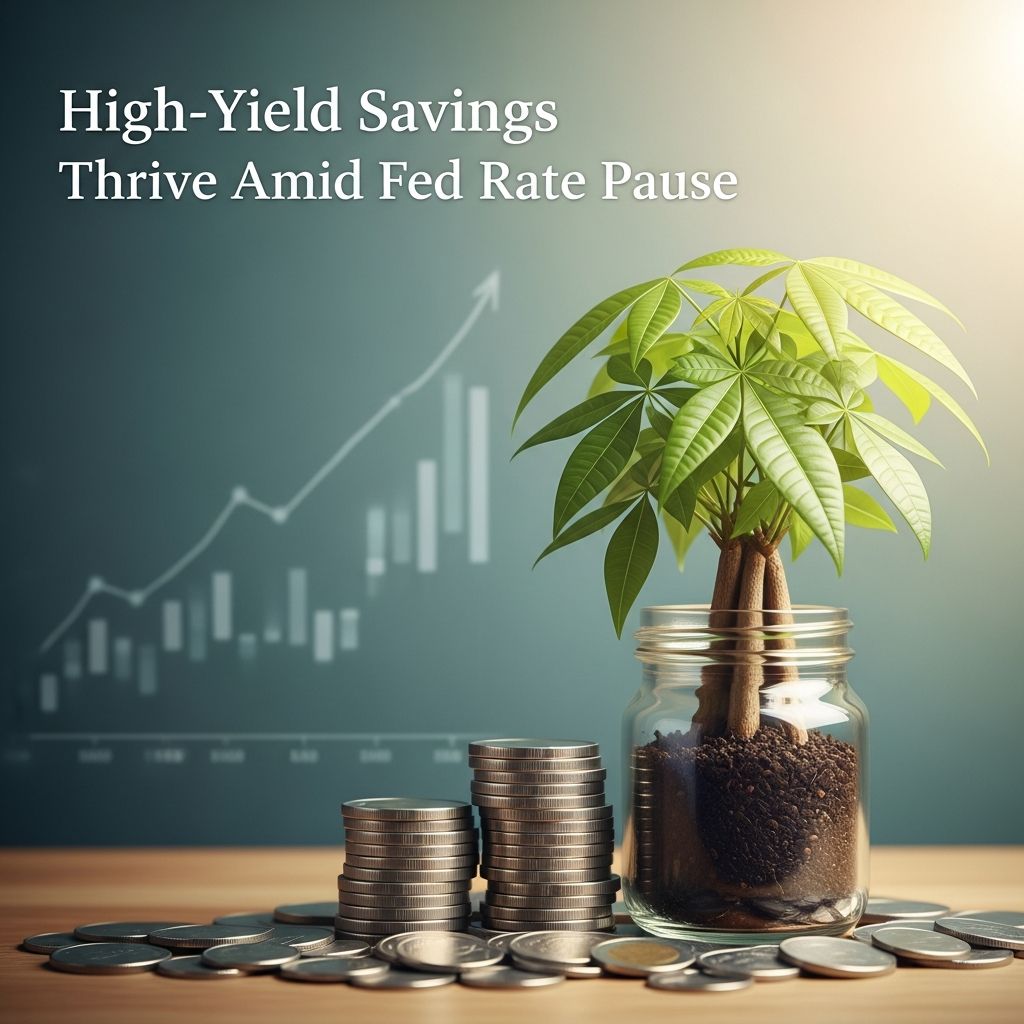
High-Yield Savings Thrive Amid Fed Rate Pause
Even as the Federal Reserve holds rates steady at 3.5%-3.75% into 2026, top high-yield savings accounts continue delivering over 4% APY to boost your emergency fund.
The Federal Reserve’s decision to maintain the federal funds rate at
3.5% to 3.75%
through early 2026 has created a stable environment for savers seeking reliable returns. Despite projections for minimal rate adjustments—potentially just one 25 basis point cut later this year—several high-yield savings accounts continue to offer annual percentage yields (APYs) exceeding 4%, outpacing traditional bank options and inflation risks. This article examines why these accounts remain attractive, highlights leading providers, and provides actionable advice for optimizing your savings strategy in the current economic climate.Understanding the Fed’s Current Stance and Its Impact on Savings
The Federal Open Market Committee (FOMC) recently voted 11-1 to hold rates steady, marking the second consecutive pause after three 25 basis point reductions in late 2025. This decision reflects ongoing concerns over persistent inflation, measured at 3.1% year-over-year via the core Personal Consumption Expenditures (PCE) index in January 2026, which remains above the Fed’s 2% target. External factors, including geopolitical tensions such as the Iran conflict, have introduced volatility in oil prices, further complicating the path to rate cuts.
The Fed’s ‘dot plot’ summary of economic projections indicates a median expectation of one modest cut in 2026, followed by another in 2027, with seven policymakers anticipating no changes this year. J.P. Morgan’s chief U.S. economist Michael Feroli has gone further, forecasting no cuts through 2026 and potential hikes in 2027 due to ‘sticky’ inflation. For savers, this environment means high-yield accounts from online banks and credit unions can still deliver superior returns, as they often pass along competitive rates to attract deposits without the overhead of physical branches.
Why High-Yield Savings Accounts Beat Traditional Options
Traditional savings accounts at brick-and-mortar banks typically yield under 0.5% APY, but high-yield variants from fintech-focused institutions offer
4% or more
, providing a buffer against rising costs. These accounts are FDIC-insured up to $250,000 per depositor, ensuring principal safety while earning compounded interest daily or monthly.- Liquidity: Access funds anytime without penalties, ideal for emergency reserves.
- No minimums or fees: Many require zero opening deposits and waive maintenance charges.
- Compounding power: Daily compounding maximizes growth; for example, $10,000 at 4.5% APY grows to $10,460 in one year.
In a neutral monetary policy range—as described by Fed Chair Jerome Powell—these accounts help preserve purchasing power amid PCE inflation hovering at 2.7% by year-end projections.
Top High-Yield Savings Accounts Offering 4%+ APY in 2026
Despite the Fed’s pause, competitive pressure among online providers keeps rates elevated. Below is a comparison of standout options based on current offerings:
| Provider | APY | Minimum Deposit | Key Features |
|---|---|---|---|
| Ally Bank | 4.25% | $0 | 24/7 support, buckets for goal tracking, ATM access |
| Marcus by Goldman Sachs | 4.40% | $0 | No fees, high-yield CDs available, mobile app |
| Discover Bank | 4.30% | $0 | Cashback debit linked, round-ups for savings |
| Capital One 360 | 4.20% | $0 | Performance Savings, integrates with checking |
| Synchrony Bank | 4.50% | $0 | ATM card, high introductory rates |
These rates are variable and subject to change, but as of March 2026, they exceed the national average by over 10 times. Providers like Synchrony lead with 4.50% APY, appealing to those building larger nests eggs.
Strategies to Maximize Returns in a Steady-Rate Era
To leverage these opportunities:
- Ladder your savings: Split funds across accounts to capture the highest rates; move excess to CDs locking in yields.
- Automate transfers: Set monthly contributions from checking to build habits without effort.
- Monitor rate changes: Use tools like Bankrate or NerdWallet trackers; switch if APYs drop below 4%.
- Combine with I Bonds or TIPS: For inflation protection, allocate 20-30% to government securities yielding above PCE.
Consider a $50,000 portfolio: At 4.3% blended APY, it generates $2,150 annually—enough to offset typical household inflation impacts. Projections from Oxford Economics suggest disinflation from housing costs could support steady high yields through mid-2026.
Building and Maintaining an Emergency Fund
Financial experts recommend 3-6 months of expenses in liquid savings. With rates at 4%+, a $20,000 fund earns about $800 yearly, covering minor shortfalls. In uncertain times—like potential Fed hikes flagged in meeting minutes—prioritize liquidity over riskier investments.
- Calculate needs: Monthly expenses x 3-6 months.
- Replenish post-use: Automate to restore balance.
- Review quarterly: Adjust for life changes like job shifts.
Risks and Considerations in 2026’s Economic Landscape
While attractive, high-yield accounts carry nuances. Rates are not fixed; a Fed hike could pressure banks to adjust downward. Geopolitical risks, including Middle East tensions, may sustain inflation, delaying cuts and benefiting savers short-term. Conversely, if disinflation accelerates as some analysts predict (e.g., via housing trends), yields might soften by Q3.
Diversify across institutions to stay under FDIC limits, and avoid accounts with hidden fees. Tax implications: Interest is taxable as ordinary income, so high earners may prefer Roth IRA ladders for tax-free growth.
Comparing High-Yield Savings to Alternatives
| Option | Yield Range | Liquidity | Risk | Best For |
|---|---|---|---|---|
| HYSA | 4.0-4.5% | High | Low (FDIC) | Emergency funds |
| CDs | 4.2-5.0% | Low | Low | Known timelines |
| Money Market | 4.1-4.4% | High | Low | Check writing |
| Treasuries | 3.8-4.2% | Medium | Very Low | Tax advantages |
| Stocks/Bonds | Variable (5-7% avg) | High | High | Long-term growth |
HYSA shines for balance of yield and access, especially with FOMC calendars showing meetings in April, June, and beyond where policy shifts could emerge.
Frequently Asked Questions (FAQs)
Will savings rates drop if the Fed cuts in 2026?
Possibly, but online banks often lag adjustments. Monitor the CME FedWatch Tool, showing 27.5-35.7% odds for a December cut.
Are high-yield accounts safe?
Yes, if FDIC/NCUA-insured. Verify coverage on the agency’s site.
How often do APYs change?
Weekly or monthly, tied to Fed funds rate. Top accounts adjust gradually.
Can I lose money in HYSA?
No principal loss, but inflation could erode real value if yields fall below 2.7% PCE projections.
What’s the best HYSA for large deposits?
Synchrony or Marcus, with unlimited transfers and ATM perks.
Positioning Your Finances for Long-Term Success
As the Fed navigates inflation at 3.1% core PCE and a neutral policy stance, high-yield savings at 4%+ provide a low-risk way to grow idle cash. With FOMC pauses likely through spring meetings (April 28-29, June 16-17), now is prime time to consolidate funds into top APY accounts. Regularly reassess amid evolving forecasts from J.P. Morgan and others predicting prolonged stability or hikes. By prioritizing these vehicles, savers can achieve meaningful growth without market exposure.
References
- J.P. Morgan pushes back on Fed’s 2026 interest-rate cut forecast — TheStreet. 2026-03-19. https://www.thestreet.com/fed/j-p-morgan-pushes-back-on-feds-2026-interest-rate-cut-forecast
- Fed Holds Rates Steady, Still Sees One Cut in 2026 — Charles Schwab. 2026. https://www.schwab.com/learn/story/fomc-meeting
- Will the Federal Reserve cut interest rates in 2026? — Fox Business. 2026. https://www.foxbusiness.com/economy/federal-reserve-cut-interest-rates-2026
- Could the US Fed Raise Interest Rates In 2026? — Morningstar. 2026. https://global.morningstar.com/en-nd/economy/could-us-fed-raise-interest-rates-2026
- Minutes of the Federal Open Market Committee — Federal Reserve. 2026-01-28. https://www.federalreserve.gov/monetarypolicy/fomcminutes20260128.htm
- Fed Leaves Rates Unchanged to Start 2026 — J.P. Morgan. 2026-01-29. https://www.jpmorgan.com/insights/markets-and-economy/economy/fed-meeting-january-2026
- FOMC Meeting Calendars — Federal Reserve. 2026. https://www.federalreserve.gov/monetarypolicy/fomccalendars.htm
Similar Articles








Read full bio of medha deb