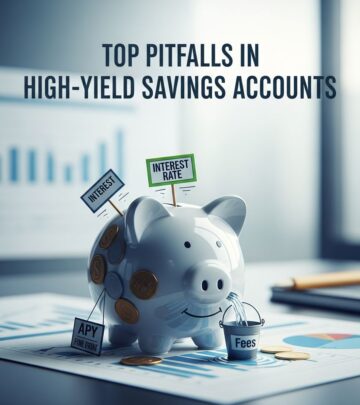
High-Yield Savings Pitfalls to Dodge
Unlock the full potential of high-yield savings accounts by steering clear of these common errors that can erode your earnings and financial progress.

High-yield savings accounts (HYSAs) provide superior interest rates compared to traditional savings options, often several times the national average, enabling faster growth through compound interest. These accounts are ideal for emergency funds and short- to medium-term goals due to their liquidity and FDIC insurance up to $250,000 per depositor. However, missteps in managing them can diminish returns or lead to unnecessary costs. This guide explores key errors to sidestep for optimal results.
Understanding High-Yield Savings Fundamentals
Before diving into pitfalls, grasp the basics. An HYSA earns an
annual percentage yield (APY)
that reflects the real return, accounting for compounding—interest on interest. For instance, a $10,000 deposit at 5.0% APY grows to $10,512 in one year and $16,486 in ten years with daily compounding, far outpacing 0.50% APY at traditional banks. Online banks dominate this space with lower overhead, offering rates around 4% versus 0.41% averages.Benefits include low risk, easy access (with limits), and inflation-fighting potential. Yet, variable rates mean they fluctuate with markets, demanding vigilance.
Overlooking Variable Rate Fluctuations
One major error is assuming HYSA rates remain fixed. Unlike certificates of deposit (CDs), HYSA APYs are variable, rising or falling with federal funds rates. In 2023-2024, rates hovered high post-pandemic hikes, but they can drop swiftly, slashing earnings if you’re unaware.
Impact example: A 4.5% APY dropping to 3% halves additional yearly interest on $20,000 from $900 to $600. Monitor via bank apps or sites like Bankrate, and maintain flexibility across institutions.
Chasing the Highest Rate Without Strategy
Rate-shopping obsessively leads to frequent transfers, triggering fees or withdrawal limits (often six per month under Regulation D, though relaxed post-2020). Bonus offers lure, but promo APYs expire, reverting lower.
- Assess minimum balances for top rates.
- Factor transfer times—delays hinder emergencies.
- Prioritize stability over marginal gains (e.g., 4.8% vs. 5.0%).
Build a ladder: Split funds across 2-3 HYSAs for diversification without constant shuffling.
Ignoring Hidden Fees and Minimums
Not all HYSAs are fee-free. Monthly maintenance, excess withdrawal, or incoming wire fees erode gains. Some require $100+ minimums to earn full APY; falling below triggers penalties.
| Fee Type | Potential Cost | Avoidance Tip |
|---|---|---|
| Monthly Maintenance | $5-15 | Choose no-fee online banks. |
| Excess Withdrawals | $10+ per transaction | Limit to 6/month; use checking for frequent access. |
| Minimum Balance Penalty | Rate reduction | Verify thresholds upfront. |
Always review fee schedules—small charges compound against interest.
Mingling Savings with Daily Spending
Using an HYSA as a checking proxy invites overspending and limits breaches. These accounts suit infrequent access, not bills or impulse buys.
Strategy: Link to a checking account for seamless transfers. Automate deposits post-paycheck to enforce separation, building habits like the 50/30/20 rule (50% needs, 30% wants, 20% savings).
Neglecting Compounding Power
Frequent withdrawals disrupt compounding, where daily or monthly credits amplify growth. A one-time $5,000 deposit at 4% APY yields $336 after five years with monthly compounding versus $324 annually.
- Deposit lump sums early in cycles.
- Avoid dipping for non-essentials.
- Reinvest dividends automatically.
Overfunding Beyond FDIC Limits
Exceeding $250,000 per depositor, per bank, per ownership category risks uninsured losses if the bank fails (rare, but possible). Solution: Spread across multiple FDIC-insured banks or use NCUA for credit unions.
For joint accounts, coverage doubles to $500,000.
Forgetting Tax Implications
HYSA interest is taxable as ordinary income, reported on Form 1099-INT if over $10. High earners may push into higher brackets; track via apps like TurboTax.
Mitigate: Max tax-advantaged accounts first (e.g., Roth IRA), then HYSAs.
Skipping Regular Performance Reviews
Set-it-and-forget-it mentality misses better rates elsewhere. Quarterly check APYs, fees, and goals alignment.
Tools: FDIC’s BankFind, annual percentage yield calculators.
Improper Goal Allocation
HYSAs excel for 1-5 year horizons (emergency funds, vacations), not long-term like retirement—stocks outperform over decades despite volatility.
| Goal Timeline | Best Vehicle | Why HYSA? |
|---|---|---|
| 0-1 Year (Emergency) | HYSA | Liquidity + growth. |
| 1-5 Years (House Down) | HYSA/CD Ladder | Low risk, decent yield. |
| 5+ Years (Retirement) | Index Funds/401(k) | HYSAs lag inflation long-term. |
Overlooking Online-Only Drawbacks
Top HYSAs are often online, lacking branches for cash deposits or in-person service. ATM networks vary; plan for digital-only interactions.
Pro: No-fee perks; Con: Tech glitches delay access.
Building Your Success Framework
1. Research 3-5 HYSAs via FDIC-insured lists.
2. Calculate effective APY post-fees.
3. Automate contributions.
4. Review bi-annually.
5. Diversify for coverage.
This approach turns HYSAs into wealth engines.
Frequently Asked Questions
Are high-yield savings accounts safe?
Yes, FDIC/NCUA insurance protects up to $250,000. Principal risk is nil; main variable is rate changes.
How often do HYSA rates change?
Variable rates adjust weekly/monthly with Fed moves. Track via bank alerts.
Can I lose money in an HYSA?
No, beyond inflation erosion if rates lag. Withdrawals are penalty-free within limits.
What’s better: HYSA or CD?
HYSAs for flexibility; CDs for locked higher rates on known timelines.
Do I need a minimum deposit?
Many have none, but check for APY qualifiers.
References
- What is a High Yield Savings Account and How Do They Work? — PNC Bank. 2024. https://www.pnc.com/insights/personal-finance/save/what-is-a-high-yield-savings-account.html
- How Do High Yield Savings Accounts Work? — Openbank. 2024. https://www.openbank.us/resources/high-yield-savings/how-do-high-yield-savings-accounts-work
- What Is a High-Yield Savings Account? — TD Bank. 2024. https://www.td.com/us/en/personal-banking/learning/what-is-a-high-yield-savings-account
- Pros and Cons of a High-Yield Savings Account — Hancock Whitney. 2024. https://www.hancockwhitney.com/insights/pros-cons-high-yield-savings
- What Is a High Yield Savings Account? Pros, Cons and How It Works — Synchrony Bank. 2024. https://www.synchrony.com/blog/bank/what-is-a-high-interest-savings-account
- What is a High-Yield Savings Account — Chase Bank. 2024. https://www.chase.com/personal/banking/education/basics/high-yield-savings-account
Similar Articles








Read full bio of medha deb