High-Yield CDs Explained
Unlock superior returns with low-risk high-yield CDs: fixed rates, insured deposits, and strategies to maximize your savings in today's market.

High-yield certificates of deposit (CDs) represent a cornerstone of conservative saving strategies, delivering fixed interest rates that often surpass those of standard savings options. These time-bound accounts lock in your funds for a predetermined period in exchange for elevated annual percentage yields (APYs), providing predictability and security backed by federal insurance.
Understanding the Fundamentals of High-Yield CDs
At their core, high-yield CDs are specialized deposit products from banks and credit unions where depositors commit a lump sum for a fixed duration, earning a guaranteed rate of return. Unlike fluctuating savings accounts, the APY remains constant throughout the term, shielding savers from market rate drops. Terms typically span from three months to five years, with longer commitments generally yielding higher rates as institutions reward patience with better compensation.
Opening a high-yield CD involves a one-time deposit, often starting at $500 to $1,000, though some demand up to $100,000 for premium yields. Interest compounds—usually daily or monthly—accelerating growth as earnings reinvest into the principal. Upon maturity, you receive your initial deposit plus accrued interest, with options to withdraw, renew, or reinvest.
Mechanics of Earning with High-Yield CDs
The appeal lies in their straightforward operation: deposit funds, let time and compounding work, then access your enhanced balance. For instance, a $10,000 deposit at 4.5% APY over 12 months compounds to approximately $10,458, assuming monthly compounding. This fixed trajectory contrasts with variable-rate accounts, offering certainty ideal for goal-oriented saving like emergency funds or down payments.
Early access incurs penalties, typically several months’ interest, deterring impulsive withdrawals. This structure incentivizes discipline, ensuring the full benefit materializes only at term’s end. Federal regulations cap insurance at $250,000 per depositor per institution via FDIC for banks or NCUA for credit unions, rendering principal loss highly improbable barring exceeding limits across accounts.
Advantages That Set High-Yield CDs Apart
- Predictable Earnings: Fixed APYs eliminate rate fluctuation risks, allowing precise return calculations from day one.
- Competitive Yields: Often 3-5% APY or higher, dwarfing traditional savings rates under 1%.
- Ultimate Safety: Government-backed insurance protects deposits, making them among the lowest-risk options.
- Compounding Power: Frequent interest crediting amplifies growth exponentially over time.
- Inflation Hedge: In low-rate environments, locking high yields preserves purchasing power.
Potential Drawbacks to Consider
- Liquidity Constraints: Funds are illiquid until maturity, with penalties eroding gains on early exits.
- Opportunity Cost: If rates rise post-purchase, you’re stuck at the lower locked rate.
- Inflation Risk: Fixed returns may lag behind surging prices over long terms.
- Minimum Commitments: Higher-entry options limit accessibility for smaller savers.
High-Yield CDs vs. Alternative Savings Vehicles
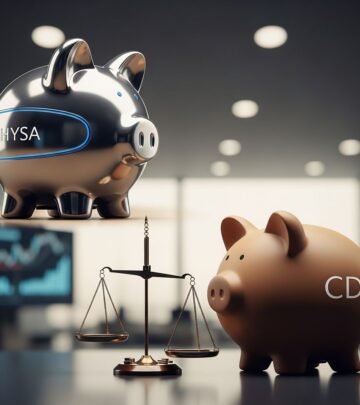
Choosing between high-yield CDs and other accounts hinges on access needs and rate outlook. High-yield savings offer flexibility but variable rates tied to federal funds benchmarks.
| Feature | High-Yield CD | High-Yield Savings |
|---|---|---|
| Rate Type | Fixed | Variable |
| Access to Funds | Penalty before maturity | Unlimited (with limits) |
| Best For | Untouchable savings goals | Liquid emergency funds |
| Insurance | FDIC/NCUA up to $250K | FDIC/NCUA up to $250K |
| Deposits | One-time | Ongoing |
CDs excel for committed funds; savings suit dynamic needs. Money market accounts blend features but often yield less.
Diverse Types of High-Yield CDs
Beyond standard offerings, variations cater to strategies:
- Traditional: Fixed rate and term for baseline reliability.
- Jumbo: For $100K+ deposits, unlocking superior APYs.
- Bump-Up: One rate increase if market rates climb.
- No-Penalty: 7-day withdrawal window post-6 months, blending flexibility.
- Callable: Bank-redeemable if rates fall, capping upside.
Strategies for Maximizing High-Yield CD Returns
To optimize, employ a CD ladder: divide savings across staggered maturities (e.g., 6-, 12-, 24-month terms). This balances liquidity and high rates, allowing periodic reinvestment at prevailing yields. Shop online banks and credit unions for top rates, as they face lower overhead than brick-and-mortar peers.
Monitor Federal Reserve signals; in descending rate cycles, lock long-term high yields preemptively. Diversify across institutions to maximize $250K insurance. Use brokered CDs via platforms for broader access, though verify insurance passthrough.
Navigating Taxes and Maturity Options
Interest is taxable as ordinary income annually, even if inaccessible until maturity—plan via IRA CDs for deferral. At maturity, automate renewals or withdrawals to avoid auto-extensions at suboptimal rates. Alerts prevent oversight.
Current Market Insights for High-Yield CDs
As of 2026, APYs hover 4-5.5% for 1-5 year terms amid steady policy, per industry benchmarks. Shorter terms yield slightly less but offer quicker re-pricing. Compare via aggregators for real-time leaderboards.
Frequently Asked Questions
What is the typical APY for a high-yield CD?
Rates range 3-5.5%, with longer terms commanding premiums; shop competitively.
Are high-yield CDs safe?
Yes, FDIC/NCUA insures up to $250,000 per depositor, minimizing risk.
Can I lose money in a CD?
Principal is secure if held to maturity and within insurance limits; penalties apply otherwise.
How do I avoid early withdrawal fees?
Select no-penalty variants or ladder terms for periodic access.
Should I choose a bank or credit union CD?
Credit unions often edge rates higher; both offer equivalent protection.
What’s a CD ladder?
Staggered maturities for balanced yield and liquidity.
Is a High-Yield CD Right for Your Portfolio?
Ideal for risk-averse savers with idle cash and defined timelines, high-yield CDs fortify financial plans. Assess liquidity needs and rate forecasts before committing—blend with savings for comprehensive coverage.
References
- What Are High-Yield CDs? — Experian. 2023. https://www.experian.com/blogs/ask-experian/what-are-high-yield-cds/
- Certificates of Deposit (CDs): How Do CDs Work? — Ally Bank. 2024-01-15. https://www.ally.com/stories/save/what-is-a-cd-how-does-it-work/
- What is a Certificate of Deposit (CD) & How Does It Work — Bank of America. 2024. https://bettermoneyhabits.bankofamerica.com/en/personal-banking/what-is-a-cd-investment
- CD vs. high-yield savings accounts: Which to choose? — Fidelity. 2025-02-10. https://www.fidelity.com/learning-center/smart-money/cd-vs-high-yield-savings
- Your Insured Deposits — FDIC. 2026-03-01. https://www.fdic.gov/resources/deposit-insurance/
Similar Articles








Read full bio of medha deb