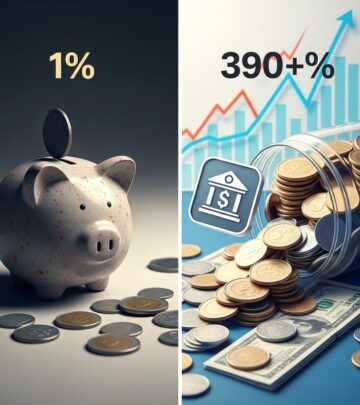
Hidden Costs of Bank of America Savings Accounts
Why traditional banking fees could drain thousands from your savings.

When evaluating where to keep your savings, the choice between traditional brick-and-mortar banks and online alternatives can significantly impact your financial future. Bank of America, one of the nation’s largest financial institutions, offers savings accounts that come with substantial costs that many customers overlook. This comprehensive analysis examines how the combination of monthly fees, minimal interest earnings, and restrictive account requirements can substantially reduce your wealth accumulation over time.
The Monthly Fee Structure That Quietly Drains Your Account
Bank of America’s primary savings offering, the Advantage Savings account, charges an $8 monthly maintenance fee. While this may seem modest on a monthly basis, the cumulative impact reveals a startling financial reality. Over a decade, this fee alone totals $960 in expenses—money that could have remained in your account or been invested for growth.
The bank does offer paths to waive this fee, but the requirements are restrictive and exclude many potential customers. Fee waivers apply if you maintain a daily balance of at least $500, link the account to a Bank of America Advantage Banking checking account, qualify for the Preferred Rewards program, or are under 25 years old. For customers who don’t meet these criteria, the $8 monthly charge becomes an unavoidable expense.
Additional Fees Beyond Monthly Maintenance
The monthly maintenance fee represents only the beginning of Bank of America’s fee structure. The account imposes numerous other charges that can accumulate quickly:
- Withdrawal limit fee: $10
- Non-Bank of America ATM withdrawals: $2.50 per transaction
- Overdraft fees: $35
- NSF (non-sufficient funds) returned item fee: $35
- Overdraft protection transfer fee: $12
- Statement copies: $5 each
- Check-cashing fees: $8 per check for amounts over $50
These ancillary fees create numerous opportunities for unexpected charges. A customer who uses an out-of-network ATM twice monthly, for instance, incurs an additional $60 annually beyond the standard monthly fee.
The Interest Rate Problem: Earning Virtually Nothing
Beyond fees, Bank of America’s savings accounts fail to generate meaningful interest income. The Advantage Savings account offers an annual percentage yield (APY) of just 0.01%. This rate represents a dramatic shortfall compared to the current market.
To illustrate the impact, consider a customer maintaining a $10,000 balance throughout the year. At Bank of America’s 0.01% rate, that balance generates merely $1 in annual interest—a pittance that falls far short of compensating for the $96 in annual maintenance fees charged to the same account.
Preferred Rewards Program Limitations
Bank of America attempts to address its uncompetitive rates through the Preferred Rewards program, which offers higher yields to customers maintaining substantial account balances. However, even with Preferred Rewards membership, the maximum available APY reaches only 0.04%—still extraordinarily low compared to market alternatives. Achieving Preferred Rewards status requires maintaining a three-month combined average daily balance of at least $20,000 across deposit and investment accounts, placing this benefit out of reach for many savers.
Comparative Analysis: What the Market Currently Offers
The financial landscape has transformed dramatically since traditional banks dominated consumer savings. Today’s high-yield savings accounts offer dramatically superior terms. As of March 2026, multiple institutions provide significantly better opportunities:
| Provider | Current APY | Minimum Deposit | Monthly Fees |
|---|---|---|---|
| Varo Money | 5.00% | $0 | $0 |
| Axos Bank | 4.21% | $0 | $0 |
| Capital One 360 | 3.30% | $0 | $0 |
| Ally Bank | 3.30% | $0 | $0 |
| Bank of America | 0.01% | $100 | $8/month |
The differences prove staggering. A customer maintaining a $25,000 balance earns approximately $1,250 annually at Varo Money’s 5.00% rate, while the identical balance at Bank of America generates just $2.50 in yearly interest. Accounting for Bank of America’s monthly fees, that customer actually loses approximately $94 in net annual wealth.
The Decade-Long Cost Calculation
Examining the complete financial picture over ten years reveals why the original article’s premise holds substantial merit. For a customer maintaining a modest $25,000 savings balance and avoiding ancillary fees, the calculation unfolds as follows:
- Monthly maintenance fees: $96 annually × 10 years = $960
- Lost interest earnings: The difference between Bank of America’s 0.01% and a competitive 4.0% rate on $25,000 equals approximately $1,000 annually in forgone earnings × 10 years = $10,000
- Total opportunity cost: Approximately $10,960
While this calculation differs from the $5,000 threshold mentioned in various analyses, the fundamental truth remains consistent: maintaining funds in traditional bank savings accounts produces a substantial long-term financial penalty. Customers with larger balances or those incurring additional fees face even steeper costs.
Physical Branch Access and Service Trade-offs
Bank of America’s primary advantage over online-only competitors involves physical branch accessibility. The institution maintains extensive branch networks that enable in-person banking services, which some customers value for specific transactions or peace-of-mind purposes.
However, this convenience factor rarely justifies the financial cost. Most banking needs—deposits, transfers, and account management—can be conducted through mobile applications offered by competing banks. Emergency situations requiring in-person assistance occur infrequently enough that the average customer should carefully weigh whether occasional convenience justifies thousands of dollars in lost wealth.
Fee-Waiver Requirements as Barriers to Benefit
The mechanism for avoiding Bank of America’s monthly maintenance fee creates perverse incentives that disadvantage many customers. To qualify for the $500 daily balance waiver, customers must maintain funds in low-yield accounts—exactly the opposite of sound financial management. This structure effectively locks savers into suboptimal financial arrangements.
The Preferred Rewards requirement—maintaining $20,000 in combined accounts—similarly benefits only those already possessing significant wealth. Younger savers, single-income households, and individuals rebuilding finances face insurmountable barriers to fee waivers and cannot access higher interest rates regardless of their banking loyalty.
Alternative Account Options for Different Life Stages
Bank of America does recognize that its standard account structure doesn’t serve all customer segments equally. The institution offers a Minor Savings Account with no monthly maintenance fee for account holders under 18 years old. This provides a useful starting point for youth savings programs and automatic wealth-building strategies through parental transfers.
However, upon reaching adulthood, accounts automatically convert to the standard Rewards Savings account structure, subjecting newly adult customers to the full fee schedule. This transition represents a critical financial moment where young adults should consider whether loyalty to Bank of America’s ecosystem truly serves their financial interests.
Decision Framework: When Bank of America Makes Sense
Despite the significant financial drawbacks, Bank of America savings accounts may suit specific customer profiles:
- Customers under 25: If you can maintain the account without fees, the convenience may outweigh minimal costs during early wealth-building years.
- Those requiring frequent in-person banking: If you conduct regular banking transactions requiring branch access and digital tools prove insufficient, the service convenience might justify some costs.
- Individuals with integrated banking needs: Customers maintaining extensive relationships with Bank of America (checking accounts, investment services, loans) may benefit from relationship-level perks.
- People unable to access online banking: Those without reliable internet access or digital literacy may find traditional banking more accessible despite higher costs.
Making the Transition to High-Yield Alternatives
Switching savings accounts requires minimal effort in today’s banking environment. High-yield savings providers typically offer:
- Easy account opening through mobile applications or websites
- Zero minimum deposits at most institutions
- Free transfers from other banking providers
- Full FDIC insurance protection up to standard limits
- Mobile check deposit and digital wallet integration
The transition process takes approximately 15-30 minutes and involves no costs. Customers can maintain existing Bank of America checking accounts for bill payment and direct deposit while relocating savings to higher-yield institutions.
Understanding the Broader Context
The gap between Bank of America’s offerings and online alternatives reflects fundamental differences in business models. Traditional banks maintain expensive physical infrastructure, extensive staffing, and branch networks. These costs flow directly to customers through fees and reduced interest rates. Online-only providers eliminate these expenses and pass savings to customers through higher rates and lower fees.
For savings accounts specifically—products requiring minimal interaction and serving primarily as holding accounts—the traditional bank model has become economically inefficient. Customers paying for services they don’t utilize subsidize the overhead that benefits infrequent users.
Long-Term Wealth Accumulation Impact
The true cost of Bank of America’s savings products extends beyond direct fees and foregone interest. Over decades, the compounding effect creates substantial wealth gaps. A 25-year-old maintaining a $10,000 savings balance for 40 years until retirement experiences dramatically different outcomes:
- Bank of America scenario: Account balance + minimal interest – $3,840 in fees = approximately $6,160 retained
- High-yield account scenario: Account balance + substantial interest – $0 in fees = approximately $52,000+ accumulated
This comparison assumes conservative estimates and excludes additional deposits or investment growth. The actual gap often proves far larger, particularly for customers building systematic savings habits.
Conclusion: Aligning Banking Choices with Financial Goals
The decision to maintain a Bank of America savings account represents a choice with substantial long-term financial implications. While the institution provides genuine value through branch access and integrated banking relationships, these benefits rarely justify the costs for customers whose primary objective involves accumulating savings safely and efficiently.
Sound financial management requires regularly evaluating whether existing banking arrangements serve current needs and goals. For most savers, particularly those seeking to maximize wealth accumulation without active management, high-yield online alternatives provide superior outcomes. The transition involves minimal effort and no costs, making the case for change compelling.
References
- Bank of America Savings Account 2026 Review — MyBankTracker. 2026. https://www.mybanktracker.com/savings/reviews/bank-of-america-savings-account-review-262418
- Bank of America Review 2026: Checking, Savings and CDs — NerdWallet. 2026. https://www.nerdwallet.com/banking/reviews/bank-of-america
- Best High-Yield Savings Accounts 2026: Top 10 Rates, Perks — GreenFi. 2026. https://www.greenfi.com/resources/best-high-yield-savings-accounts-2026
- The Top High-Yield Savings Rates: Up to 5.00% on March 6, 2026 — Fortune. 2026-03-06. https://fortune.com/article/best-savings-account-rates-3-6-2026/
Similar Articles








Read full bio of Sneha Tete