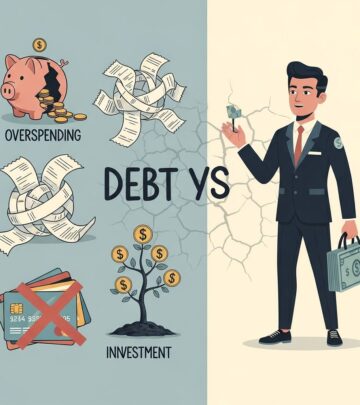
Decision Fatigue: 4 Ways It Costs You Money
Discover how decision fatigue drains your willpower and wallet, with strategies to simplify choices and boost your financial health.

Every day, you face a barrage of decisions—from what to eat for breakfast to which bills to pay first. While each choice seems minor, the sheer volume creates decision fatigue, a psychological state where your mental resources deplete, leading to poorer judgments, especially in spending. This exhaustion doesn’t just affect your willpower; it directly impacts your finances by encouraging impulse purchases, procrastination on important tasks, and suboptimal financial planning. Understanding this phenomenon is key to safeguarding your money.
What Is Decision Fatigue?
Decision fatigue occurs when the mental energy required for choices wears thin after repeated use. Pioneered in research by psychologists like Roy Baumeister, it shows that willpower is a finite resource, much like a muscle that fatigues with overuse. Studies demonstrate that after making numerous decisions, people opt for simpler, often costlier options or default to status quo behaviors.
For instance, judges grant parole more frequently right after breaks when their decision-making is refreshed, dropping sharply as the day progresses. Similarly, shoppers at the end of a store aisle—after hundreds of micro-decisions—are more likely to grab expensive items without scrutiny.
How Decision Fatigue Hits Your Wallet
The financial toll of too many decisions manifests in several ways. Here’s a breakdown:
- Impulse Buying: Exhausted shoppers default to ‘yes’ on tempting offers. A study found grocery store purchases increase by 30-40% when decision load is high.
- Procrastination on Finances: Paying bills or reviewing investments feels overwhelming, leading to late fees or missed opportunities.
- Poor Negotiation: Haggling over prices or services requires focus; fatigue leads to accepting first offers.
- Unhealthy Habits: Decision drain spills into lifestyle choices, like ordering takeout instead of cooking, inflating food costs over time.
| Scenario | Decision-Fatigued Choice | Financial Cost |
|---|---|---|
| Grocery Shopping | Grab pre-packaged meals | $50 extra per week |
| Bill Payment | Delay until late | $30-50 in fees |
| Online Shopping | Add to cart impulsively | $100+ unnecessary spend |
| Investing | Skip research | Lower returns, higher fees |
The Science Behind Willpower Depletion
Research from the American Psychological Association confirms willpower depletion: after resisting temptations or making choices, glucose levels in the brain drop, impairing prefrontal cortex function—the area governing self-control. In finance, this means after a day of work decisions, evening personal finance tasks suffer.
A classic experiment had participants choose jam flavors; those overwhelmed by options bought more but chose poorly. Applied to money: endless investment options or credit card choices paralyze, leading to defaults like high-fee accounts.
Real-Life Examples of Costly Decision Overload
Consider Sarah, a working mom. Mornings exhaust her with outfit, breakfast, and commute choices. By evening, she skips budgeting, orders pizza ($20), and impulse-buys clothes online ($80). Weekly, this tallies $200+ in avoidable costs.
Or take Mike, who after 50 daily work decisions, accepts his bank’s high-interest loan renewal without shopping around, costing $500 yearly in extra interest. These anecdotes mirror broader patterns: decision overload turns small leaks into financial floods.
Strategies to Combat Decision Fatigue
Reducing decision load preserves willpower for high-stakes financial choices. Implement these proven tactics:
- Automate Finances: Set up auto-payments for bills, transfers to savings, and recurring investments. This eliminates monthly deliberations.
- Simplify Wardrobe: Adopt a capsule wardrobe (e.g., Steve Jobs’ black turtlenecks) to cut morning choices, freeing mental energy.
- Meal Prep: Plan weekly meals once, prep in batches. Saves $100/month vs. daily decisions leading to takeout.
- Routine Building: Standardize daily habits like exercise or coffee orders to bypass trivial choices.
Simplifying Your Financial Life
Streamline money management to minimize decisions:
- Consolidate Accounts: Use 1-2 checking/savings accounts, one investment platform. Fewer logins mean less choice paralysis.
- Pre-Commit Rules: E.g., ‘No spending over $20 without 24-hour wait.’ Removes on-the-spot judgments.
- Limit Options: Curate shopping lists or use apps blocking impulse sites during fatigue-prone hours (evenings).
Voluntary simplicity amplifies this: focus on needs vs. wants, outsourcing low-value decisions to systems.
Daily Routines to Preserve Willpower
Structure your day to tackle big decisions early:
- Morning: Handle finances when fresh—review budgets, invest.
- Afternoon: Routine tasks.
- Evening: Relax, no choices.
Replenish willpower with rest, nutrition, and breaks. Short walks or meditation restore glucose and focus, per NIH studies.
Case Studies: Success Through Fewer Choices
Mark Zuckerberg limits outfits to gray tees, saving decisions for Facebook strategy. Result: sharper focus, business growth. Similarly, a family automating bills and meal prepping saved $3,000 yearly, redirecting to debt payoff.
In investing, Warren Buffett advises index funds over stock-picking marathons, avoiding fatigue-induced errors.
Frequently Asked Questions (FAQs)
Q: What causes decision fatigue the most?
A: Trivial, repeated choices like what to wear or eat deplete willpower fastest, leaving little for finances.
Q: How much can decision fatigue cost annually?
A: Easily $1,000-$5,000 through impulses, fees, and missed savings, varying by lifestyle.
Q: Can apps help reduce financial decisions?
A: Yes—tools like Mint or YNAB automate tracking; Acorns rounds up purchases for effortless investing.
Q: Is decision fatigue real science?
A: Yes, backed by peer-reviewed studies on ego depletion and glucose-willpower links.
Q: How do I start simplifying today?
A: Pick one area: automate a bill or plan tomorrow’s meals now.
Long-Term Benefits of Fewer Decisions
Embracing minimalism yields compounding gains: more savings, less stress, better health. Over years, this shifts from reactive spending to intentional wealth-building. Track progress monthly to stay motivated.
Ultimately, mastering decision load empowers financial freedom. Fewer choices today mean richer tomorrows.
References
- Ego Depletion: Is the Active Self a Limited Resource? — Roy F. Baumeister et al. Journal of Personality and Social Psychology. 1998-05-01. https://doi.org/10.1037/0022-3514.74.5.1252
- Decision Fatigue and Glucose Levels — Matthew Gailliot et al. Personality and Social Psychology Bulletin. 2007-11-01. https://doi.org/10.1177/0146167207305172
- Parole Board Study on Decision Fatigue — Shai Danziger et al. Proceedings of the National Academy of Sciences. 2011-04-25. https://www.pnas.org/doi/10.1073/pnas.1018033108
- Willpower: Rediscovering the Greatest Human Strength — American Psychological Association Review. 2012. https://www.apa.org/monitor/2012/01/willpower
- Consumer Choice Overload — Sheena Iyengar, Columbia Business School. 2000. https://www0.gsb.columbia.edu/faculty/siyengar/papers/2000%20theimpactofchoice.pdf
Similar Articles








Read full bio of Sneha Tete