HELOC vs Credit Cards for Debt Relief
Explore if tapping home equity through a HELOC beats high-interest credit card debt—pros, cons, and smart strategies revealed.
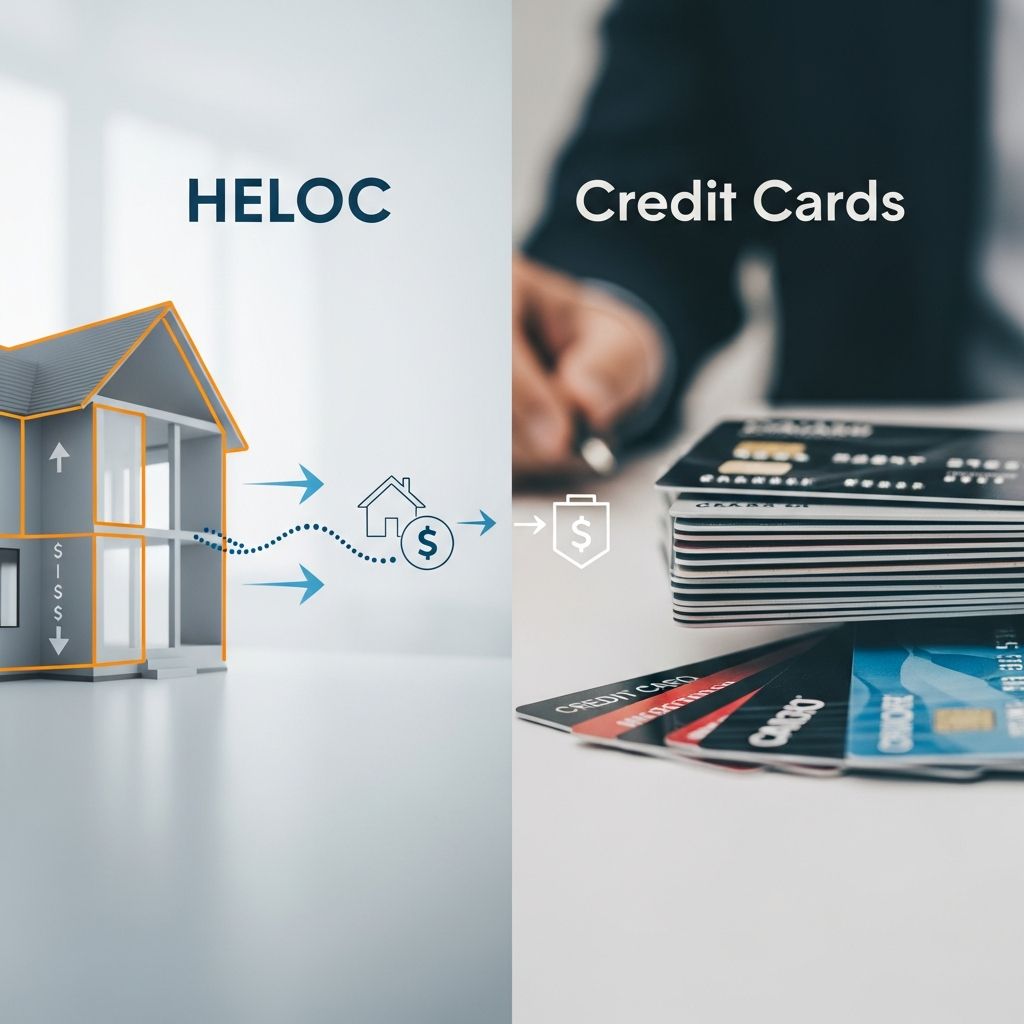
High-interest credit card debt burdens millions of Americans, with average rates exceeding 23% in recent years. A home equity line of credit (HELOC) offers a potential lifeline by allowing homeowners to borrow against their property’s value at much lower rates, often around 8%. This strategy can slash interest costs but introduces significant risks since your home secures the loan. This guide breaks down the mechanics, benefits, drawbacks, and alternatives to help you decide if a HELOC aligns with your financial goals.
Understanding Home Equity Lines of Credit
A
HELOC
functions like a revolving credit line secured by your home’s equity—the difference between your property’s market value and your outstanding mortgage balance. Lenders typically let you access 80-85% of this equity, providing flexibility to draw funds as needed during a draw period, usually 5-10 years, followed by a repayment phase.Unlike a traditional home equity loan that disburses a lump sum, a HELOC charges interest only on the amount you withdraw. This pay-as-you-go structure mirrors credit cards but with secured collateral, leading to lower rates. For instance, if your home is worth $400,000 and you owe $200,000, you might qualify for up to $160,000 in credit, depending on lender criteria and your credit score.
Why Credit Card Debt Hurts Your Wallet
Credit cards offer unsecured convenience but at a steep price. Average APRs hover near record highs of 23%, compounding daily and ballooning balances quickly. Minimum payments mostly cover interest, extending payoff timelines indefinitely without disciplined repayment. In contrast, HELOC rates, tied to the prime rate, remain far lower, making debt consolidation appealing for long-term savings.
| Feature | Credit Cards | HELOC |
|---|---|---|
| Average Interest Rate | ~23% | ~8% |
| Secured By | Unsecured | Home Equity |
| Repayment Flexibility | Minimum payments, no end date | Draw period + repayment phase |
| Access Method | Revolving | Revolving (draw as needed) |
This table highlights the core differences driving many toward HELOCs for debt payoff.
Key Advantages of Using a HELOC for Credit Card Payoff
- Drastic Interest Savings: Shifting $20,000 from a 23% card to an 8% HELOC could save thousands annually. More payments target principal, accelerating debt reduction.
- Flexible Borrowing: Draw only what you need to clear cards, avoiding unnecessary debt. Pay interest solely on used funds.
- Fixed or Predictable Payments: Many HELOCs offer fixed-rate options post-draw period, aiding budgeting over cards’ variable minimums.
- Potential Tax Benefits: Interest may be deductible if funds improve your home, up to $750,000 in qualified loans through 2026.
- Lower Monthly Burden: Longer terms (10-30 years) reduce payments compared to shorter debt consolidation loans.
The Hidden Dangers and Downsides
While tempting, HELOCs aren’t risk-free. Your home is collateral; defaulting risks foreclosure, a far graver consequence than credit damage from cards. Variable rates, common in HELOCs, could rise with market shifts, increasing costs unpredictably.
- Risk of More Debt: Clearing cards frees them up—without spending discipline, you could accumulate debt twice over.
- Equity Erosion: Borrowing reduces your home stake, problematic if values dip or you sell soon.
- Fees and Closing Costs: Expect appraisals, origination fees (1-5% of line), and annual charges, adding upfront expenses.
- Qualification Hurdles: Needs strong credit (680+ FICO), stable income, and sufficient equity (15-20% minimum).
- Rate Volatility: Unlike fixed-rate home equity loans, HELOCs fluctuate, potentially negating savings if rates climb.
Financial Profile: Who Benefits Most?
Ideal candidates have substantial equity, excellent credit, steady income, and a commitment to avoid new card debt. Run the numbers: If your card debt exceeds $10,000 at double-digit rates and you can afford payments 20-30% higher than minimums, a HELOC often wins.
Calculate affordability using this formula: Monthly payment = (Loan amount × Monthly rate) / (1 – (1 + Monthly rate)^(-Term months)). Tools from lenders help simulate scenarios.
Comparing HELOC to Other Debt Relief Options
Don’t overlook alternatives. Debt consolidation loans offer unsecured fixed rates (7-15%) without home risk but shorter terms mean higher payments. Balance transfers provide 0% intro APRs (12-21 months) if your credit qualifies, buying time interest-free.
| Option | Interest Rate | Risk Level | Best For |
|---|---|---|---|
| HELOC | 8-10% variable | High (home at risk) | High equity, disciplined spenders |
| Home Equity Loan | 7-9% fixed | High | Lump-sum needs |
| Debt Consolidation Loan | 7-15% fixed | Low | No equity, shorter payoff |
| Balance Transfer Card | 0% intro, then 18-25% | Low | Short-term payoff |
Steps to Secure a HELOC Safely
- Check Equity: Appraise your home and subtract mortgage balance; aim for 20%+ cushion.
- Review Credit: Boost score above 680; pay down utilization below 30%.
- Shop Lenders: Compare rates, fees, draw periods from banks, credit unions, online lenders.
- Pay Off Cards Immediately: Transfer funds directly; cut up cards or lock away to prevent reuse.
- Budget Ruthlessly: Allocate savings to extra principal payments; track via apps.
- Monitor Rates: Refinance if fixed options emerge or rates drop.
Real-World Scenarios: Does It Pay Off?
Consider Jane with $25,000 card debt at 22% APR. Minimum payments barely dent principal. Switching to a HELOC at 8.5% halves interest, freeing $400/month for savings or payoff. Over 10 years, she saves $18,000+ in interest.
Conversely, if Bob lacks discipline, clearing cards leads to $40,000 total debt, now risking his home. Success hinges on behavior change.
Frequently Asked Questions
Can I use a HELOC if I have bad credit?
Rates climb with poor scores, but approval possible above 620 FICO with ample equity. Improve credit first for best terms.
How long does HELOC approval take?
2-6 weeks, including appraisal. Faster than mortgages but slower than cards for emergencies.
What if home values drop after borrowing?
You owe the full amount regardless; negative equity complicates sales or refinancing.
Are HELOC rates fixed or variable?
Mostly variable, but some offer fixed-rate advances. Confirm with lender.
Should renters consider this?
No—requires homeownership and equity. Explore personal loans instead.
Building Lasting Financial Habits Post-HELOC
A HELOC addresses symptoms, not causes. Pair it with budgeting (50/30/20 rule), emergency funds (3-6 months expenses), and credit counseling if needed. Automate payments to avoid misses. Track progress quarterly; celebrate milestones without spending.
Ultimately, while HELOCs offer powerful relief from credit card traps, they demand respect for the collateral involved. Assess your situation holistically—equity, discipline, and alternatives—before proceeding. Consult a financial advisor for personalized math.
References
- Should I Use a HELOC Over a Credit Card? — Comerica. 2023. https://www.comerica.com/insights/personal-finance/should-i-use-a-heloc-over-a-credit-card.html
- Why you should use home equity to pay credit card debt in 2025 — CBS News. 2025-01-15. https://www.cbsnews.com/news/why-you-should-use-home-equity-to-pay-credit-card-debt-in-2025/
- Which Is Better: Debt Consolidation or Home Equity Loan? — InCharge Debt Solutions. 2024. https://www.incharge.org/blog/better-debt-consolidation-home-equity-loan/
- Should I Use a HELOC to Pay Off Credit Card Debt? — Experian. 2025. https://www.experian.com/blogs/ask-experian/should-i-use-heloc-to-pay-off-credit-card-debt/
- Credit Card Vs Home Equity Loan & HELOC Financing — TD Bank. 2024. https://www.td.com/us/en/personal-banking/credit-card-vs-home-equity-financing
Similar Articles








Read full bio of Sneha Tete