HELOC and Home Equity Loan Requirements in 2025
Complete guide to qualifying for home equity loans and HELOCs with 2025 requirements and eligibility criteria.

Borrowing against your home’s equity can be an effective way to access funds for renovations, debt consolidation, or other major expenses. However, qualifying for a home equity loan or home equity line of credit (HELOC) requires meeting specific financial criteria set by lenders. Understanding these requirements before applying can help you determine your eligibility and improve your chances of approval.
Key Requirements for Home Equity Borrowing
Whether you’re considering a home equity loan or a HELOC, lenders evaluate borrowers based on several fundamental criteria. These requirements protect lenders by ensuring borrowers have the financial capacity to repay the borrowed funds. The main qualification factors include maintaining adequate equity in your home, demonstrating a strong credit history, maintaining a healthy debt-to-income ratio, and providing proof of stable income.
At Least 20 Percent Equity in Your Home
One of the most critical requirements for securing a home equity loan or HELOC is maintaining sufficient equity in your property. Most lenders require you to have a minimum of 20 percent equity in your home, though some lenders may accept as little as 15 percent. This equity requirement ensures that even after lending you money, the lender maintains a secure position with adequate collateral.
Understanding Home Equity and LTV
Home equity represents the difference between your home’s current market value and the outstanding balance on your mortgage. To calculate your equity percentage, lenders use the loan-to-value (LTV) ratio. To find your LTV, divide your current mortgage balance by your home’s appraised value. For example, if your mortgage balance is $150,000 and your home is appraised at $450,000, your LTV would be approximately 33 percent, meaning you have 67 percent equity in your home.
Combined Loan-to-Value (CLTV) Considerations
Beyond your primary mortgage’s LTV, lenders also consider the combined loan-to-value (CLTV) ratio, which includes both your existing mortgage and the new home equity financing you’re seeking. Generally, lenders want your CLTV to be no more than 80 percent. This means that the total of your mortgage balance plus the home equity loan cannot exceed 80 percent of your home’s appraised value. Some lenders may extend this to 85 or 90 percent, but 80 percent is the industry standard.
Why the 20 Percent Equity Cushion Matters
The requirement to maintain at least 20 percent equity in your home serves as a protective buffer for lenders. This cushion helps protect them against potential declines in home value and ensures they maintain a strong collateral position. Additionally, having substantial equity in your home typically indicates you’re a more responsible borrower who has been making mortgage payments consistently over time.
Credit Score Requirements
Your credit score is a vital factor in determining your eligibility for home equity financing. Lenders use your credit score to assess your borrowing history and your likelihood of repaying the debt on time.
Minimum Credit Score for Qualification
A credit score in the mid-600s is typically the minimum required to get approved for a home equity loan or HELOC. Specifically, most lenders require a minimum credit score between 620 and 680, depending on the type of loan. However, meeting the minimum requirement doesn’t guarantee favorable terms or rates.
Credit Scores and Interest Rates
Your credit score directly impacts the interest rate you’ll receive on your home equity financing. A credit score in the 700s will qualify you for better rates and more favorable terms. A score of at least 740 helps you secure the best available interest rates, which could save you substantial amounts over the life of your home equity loan.
Options for Borrowers with Lower Credit Scores
Some lenders extend home equity loans and HELOCs to borrowers with credit scores below 620, but these lenders typically require additional compensating factors. Borrowers with lower credit scores may need to have more equity in their homes, carry less debt relative to their income, and accept higher interest rates, limited loan amounts, and shorter repayment periods.
Debt-to-Income (DTI) Ratio Requirements
Your debt-to-income ratio is another crucial factor lenders evaluate when determining whether to approve your home equity loan or HELOC application. This ratio measures how much of your gross monthly income goes toward paying debt obligations.
Understanding Your DTI Ratio
To calculate your debt-to-income ratio, add up all of your monthly debt payments and divide by your monthly gross income. Your monthly debt payments include mortgage payments, car loans, student loans, credit card payments, and any other recurring debt obligations. For example, if your monthly debts total $2,150 and your gross monthly income is $5,000, your DTI ratio would be 43 percent.
Maximum DTI Ratio Thresholds
Lenders typically want your DTI ratio to be no more than 43 percent. This threshold shows that your existing obligations consume less than half your earnings and demonstrates you have adequate financial capacity to take on additional debt. A general standard for conventional loans is a DTI ratio of 36 percent, though many lenders allow up to 43 percent for home equity borrowing.
Improving Your DTI Ratio
If your current DTI ratio exceeds acceptable thresholds, you can improve it by either increasing your income or reducing your monthly debt obligations. Paying off high-interest credit card balances or paying off car loans before applying can lower your debt payments, thus improving your ratio. Additionally, the higher your income, the easier it becomes to lower your DTI ratio.
Adequate Income and Proof of Income
Lenders require evidence that you have sufficient and stable income to support your home equity loan or HELOC payments. While there isn’t a set minimum income requirement, your income must be adequate to satisfy the DTI ratio requirement for the amount of money you’re seeking to borrow.
Income Verification Documentation
When applying for a home equity loan or HELOC, be prepared to provide comprehensive income verification information. This typically includes W-2 forms, recent paystubs, tax returns, and 1099 forms if you’re self-employed. Lenders may also request additional documentation if your income situation is complex or includes multiple income sources.
The Importance of Steady Income
A consistent income history indicates to lenders that you’ll be able to make regular payments on your loan. Lenders typically look for at least two years of stable income in the same field or industry. If you’ve recently changed jobs or experienced significant income fluctuations, lenders may require additional explanation or documentation to verify income stability.
Mortgage Payment History and Standing
Beyond equity, credit score, DTI ratio, and income, lenders also require that you be in good standing on your current mortgage payments. This means your mortgage account should be current with no late payments or delinquencies in your recent payment history. A strong mortgage payment history demonstrates your ability and commitment to repaying secured debt obligations.
Home Appraisal and Property Requirements
When you apply for a home equity loan or HELOC, the lender will order a home appraisal to determine your property’s current fair market value. This appraisal is essential for calculating your available equity and determining the maximum loan amount you can borrow. The lender will use the appraised value to determine your LTV and CLTV ratios.
Calculating Your Borrowing Capacity
Understanding how to calculate your maximum borrowing capacity helps you determine realistic loan amounts before applying. Here’s a step-by-step approach to determine how much you can borrow.
Step 1: Determine Your Home’s Value
The first step is establishing your home’s current market value. You can obtain this through a professional appraisal, automated valuation models, or comparative market analysis from a real estate professional. For this example, assume your home is appraised at $400,000.
Step 2: Calculate Your Available Equity
To determine your available equity, subtract your outstanding mortgage balance from your home’s appraised value. If your mortgage balance is $250,000 and your home is worth $400,000, you have $150,000 in equity. However, this full amount isn’t available for borrowing due to lender requirements.
Step 3: Apply the 80 Percent CLTV Rule
Most lenders cap your total borrowing at 80 percent of your home’s value. To calculate your maximum borrowing capacity, multiply your home’s value by 0.80, then subtract your existing mortgage balance. Using our example: $400,000 × 0.80 = $320,000 – $250,000 = $70,000. This means you could qualify to borrow up to $70,000 in home equity financing.
Step 4: Consider Your Financial Profile
Even if you have sufficient equity and favorable LTV/CLTV ratios, your actual borrowing capacity also depends on your credit score, DTI ratio, and income. If your appraised value, credit profile, and financial metrics align favorably, you’re likely to receive approval for the maximum calculated amount.
Comparing HELOCs and Home Equity Loans
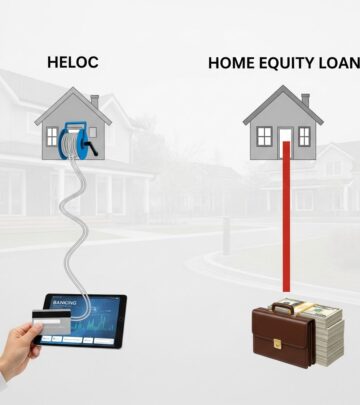
While the qualification requirements for home equity loans and HELOCs are generally similar, some differences exist in the application process and lender-specific requirements.
| Criteria | Home Equity Loan | HELOC |
|---|---|---|
| Credit Score Minimum | 640-680 | 640-680 (some lenders accept 650+) |
| Equity Requirement | At least 20% | At least 20% |
| DTI Ratio Maximum | 43% or less | 43% or less |
| Application Process | Includes title searches and full appraisals | Usually skips title searches and full in-person appraisals |
| Processing Time | More complex, longer timeframe | Simpler, faster process |
Documentation Required for Application
- Proof of employment and income (pay stubs, tax returns, W-2s, or 1099s)
- Bank and financial statements
- Homeowners insurance policy information
- Proof of home ownership (title or deed)
- Complete list of assets and debts, including your mortgage
- Explanation of the reason for requesting the loan
Frequently Asked Questions
Q: What is the minimum home equity percentage required to qualify for a HELOC or home equity loan?
A: Most lenders require a minimum of 20 percent equity in your home, though some lenders may accept as little as 15 percent. The more equity you have, the better your loan terms and borrowing capacity typically are.
Q: Can I get a home equity loan with a credit score below 620?
A: Some lenders offer loans to borrowers with credit scores below 620, but they typically require compensating factors such as higher equity percentages, lower debt-to-income ratios, and they will likely charge higher interest rates.
Q: What does debt-to-income ratio mean, and how is it calculated?
A: Your debt-to-income ratio is the percentage of your gross monthly income that goes toward debt payments. Calculate it by dividing your total monthly debt payments by your gross monthly income. Lenders typically want this to be 43 percent or less.
Q: Is there a minimum income requirement for home equity loans or HELOCs?
A: There’s no specific minimum income requirement, but your income must be sufficient to meet the lender’s debt-to-income ratio requirement for the loan amount you’re seeking. Lenders want to see stable, verifiable income.
Q: How long does the application process typically take?
A: The application process is somewhat simpler than a mortgage application. HELOCs typically have a faster process than home equity loans since they usually don’t require title searches or full in-person appraisals.
Q: What happens if I don’t meet all the requirements?
A: If you don’t meet standard requirements, you have several options: improve your credit score, reduce your debt-to-income ratio, wait to build more equity, or seek lenders that specialize in non-traditional borrowing profiles, though they typically offer less favorable terms.
Q: Does the type of income matter for qualification?
A: Lenders typically accept various income types including W-2 employment income, self-employment income, retirement income, and investment income. Self-employed borrowers may need to provide additional documentation such as tax returns and profit-and-loss statements.
Q: How is the maximum borrowing amount determined?
A: Lenders typically allow you to borrow up to 80 percent of your home’s value, minus what you still owe on your mortgage. Some lenders may go as high as 85 or 90 percent. The exact amount depends on your home value, mortgage balance, credit score, income, and debt-to-income ratio.
References
- How Much Home Equity Can You Really Borrow? — Bankrate. 2025. https://www.bankrate.com/home-equity/maximum-home-equity-amount/
- HELOC and Home Equity Loan Requirements in 2025 — Bankrate. 2025. https://www.bankrate.com/home-equity/requirements-to-borrow-from-home-equity/
- Understanding The Home Equity Loan Approval Process — Bankrate. 2025. https://www.bankrate.com/home-equity/home-equity-loan-approval-process/
- Federal Reserve Consumer Credit Panel — Board of Governors of the Federal Reserve System. 2024. https://www.federalreserve.gov/
- Understanding Credit Scores and Lending Standards — Consumer Financial Protection Bureau. 2024. https://www.consumerfinance.gov/
Similar Articles








Read full bio of Sneha Tete