Health Savings Accounts: Complete Pros and Cons Guide
Understand the advantages and disadvantages of HSAs to make informed healthcare decisions.
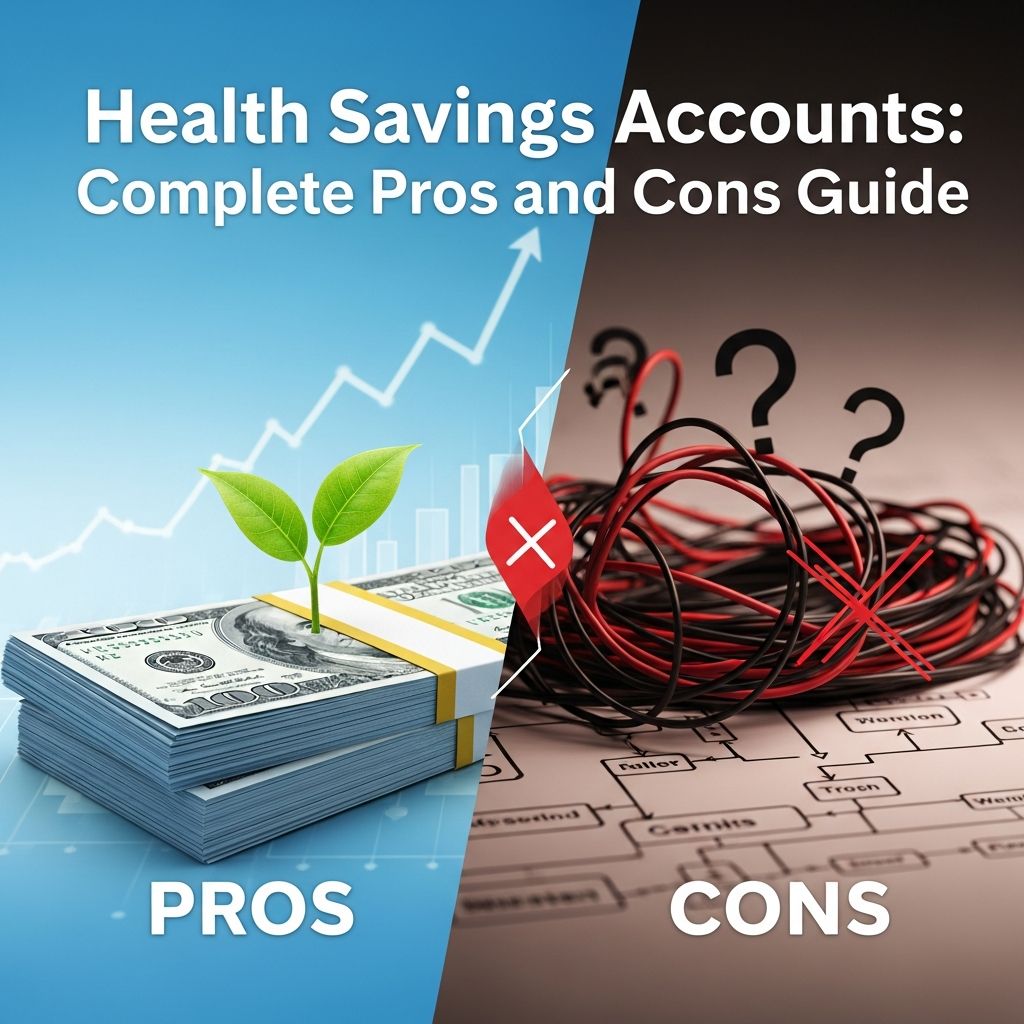
Understanding Health Savings Accounts: Pros and Cons
A Health Savings Account (HSA) is a tax-advantaged savings vehicle designed to help individuals set aside pre-tax dollars to pay for qualified medical expenses. Unlike traditional health insurance accounts, HSAs offer unique flexibility and long-term savings potential. However, like any financial tool, they come with distinct advantages and limitations that deserve careful consideration. Understanding both sides of the HSA equation is essential for making informed decisions about your healthcare and financial planning.
What Is a Health Savings Account?
An HSA is a special tax-advantaged savings account that pairs with a High Deductible Health Plan (HDHP). These accounts function similarly to Individual Retirement Accounts (IRAs) but are specifically designated for medical expenses. To be eligible for an HSA, you must be enrolled in an HSA-qualified health plan, which typically covers only preventive services before the deductible is met. The funds you contribute to your HSA can be used immediately for qualified medical expenses or invested for future growth, providing flexibility that distinguishes HSAs from other healthcare savings options.
The Advantages of Health Savings Accounts
Triple-Tax Advantages
The most compelling benefit of an HSA is its triple-tax advantage structure. First, contributions to your HSA are made with pre-tax dollars, either through payroll deduction or as tax-deductible contributions when filing taxes. This immediately reduces your taxable income. Second, any interest earned on your HSA balance grows tax-free, allowing your money to compound without federal income tax implications. Third, withdrawals used for qualified medical expenses are entirely tax-free, creating a complete tax exemption across all three stages of the account lifecycle.
For individuals in the 22% federal income tax bracket, this triple-tax benefit can translate to nearly 30% in total tax savings when accounting for federal income tax, FICA taxes (Social Security and Medicare), and potentially state income taxes. This substantial tax advantage makes HSAs one of the most tax-efficient healthcare savings tools available.
No Use-It-or-Lose-It Requirement
Unlike Flexible Spending Accounts (FSAs), HSAs do not operate under use-it-or-lose-it rules. Any unused funds roll over from year to year without limit or possibility of forfeiture. This fundamental difference allows your HSA balance to accumulate over time, potentially growing into a substantial reserve for future healthcare needs. You can carry forward funds indefinitely, providing long-term financial security and the ability to build a health expense nest egg.
Portability and Ownership
Your HSA is yours to keep regardless of life changes. The account remains with you even when you change employers, switch health plans, or retire. Unlike employer-sponsored Health Reimbursement Arrangements (HRAs), HSAs are portable and non-forfeitable, giving you complete control over your healthcare savings. This portability ensures that years of contributions and investment growth remain accessible throughout your career transitions.
Investment Opportunities
HSAs go beyond simple savings by allowing you to invest your funds in various vehicles such as money market accounts and mutual funds. By investing at least a portion of your HSA funds, you can potentially grow your medical spending nest egg through market returns. According to 2025 estimates, a 65-year-old individual may need approximately $172,500 in after-tax savings to cover healthcare expenses in retirement. Strategic HSA investment during your working years can significantly contribute to meeting these substantial future healthcare costs.
Comprehensive Coverage of Medical Expenses
HSAs can be used to pay for a remarkably broad range of qualified medical expenses. These include medical plan deductibles, diagnostic services, Medicare Part B premiums, long-term care insurance premiums, LASIK surgery, nursing services, copayments, coinsurance, dental care, contact lenses, eyeglasses, bandages, and X-rays. This extensive list of covered expenses makes HSAs applicable to most people’s healthcare situations, providing flexibility in how you use your funds.
No Minimum Contribution Required
There is no mandatory minimum contribution to maintain an HSA. You can contribute any amount up to the annual limit, or even skip contributions in years when it doesn’t fit your budget. This flexibility allows you to adjust contributions based on your financial circumstances and healthcare needs.
FDIC Insurance Protection
HSA funds held in banks or credit unions are protected by Federal Deposit Insurance Corporation (FDIC) coverage. This protection ensures that your healthcare savings are safeguarded up to applicable insurance limits, providing peace of mind regarding the security of your funds.
The Disadvantages of Health Savings Accounts
High Deductible Requirements
HSAs must be paired with High Deductible Health Plans (HDHPs), which have significantly higher annual deductibles than traditional health insurance plans. For 2021, an HDHP had a minimum annual deductible of $1,400 for Self Only coverage and $2,800 for Self Plus One/Self and Family coverage, with these amounts indexed annually. These higher deductibles mean you must pay more out-of-pocket before your health insurance coverage begins, which can be financially challenging if you face unexpected medical expenses early in the year.
Lower Maximum Out-of-Pocket Expenses
While HDHPs have higher deductibles, they also feature lower maximum out-of-pocket expense limits compared to traditional plans. This trade-off can result in higher overall healthcare costs for individuals who require substantial medical services throughout the year. You may find yourself paying more for healthcare than you would under a traditional health plan.
Eligibility Limitations
Not everyone qualifies for an HSA. You must be enrolled in an HSA-eligible health plan and cannot simultaneously have other health coverage or be claimed as a dependent on someone else’s tax return. Additionally, individuals enrolled in Medicare or with a Health Care Flexible Spending Account (HCFSA) may not be eligible for HSAs, though they might qualify for Health Reimbursement Arrangements (HRAs) instead. These eligibility restrictions exclude many people from accessing HSA benefits.
Penalties for Non-Qualified Withdrawals
If you withdraw HSA funds for non-qualified medical expenses before age 65, you face significant penalties. The withdrawal amount is subject to income tax plus an additional 20% penalty, effectively making your HSA usage very expensive for non-medical purposes. After age 65, you can withdraw funds without penalty (though ordinary income tax still applies), but this restriction means HSAs function differently from retirement accounts during your working years.
Limited Premium Coverage
While HSAs can cover many healthcare expenses, they generally cannot be used to pay health insurance premiums. This limitation reduces the flexibility of HSA funds and means you still need to pay premiums from other income sources. The few exceptions—such as Medicare premiums or health insurance premiums while receiving federal unemployment compensation—don’t apply to most people’s situations.
Administrative Complexity
Managing an HSA requires keeping detailed records of medical expenses and ensuring that withdrawals are used only for qualified expenses. The Internal Revenue Service (IRS) permits audits of HSA usage, and improper withdrawals can trigger audits and penalties. This administrative burden is more complex than traditional health insurance, requiring individuals to maintain documentation and remain vigilant about compliance.
Investment Risk
While the ability to invest HSA funds offers growth potential, it also introduces investment risk. Market downturns could reduce your HSA balance at precisely the moment you need funds for medical expenses. Unlike guaranteed savings accounts, invested HSA funds are subject to market volatility.
HSA vs. Other Healthcare Savings Options
| Feature | HSA | FSA | HRA |
|---|---|---|---|
| Tax-Advantaged Contributions | Yes | Yes | No (employer-funded) |
| Tax-Free Growth | Yes | No | No |
| Use-It-or-Lose-It Rule | No | Yes | No |
| Portability | Yes | No | No |
| Investment Options | Yes | Limited | No |
| Ownership | Individual | Employer | Employer |
Who Should Consider an HSA?
HSAs work best for individuals who are relatively healthy and expect minimal medical expenses in the near term. If you can afford to pay out-of-pocket medical costs and want to maximize long-term savings, an HSA provides excellent value. Additionally, higher-income earners benefit significantly from the triple-tax advantage, as they fall into higher tax brackets. Self-employed individuals also appreciate HSAs because contributions reduce self-employment tax obligations. Conversely, individuals with chronic conditions requiring frequent medical care, families with young children, or those unable to afford high deductibles may find traditional health plans more suitable.
Maximizing Your HSA Benefits
To get the most from your HSA, contribute the maximum allowed amount each year, especially if your employer offers matching contributions. Since contributions are tax-deductible, you benefit from immediate tax savings. Invest a portion of your HSA funds in diversified investments to allow compound growth over time. Keep meticulous records of all medical expenses for potential future reimbursement or to substantiate withdrawals if audited. Consider your HSA as a retirement healthcare fund rather than simply a current-year savings account, allowing funds to accumulate and grow throughout your career.
Frequently Asked Questions
Q: What is the difference between an HSA and an HRA?
A: An HSA is an individual account that you own and control, where you make contributions with tax-deductible dollars and retain funds when changing jobs. An HRA is an employer-sponsored virtual fund that receives premium pass-through credits and is forfeited if you leave employment or switch health plans.
Q: Can I use my HSA after I retire?
A: Yes, your HSA remains with you after retirement. After age 65, you can withdraw funds without the 20% penalty, though non-medical withdrawals are still subject to ordinary income tax. HSA funds can be particularly valuable for covering Medicare premiums and other healthcare costs in retirement.
Q: What happens to my HSA if I switch employers?
A: Your HSA is portable and belongs to you personally, so you keep the account and all accumulated funds when changing employers. You can continue contributing if your new employer offers an HSA-eligible plan, or manage the account independently.
Q: Are prescription medications covered by HSA?
A: Yes, qualified prescription medications are considered eligible medical expenses and can be paid for with HSA funds. Over-the-counter medications are also eligible if prescribed by a healthcare provider.
Q: Can I claim HSA expenses on my tax return?
A: No, you cannot claim HSA-funded medical expenses as itemized deductions on your tax return, as these expenses have already reduced your taxable income through the HSA contribution. Double-claiming would be tax fraud.
Q: What happens if I accidentally use my HSA for a non-qualified expense?
A: Non-qualified withdrawals before age 65 are subject to income tax plus a 20% penalty on the withdrawn amount. You should maintain detailed records and consult with a tax professional if unsure about qualified expenses.
Conclusion
Health Savings Accounts represent a powerful tool for tax-advantaged healthcare savings, offering triple-tax benefits, investment opportunities, and long-term flexibility that few other financial accounts provide. The advantages—particularly the tax efficiency and portability—make HSAs attractive for many individuals, especially those in higher tax brackets or with long-term healthcare planning horizons. However, the requirement to pair HSAs with high-deductible health plans, penalties for non-qualified withdrawals, and eligibility limitations present significant drawbacks for others.
The decision to choose an HSA should align with your personal health status, financial situation, and long-term goals. Those who can comfortably manage higher deductibles and want to build substantial healthcare savings for retirement should strongly consider HSAs. Conversely, individuals with ongoing healthcare needs or limited financial flexibility may find traditional health plans more appropriate. Consulting with a healthcare benefits advisor and tax professional can help you determine whether an HSA fits your specific circumstances and maximize the benefits you receive from whichever healthcare savings vehicle you choose.
References
- Health Savings Accounts — U.S. Office of Personnel Management (OPM). 2024. https://www.opm.gov/healthcare-insurance/healthcare/health-savings-accounts/
- Health Savings Account (HSA) — Rutgers University Human Resources. 2024. https://uhr.rutgers.edu/benefits/health-savings-account-hsa
- Health Savings Account (HSA) – Glossary — U.S. Centers for Medicare & Medicaid Services. 2024. https://www.healthcare.gov/glossary/health-savings-account-hsa/
- What is an HSA and how does it work? — Fidelity Investments. 2025. https://www.fidelity.com/learning-center/smart-money/what-is-an-hsa
- Health Savings Accounts — Federal Deposit Insurance Corporation (FDIC). 2024. https://www.fdic.gov/financial-institution-employees-guide-deposit-insurance/health-savings-accounts
- Health Savings Accounts (HSAs) — Congressional Research Service. 2023. https://www.congress.gov/crs-product/R45277
Similar Articles








Read full bio of medha deb