Hard Skills vs Soft Skills: Essential Guide
Master the difference between hard and soft skills to advance your career and workplace success.
Hard Skills vs. Soft Skills: Understanding the Difference
In today’s competitive job market, employers look for candidates who possess a well-rounded skill set. However, not all skills are created equal. Understanding the distinction between hard skills and soft skills is crucial for career development, job applications, and professional growth. While both types of skills are essential for success in the workplace, they serve different purposes and are developed through different pathways.
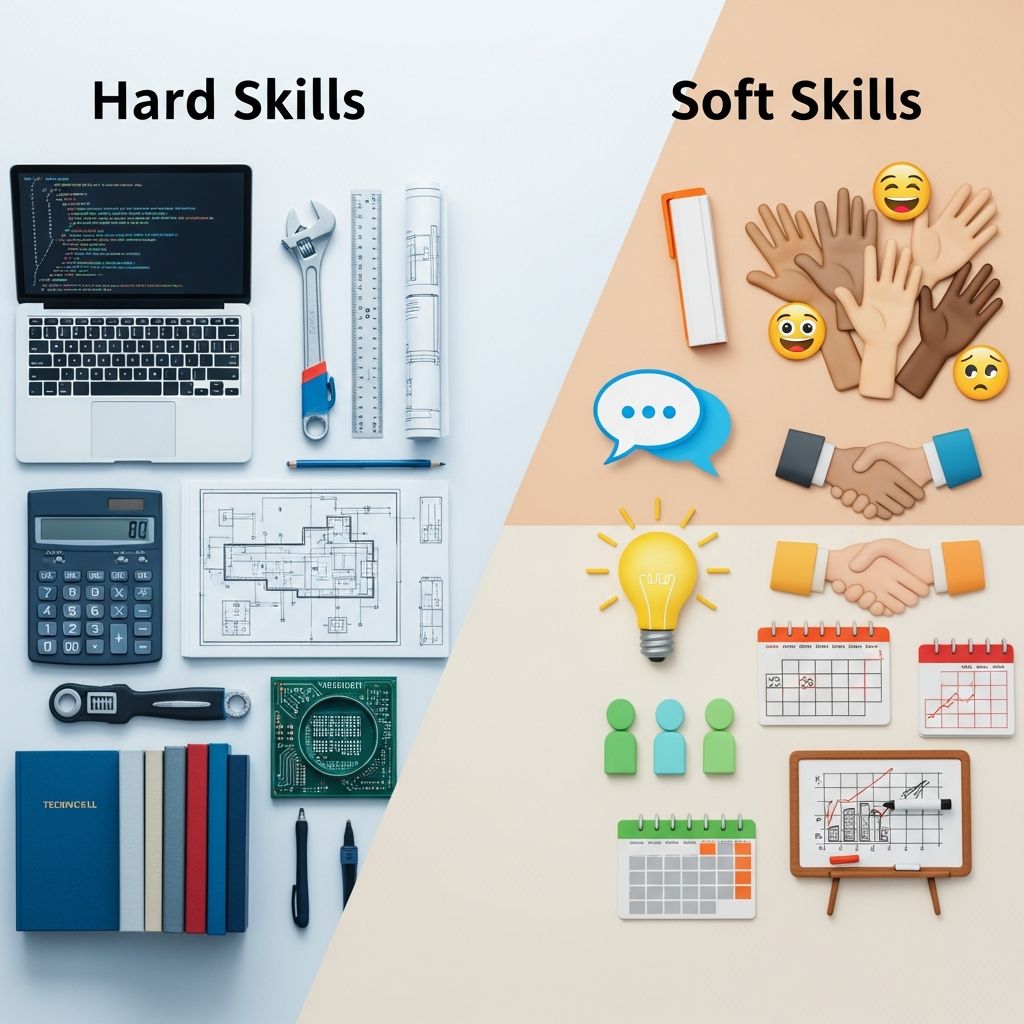
Hard skills are technical abilities that can be measured and quantified, typically specific to particular jobs or industries. Soft skills, by contrast, are interpersonal and behavioral traits that apply across various roles and situations. The interplay between these two skill categories determines how effectively professionals can perform their duties and navigate workplace challenges.
What Are Hard Skills?
Hard skills are specific, teachable abilities or knowledge sets that are typically acquired through formal education, training programs, or on-the-job experience. These skills are concrete, measurable, and directly applicable to performing specific job functions. They represent the technical expertise required to execute particular tasks within a profession or industry.
Hard skills are often listed in job descriptions as essential requirements because employers need to ensure candidates can perform the core technical responsibilities of the position. These skills demonstrate competency in specialized areas and are typically validated through certifications, degrees, or practical assessments.
Characteristics of Hard Skills
Hard skills possess several defining characteristics that distinguish them from other types of abilities:
- They are quantifiable and measurable through tests, certifications, or practical demonstrations
- They are job-specific and directly related to particular roles or industries
- They can be learned through formal training, education programs, or structured practice
- They have a clear learning pathway with measurable progression from novice to expert
- They typically appear on resumes and are formally documented
Examples of Hard Skills
Hard skills span virtually every profession and industry. Here are common examples across different fields:
| Technology & IT | Healthcare & Science | Trades & Crafts | Business & Finance |
|---|---|---|---|
| Computer programming (Python, JavaScript) | Surgical proficiency | Plumbing | Accounting and bookkeeping |
| Data analysis | Medical billing and coding | Carpentry | Financial forecasting |
| Machine learning | HVAC maintenance | Painting techniques | Data analysis |
| Database management | Teaching/instruction | Mechanical engineering | Project management |
| Graphic design | Cooking/baking skills | Event planning | SEO and marketing techniques |
Additional hard skills include proficiency in foreign languages, expertise in specific software applications like Microsoft Excel, inventory control, blockchain technology, and logistics management. The list extends as widely as the number of professions that exist in the modern economy.
What Are Soft Skills?
Soft skills are interpersonal attributes and personality traits that influence how you interact with others and manage your work. Often linked to emotional intelligence, soft skills comprise the personal habits and behavioral characteristics that shape how you approach challenges, collaborate with colleagues, and navigate workplace dynamics. Unlike hard skills, soft skills are more subjective and harder to measure, yet they are equally important for professional success.
Soft skills are transferable across industries and roles, making them valuable regardless of your career path. While a software engineer and a restaurant manager require vastly different hard skills, both can leverage identical soft skills like communication, problem-solving, and leadership to excel in their respective positions.
Characteristics of Soft Skills
Soft skills possess distinct characteristics that differentiate them from hard skills:
- They are subjective and harder to measure quantitatively
- They are universally transferable across different jobs and industries
- They are often developed over a lifetime through personal experiences and relationships
- They relate to personality and behavioral traits rather than technical knowledge
- They are demonstrated through workplace interactions and observed in how you work
- They directly impact team dynamics, productivity, and workplace culture
Examples of Soft Skills
Soft skills are universal competencies that enhance professional effectiveness across all fields. Common examples include:
| Communication & Interpersonal | Problem-Solving & Thinking | Management & Organization | Emotional & Personal |
|---|---|---|---|
| Effective communication | Problem-solving | Time management | Empathy |
| Active listening | Critical thinking | Organization | Emotional intelligence |
| Teamwork | Strategic thinking | Multitasking | Adaptability |
| Leadership | Creativity | Conflict resolution | Integrity |
| Interpersonal skills | Innovation | Attention to detail | Dependability |
The top five soft skills in highest demand among employers are management, communication, customer service, leadership, and sales. Other valuable soft skills include flexibility, patience, persuasion, collaboration, cultural awareness, mentoring, networking, negotiation, positive attitude, open-mindedness, work ethic, and sensitivity.
Key Differences Between Hard and Soft Skills
While both hard and soft skills contribute to professional success, they differ fundamentally in several important ways:
How They’re Acquired
Hard skills are learned through dedicated training and practice. The learning path is concrete and clearly defined. To develop hard skills, you typically pursue formal education, professional certifications, or structured on-the-job training. For example, becoming a therapist requires completing relevant psychological qualifications and learning specific therapeutic techniques. The progression from novice to expert follows a measurable pathway.
Soft skills are often developed over your entire lifetime through personal experiences, relationships, and workplace interactions. While they can be improved through training programs, books, and self-reflection, they’re typically cultivated through lived experience rather than formal coursework. You develop communication skills through conversations, leadership through taking on responsibilities, and adaptability through facing challenges.
Measurement and Assessment
Hard skills are easier to measure and assess than soft skills. They can be demonstrated through relevant qualifications and certifications, evaluated using specific tests and tasks, and assessed through portfolio reviews or practical demonstrations. When hiring a designer, you can evaluate their work samples; when hiring a programmer, you can administer coding tests.
Soft skills are more subjective and challenging to evaluate. While various assessment tools exist—such as personality tests, behavioral interviews, and 360-degree feedback—the measurements remain less precise than hard skill assessments. Evaluating someone’s communication ability or leadership potential requires observation, interviews, and subjective judgment.
Job Specificity
Hard skills are often specific to particular roles or industries. A nurse and a chef require completely different hard skills specific to their professions. These skills may not transfer when changing careers.
Soft skills are universally applicable across all careers and industries. The ability to communicate effectively, solve problems creatively, or manage time efficiently benefits professionals in every field. This universal applicability makes soft skills particularly valuable as professionals transition between roles or industries.
Why Both Skill Types Matter
Employers increasingly recognize that success in today’s workplace requires a balance of both hard and soft skills. While hard skills get your foot in the door by demonstrating technical competency, soft skills often determine how well you thrive in the organization.
Hard skills ensure you can execute the core responsibilities of your position. Soft skills enable you to work collaboratively, adapt to change, communicate effectively, and navigate complex workplace dynamics. Together, they create a well-rounded professional capable of both technical excellence and interpersonal effectiveness.
Research shows that soft skills are increasingly valued by employers. Organizations recognize that even the most technically skilled employee who cannot communicate, collaborate, or adapt will struggle to succeed. Conversely, someone with exceptional soft skills but lacking necessary technical abilities will find their potential limited.
Developing Hard Skills
Since hard skills follow a structured learning pathway, development strategies are relatively straightforward:
- Formal education: Pursue degrees, diplomas, or certification programs in your field
- Professional training: Enroll in specialized courses and workshops
- On-the-job training: Learn through supervised practice in your workplace
- Online learning platforms: Utilize courses from platforms offering structured curricula
- Certifications: Obtain industry-recognized credentials validating your expertise
- Practice and repetition: Develop mastery through consistent, deliberate practice
Developing Soft Skills
Soft skills development is more nuanced and ongoing:
- Self-awareness: Reflect on your strengths and areas for improvement
- Workplace experience: Seek opportunities that challenge you to develop new interpersonal abilities
- Feedback and coaching: Ask colleagues and supervisors for constructive feedback
- Training programs: Participate in soft skills workshops and seminars
- Reading and learning: Study books, articles, and resources on communication, leadership, and emotional intelligence
- Mentorship: Learn from mentors who excel in desired soft skills
- Diverse interactions: Actively engage with people from different backgrounds and perspectives
Building a Balanced Skill Set
Professional success requires developing and maintaining a balance between hard and soft skills. When collaborating in work environments, the difference between hard skills and soft skills matters less than how you apply them together. Hard skills help you execute tasks; soft skills help you adapt, lead, and work effectively with others.
As you advance in your career, soft skills often become increasingly important. Entry-level positions may emphasize technical abilities, but leadership and management roles require sophisticated soft skills. Simultaneously, maintaining and updating your hard skills ensures you remain technically current and competent.
Frequently Asked Questions
Q: Can soft skills be taught and developed?
A: Yes, soft skills can absolutely be developed and improved. While they may be rooted in personality traits, targeted training, self-reflection, feedback, and conscious practice help enhance soft skills. Many organizations now invest in soft skills training programs recognizing their impact on organizational success.
Q: Which skills are more important: hard or soft?
A: Both are equally important. Hard skills demonstrate your ability to perform specific job functions, while soft skills determine how effectively you work with others and adapt to challenges. Employers increasingly emphasize the importance of soft skills alongside technical expertise.
Q: Should I focus on hard skills or soft skills development?
A: Ideally, you should develop both simultaneously. Invest in maintaining and updating hard skills relevant to your career field while continuously cultivating soft skills through workplace experience and intentional practice. A balanced approach yields the strongest professional profile.
Q: How do I highlight soft skills on my resume?
A: Demonstrate soft skills through concrete examples and achievements rather than simply listing them. Use action verbs that show how you applied these skills, provide evidence in accomplishments, and let your cover letter and interviews showcase your interpersonal abilities and behavioral strengths.
Q: Are hard skills more valuable in technical careers?
A: While technical careers heavily emphasize hard skills, soft skills remain critical even in highly technical roles. Technical professionals who can communicate clearly, collaborate effectively, and lead projects become more valuable and advance further in their careers than those lacking these interpersonal abilities.
References
- Hard Skills vs. Soft Skills: Definitions and 50+ Examples — EdgePoint Learning. 2024. https://www.edgepointlearning.com/blog/hard-skills-vs-soft-skills/
- Hard Skills vs. Soft Skills: Difference, Definition, Examples — Babbel for Business. 2024. https://www.babbelforbusiness.com/us/blog/hard-skills-vs-soft-skills-whats-the-difference-and-how-can-they-be-developed/
- Hard Skills vs Soft Skills: How to Tell the Difference [2025] — Asana. 2025. https://asana.com/resources/hard-skills-vs-soft-skills
- Hard Skills vs. Soft Skills: What’s the Difference? — Indeed.com. 2024. https://www.indeed.com/career-advice/resumes-cover-letters/hard-skills-vs-soft-skills
- What Is the Difference Between Hard Skills and Soft Skills? — Walden University Lifelong Learning. 2024. https://lifelonglearning.waldenu.edu/resource/what-is-the-difference-between-hard-skills-and-soft-skills.html
- Understanding Soft vs. Hard Skills — Washington State University Human Resource Services. 2024. https://hrs.wsu.edu/understanding-soft-vs-hard-skills/
- Hard Skills vs. Soft Skills: What’s the Difference? — Coursera. 2024. https://www.coursera.org/articles/hard-skills-vs-soft-skills
Similar Articles








Read full bio of medha deb