$1 Million Retirement: Complete Guide To Making It Work
Comprehensive strategies to build, manage, and sustain a $1 million retirement nest egg for financial security.

Retiring with $1 million is a milestone many aspire to, but is it enough? This guide examines whether a million-dollar nest egg can sustain your golden years, covering expense assessment, income sources, investment strategies, the 4% rule, inflation impacts, and essential tools like retirement calculators. Drawing from financial experts, it provides actionable steps to build and preserve wealth for a secure retirement.
Is $1 Million Enough to Retire On?
Whether $1 million suffices for retirement hinges on individual factors like expenses, lifestyle, location, and other income streams. According to a 2024 Bankrate survey, one in three working Americans believes they need more than $1 million for a comfortable retirement, with 20% aiming for over $2 million. Yet experts affirm it’s possible with disciplined planning.
Evan Patzer, a retirement specialist, notes: ‘Yes, no and maybe so,’ emphasizing the balance between income and expenses. Cynthia Campos Delgado adds, ‘It is most definitely possible to retire on $1 million, but it depends on each individual.’ Key considerations include Social Security, pensions, housing costs, healthcare, and inflation.
For early retirees pursuing Financial Independence, Retire Early (FIRE), $1.25 million may be a baseline for $50,000 annual spending, adjusted for age, insurance, and location.
Key Factors Determining Sufficiency
- Annual Expenses: Aim for $40,000–$50,000 yearly to make $1 million viable using a 4–5% withdrawal rate.
- Social Security: Average benefits cover basics, reducing reliance on savings.
- Lifestyle: Frugal living in low-cost areas stretches funds further than luxury spending.
- Longevity: Plan for 25–30+ years, factoring in healthcare inflation.
Assess Your Retirement Expenses
The foundation of retirement planning is understanding expenses. Advisors recommend categorizing into essentials (housing, food, utilities) and discretionary (travel, hobbies). Reducing largest costs like housing frees capital for growth.
Delgado suggests splitting budgets: necessities first, then trim non-essentials. Patzer highlights downsizing housing to preserve tax-advantaged accounts like 401(k)s or IRAs.
| Expense Category | Average Annual Cost | Retirement Reduction Tips |
|---|---|---|
| Housing | $20,000–$30,000 | Downsize, relocate to lower-cost area, pay off mortgage |
| Healthcare | $10,000+ | Medicare supplements, HSAs |
| Food & Utilities | $8,000 | Budget meals, energy efficiency |
| Travel/Entertainment | $5,000–$10,000 | Prioritize free activities, off-season travel |
Average retiree expenses by age group show peaks in mid-retirement: 35-under ($49,130), 55-64 ($537,560 cumulative needs).
Calculate Your Retirement Income Sources
Beyond $1 million, tally guaranteed income: Social Security (average $1,900/month), pensions, annuities. Subtract from expenses to find the savings gap.
Example: $50,000 expenses – $24,000 Social Security = $26,000 needed from savings. Invest the $1 million for 4% yield ($40,000), covering the gap with growth potential.
- Social Security: Claim at full retirement age (67 for most) for max benefits.
- Pensions: Rare today but valuable if available.
- Part-time Work: Bridges early gaps without depleting principal.
Investing Your $1 Million Nest Egg
Don’t park $1 million in cash; invest diversely for income and growth. Patzer advises balancing dividend stocks, bonds, and funds against volatility.
Strategies:
- Dividend Funds: Steady income from diversified stocks.
- Bond Funds: Lower risk, reliable yields.
- Stocks/Growth Assets: Combat inflation over 25–30 years.
- Diversification: Avoid single-asset concentration.
For year-end optimization, max contributions: 401(k) $23,500 + $7,500 catch-up (50+), IRAs $1,000 catch-up.
The 4% Rule and Safe Withdrawal Rates
The 4% rule—safe withdrawal of 4% ($40,000 from $1 million) annually, inflation-adjusted—originates from the Trinity Study, sustaining 30 years in most scenarios.
$1,000 monthly income requires $240,000–$300,000 at 4–5% rate. For FIRE, 25x annual spending (e.g., $36,000 x 25 = $900,000).
Adjust for reality: conservative 3–3.5% for longevity; aggressive up to 5% if markets favor.
Accounting for Inflation and Longevity
Inflation erodes purchasing power; healthcare costs rise 5–7% annually. Social Security adjusts partially, so allocate to growth assets.
Plan for 30+ years: A 10% return assumption is unrealistic long-term; target 5–7% after taxes/fees.
Retirement Savings Accounts and Strategies
Leverage tax-advantaged vehicles:
- 401(k)/403(b): Employer matches, high limits.
- IRAs: Traditional/Roth flexibility.
- HSAs: Triple tax-free for healthcare.
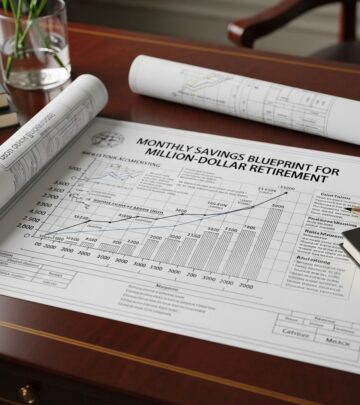
Saving $1,000/month compounds powerfully. Example: 7% return over 30 years yields over $1 million.
Retirement Calculators and Planning Tools
Use calculators to project needs: Input age, savings, contributions, returns. MoneyRates and Bankrate tools estimate shortfalls.
Steps: 1) Enter current savings/age. 2) Forecast expenses/income. 3) Adjust contributions/investments.
Frequently Asked Questions (FAQs)
Q: Is $1 million enough for retirement?
A: Yes for many with low expenses ($40k/year), Social Security, and 4% withdrawals, but assess personally.
Q: What is the 4% rule?
A: Withdraw 4% of initial portfolio annually, adjusted for inflation, for 30-year sustainability.
Q: How much to save monthly for $1 million?
A: $1,000/month at 7% over 30 years reaches ~$1M via compounding.
Q: When to take Social Security?
A: Delay to 70 for max benefits if health allows, bridging with savings.
Q: How does inflation affect my nest egg?
A: Plan for 3% annual erosion; invest in stocks for growth.
Conclusion: Build Your Million-Dollar Retirement
Achieving and sustaining a $1 million retirement requires holistic planning: control expenses, maximize income, diversify investments, and monitor with tools. Start today—compound interest and discipline pave the way to security.
References
- Retiring With $1 Million: Here’s How It Can Be Done — Bankrate. 2024-08-19. https://www.bankrate.com/retirement/can-you-retire-comfortably-on-1-million/
- Financial Independence, Retire Early (FIRE) — MoneyRates. 2024. https://www.moneyrates.com/savings/financial-independence-retire-early.htm
- Is Saving $1000 a Month Good? — MoneyRates. 2025. https://www.moneyrates.com/savings/is-saving-1000-a-month-good.htm
- Retirement Planning Guide: Strategies for Saving — MoneyRates. 2024. https://www.moneyrates.com/investment/retirement-planning-guide.htm
- The Definitive Guide to Financial Planning for Retirement — Bank at First. 2024. https://www.bankatfirst.com/personal/discover/flourish/definitive-guide-financial-planning-retirement.html
Similar Articles








Read full bio of medha deb