Growth vs Value Investing
Discover the key differences between growth and value investing strategies to build a portfolio that matches your financial goals and risk tolerance.
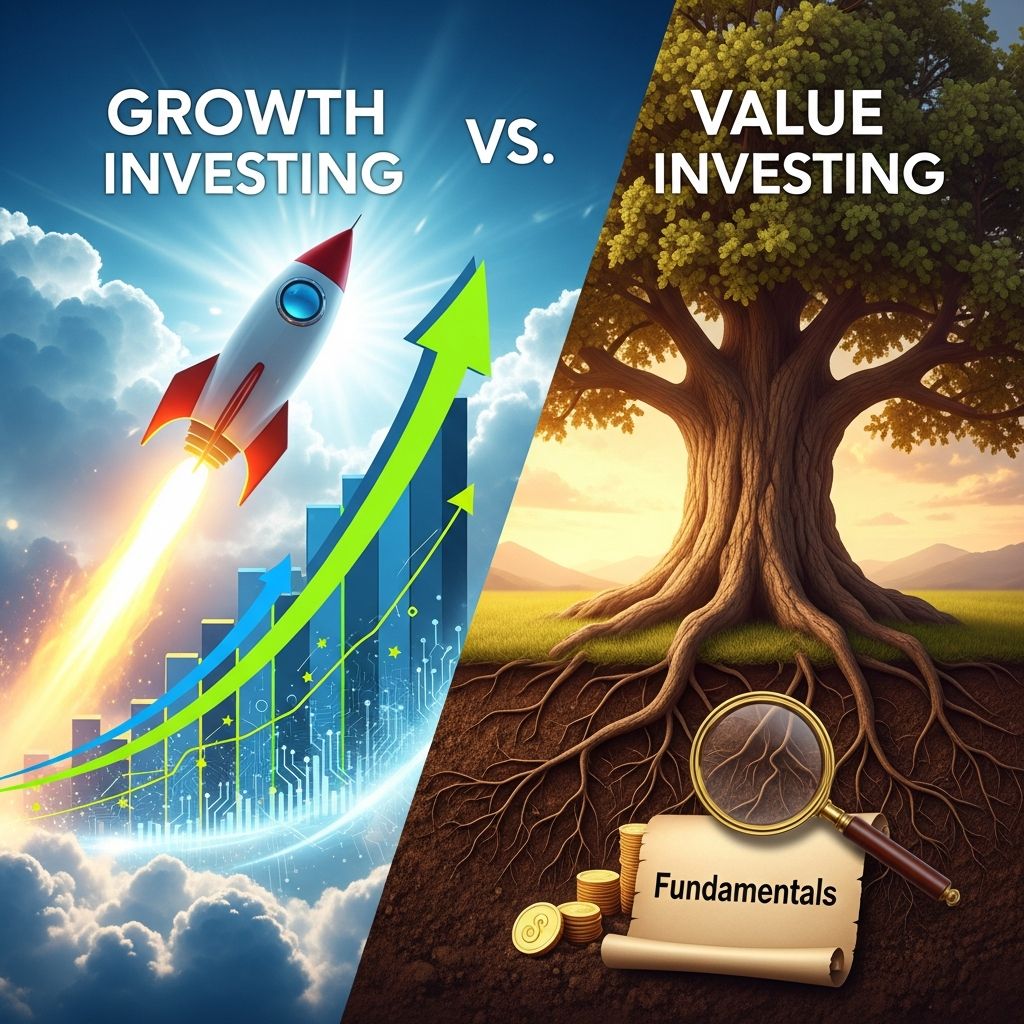
Investors often face a fundamental choice between two dominant stock-picking philosophies: growth investing, which targets companies poised for rapid expansion, and value investing, which seeks out undervalued firms trading below their true worth. Understanding these approaches helps in crafting a resilient portfolio tailored to market conditions and personal objectives.
Defining the Core Philosophies
Growth investing centers on companies expected to outpace the broader market in revenue, earnings, or market share expansion. These firms, often in innovative sectors like technology, reinvest profits to fuel further development rather than distributing dividends. Investors bet on future potential, accepting higher current valuations in anticipation of substantial capital appreciation.
In contrast, value investing hunts for established businesses whose share prices lag behind their intrinsic value, often due to temporary market oversights or sector downturns. Proponents, inspired by pioneers like Benjamin Graham, analyze fundamentals such as assets, cash flows, and earnings to identify bargains, expecting prices to eventually align with underlying strengths.
Key Metrics for Distinguishing Styles
Valuation ratios provide clear markers to differentiate these strategies. Growth stocks typically exhibit elevated metrics reflecting optimism about prospects, while value stocks show compressed figures signaling potential discounts.
| Metric | Growth Stocks | Value Stocks |
|---|---|---|
| P/E Ratio | High (often 25+) | Low (under 15) |
| P/B Ratio | High | Low |
| Dividend Yield | Low or None | High |
| EPS Growth Rate | 15%+ annually | Moderate |
| Debt-to-Equity | Variable, growth-focused | Lower, stability-oriented |
These indicators highlight how growth prioritizes forward-looking expansion metrics like earnings per share (EPS) growth and return on equity (ROE), whereas value emphasizes historical data such as book value and cash flows.
Company Profiles and Sector Alignments
Growth-oriented companies are frequently younger, smaller-to-mid cap entities in dynamic industries. They capture expanding markets through innovation, boasting high reinvestment rates and robust revenue trajectories. Examples include tech disruptors dominating consumer tech or biotech firms pioneering therapies.
- High market share gains in nascent sectors
- Large addressable opportunities
- Strong leadership driving scalability
Value plays, meanwhile, feature mature large-cap firms in cyclical areas like financials, energy, industrials, and materials. These weathered companies offer stability, often paying consistent dividends from steady operations.
Historical Performance Cycles
No strategy dominates perpetually; outperformance rotates roughly every decade. From 1979-1988 and 2000-2008, value indices like the Russell 1000 Value surpassed growth peers amid economic recoveries and inflation pressures. Conversely, growth shone in 1989-1999 and 2009-2020, propelled by tech booms and low-interest environments.
Recent shifts post-2020 show value rebounding amid rising rates and inflation, underscoring the cyclical nature. Long-term data from indices reveals value’s edge in inflationary regimes, while growth thrives in accommodative monetary policy eras.
| Period | Top Performer | Key Drivers |
|---|---|---|
| 1979-1988 | Value | Economic cycles, dividends |
| 1989-1999 | Growth | Tech expansion |
| 2000-2008 | Value | Dot-com bust recovery |
| 2009-2020 | Growth | Low rates, innovation |
| 2020+ | Value | Rising inflation/rates |
Risks and Rewards Breakdown
Growth investing promises explosive returns but carries elevated volatility. Stocks can plummet if growth falters, as seen in market corrections. Limited dividends mean reliance on price gains, amplifying downside in bear markets.
Value offers a margin of safety through undervaluation and income streams, with lower beta to market swings. However, ‘value traps’—stocks that remain cheap due to structural woes—pose prolonged underperformance risks.
| Aspect | Growth | Value |
|---|---|---|
| Upside Potential | Unlimited | Limited but steady |
| Volatility | High | Lower |
| Income Generation | Minimal | Strong via dividends |
| Market Sensitivity | Low rates favor | Inflation/rates favor |
Building a Balanced Approach
Rather than choosing sides, many blend both for diversification. Core-satellite portfolios allocate to value for stability and growth for alpha. Lifecycle shifts also matter: younger investors tolerate growth’s risks, while retirees favor value’s income.
- Assess risk tolerance and timeline
- Monitor economic indicators like inflation
- Rebalance periodically to capture rotations
- Incorporate quality filters across styles
Quality traits—solid balance sheets, competitive moats—enhance either strategy, mitigating pitfalls.
Practical Selection Criteria
For growth: Seek 15%+ revenue growth, expanding margins, and scalable models. Analyze forward estimates and competitive positioning.
For value: Target low P/E relative to peers, high free cash flow yields, and catalyst events like spin-offs. Avoid distressed firms lacking recovery paths.
Market Influences and Future Outlook
Rising interest rates and persistent inflation bolster value, as higher discount rates compress growth multiples. Earnings surprises in cyclicals further support this tilt. Yet, technological disruptions could reignite growth dominance.
Investors should track macroeconomic pivots: low rates and subdued inflation favor growth; the reverse aids value.
Frequently Asked Questions
What is the main difference between growth and value investing?
Growth focuses on future expansion potential with high valuations, while value targets currently undervalued stocks based on fundamentals.
Which performs better in inflationary times?
Value stocks historically outperform as they benefit from pricing power and dividends amid rising costs.
Can I invest in both styles?
Yes, blending reduces risks and captures cycles; many funds offer hybrid options.
Are growth stocks always tech-focused?
Often, but not exclusively; healthcare and consumer discretionary also feature high-growth names.
How do dividends factor in?
Value stocks typically yield more, providing income; growth reinvests for compounding.
Conclusion
Mastering growth versus value equips investors to navigate markets adeptly. By grasping metrics, histories, and contexts, one can strategically deploy capital for sustained gains.
References
- Value vs Growth Investing: Which Is The Better Approach — ET Money. 2023. https://www.etmoney.com/learn/mutual-funds/growth-vs-value-investing-which-one-should-you-choose/
- Growth vs. Value Stock Investing: Understanding the Differences — NerdWallet. 2024-01-15. https://www.nerdwallet.com/investing/learn/value-vs-growth-investing-styles
- Growth versus Value Investing — Fidelity Investments. 2023-05-10. https://www.fidelity.com/learning-center/investment-products/mutual-funds/2-schools-growth-vs-value
- Growth vs. Value Investing: Key Differences & Which Is Best? — Wealthsimple. 2024. https://www.wealthsimple.com/en-ca/learn/growth-vs-value-investing
- Growth vs. value stocks: what’s the difference? — RBC Global Asset Management. 2023-11-20. https://www.rbcgam.com/en/ca/learn-plan/investment-basics/growth-vs-value-stocks-whats-the-difference/detail
- Value vs. Growth Stocks – How to Choose for Investing — New York Life. 2024-02-05. https://www.newyorklife.com/articles/value-vs-growth-stocks
- Value vs growth investing: A historical overview — J.P. Morgan Asset Management. 2023. https://am.jpmorgan.com/ch/en/asset-management/adv/insights/value-vs-growth-investing/
Similar Articles








Read full bio of Sneha Tete