Growth Rates: Definition, Calculation, and Investment Impact
Understand growth rates and their critical role in financial analysis and investment decisions.

What Are Growth Rates?
Growth rates represent the percentage change in a specific variable over a defined period of time. They are fundamental metrics used to measure progress, expansion, or decline in various financial and economic contexts. Growth rates can be applied to earnings, revenue, investments, population, GDP, or virtually any measurable quantity that changes over time. Understanding growth rates is essential for investors, analysts, and business professionals who need to evaluate performance, compare opportunities, and make informed financial decisions.
Growth rates provide a standardized way to assess how quickly something is increasing or decreasing. Rather than looking at absolute numbers, which can be misleading when comparing entities of different sizes, growth rates normalize the data to show relative performance. This makes it possible to compare a small startup’s expansion with a large corporation’s growth on an equal basis.
Understanding the Basics of Growth Rates
At its core, a growth rate measures the change in value from one period to another, expressed as a percentage. The simple growth rate formula divides the change in value by the initial value and multiplies by 100 to express the result as a percentage. This straightforward calculation helps investors quickly understand whether an investment or business is expanding or contracting.
Growth rates come in different varieties, each serving specific purposes in financial analysis. Some measure short-term changes, while others capture long-term trends. The choice of which growth rate to use depends on the context, the time frame being analyzed, and the specific question being asked. By understanding the different types and how to calculate them, investors can make more sophisticated assessments of financial opportunities.
Types of Growth Rates
Compound Annual Growth Rate (CAGR)
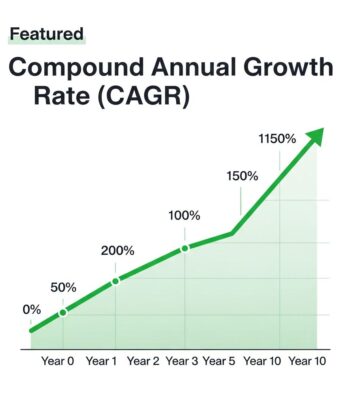
The Compound Annual Growth Rate, commonly known as CAGR, is one of the most widely used growth metrics in finance and investing. CAGR represents the mean annual growth rate of an investment over a specified period longer than one year. It smooths out volatility and provides a single growth figure that represents how an investment would have grown if it had expanded at a constant rate each year.
CAGR is particularly valuable because it accounts for the effects of compounding, which is critical for long-term investments. Unlike simple average returns, CAGR reflects the reality that money grows exponentially over time. This makes it an excellent metric for comparing investments with different time horizons and volatility profiles. CAGR is commonly used to evaluate mutual fund performance, portfolio returns, and business revenue expansion over multiple years.
Earnings Per Share (EPS) Growth
Earnings Per Share growth measures the year-over-year increase in a company’s net income divided by its outstanding shares. EPS growth is a critical metric for equity investors because it directly reflects how much profit a company generates for each share of stock. Strong EPS growth often correlates with stock price appreciation, as investors reward companies that are increasingly profitable on a per-share basis.
Investors typically compare a company’s current EPS growth rate with historical trends, industry averages, and analyst expectations. A company that consistently delivers EPS growth exceeding market expectations is often considered a quality investment. However, EPS growth can be manipulated through share buybacks or accounting adjustments, so it should be analyzed alongside other metrics.
Revenue Growth
Revenue growth measures the increase in total sales or income generated by a business over a specific period. This metric shows whether a company is successfully expanding its customer base, increasing prices, or both. Revenue growth is often considered more reliable than EPS growth because it is harder to manipulate through accounting practices.
For mature companies, steady revenue growth combined with improving profit margins indicates strong operational management. For growth companies, especially in technology sectors, rapid revenue expansion is often prioritized over profitability in the early stages. Analyzing revenue growth trends helps investors understand whether a company’s expansion is sustainable or driven by temporary factors.
Dividend Growth
Dividend growth measures the rate at which a company increases the cash payments it distributes to shareholders. Dividend growth is important for income-focused investors who rely on regular cash flows from their investments. Companies that consistently increase dividends often demonstrate financial strength and confidence in their future earnings prospects.
A long history of dividend growth can indicate a financially stable company with durable competitive advantages. Many investors use dividend growth as a sign of quality, and dividend aristocrats—companies that have increased dividends for 25 consecutive years or more—often attract conservative investors seeking reliable income streams.
Gross Domestic Product (GDP) Growth
GDP growth measures the rate at which a nation’s total economic output increases. It reflects the overall health of an economy and is one of the most important macroeconomic indicators. GDP growth affects employment, inflation, interest rates, and investment returns across an economy.
For investors, GDP growth provides important context for business expansion and consumer spending patterns. During periods of strong GDP growth, companies typically experience higher revenues and profitability. Conversely, during economic downturns or recessions, negative GDP growth often signals reduced consumer spending and business investment.
How to Calculate Growth Rates
Simple Growth Rate Calculation
The basic formula for calculating a simple growth rate is straightforward. Take the ending value, subtract the beginning value, divide by the beginning value, and multiply by 100 to express as a percentage. For example, if an investment grows from $10,000 to $12,000 over one year, the growth rate is ($12,000 – $10,000) / $10,000 × 100 = 20%.
This simple calculation works well for single-period measurements but becomes less useful when comparing investments over different time frames or when accounting for compounding effects.
CAGR Calculation Method
CAGR requires a slightly more complex calculation that accounts for multiple years of growth. The formula is: CAGR = (Ending Value / Beginning Value) ^ (1 / Number of Years) – 1. This calculation demonstrates how consistent annual growth would need to be to achieve the actual change from beginning to ending values.
For instance, if an investment grows from $10,000 to $16,000 over four years, the CAGR is ($16,000 / $10,000) ^ (1/4) – 1 = 1.1225 – 1 = 12.25%. This means the investment grew at an average annual rate of approximately 12.25% per year.
Year-Over-Year Growth
Year-over-year growth compares a metric’s value in one period to the same period in the previous year. This calculation removes seasonal variations and provides insight into underlying trends. For example, retail sales in December 2024 compared to December 2023 would show year-over-year growth while accounting for seasonal holiday shopping patterns.
Why Growth Rates Matter for Investors
Performance Evaluation
Growth rates enable investors to objectively measure how well their investments are performing. By tracking growth rates over time, investors can determine whether their portfolio is meeting their financial goals and whether adjustments are needed.
Comparative Analysis
Growth rates allow meaningful comparisons between different investments, companies, and sectors. An investor can compare a technology company’s revenue growth with a utility company’s revenue growth despite their vastly different sizes and industries. This normalization makes it possible to identify which investments are expanding most rapidly relative to their starting point.
Valuation Assessment
Many valuation models incorporate growth rate expectations. Companies with higher expected growth rates often command higher price-to-earnings multiples. Understanding historical and projected growth rates helps investors determine whether a stock is fairly valued or overpriced relative to its growth potential.
Risk Evaluation
Growth rate consistency and predictability provide important risk signals. Companies with stable, reliable growth rates are generally considered less risky than companies with erratic or declining growth. Conversely, exceptionally high growth rates that cannot be sustained may indicate inflated valuations and higher risk.
Factors That Influence Growth Rates
Economic Conditions
Macroeconomic factors including interest rates, inflation, unemployment, and GDP growth significantly influence company growth rates. During economic expansions, businesses typically experience accelerated growth, while recessions often lead to stagnation or decline.
Industry Dynamics
Different industries have inherent growth characteristics. Technology and healthcare sectors often exhibit higher growth rates than mature industries like utilities or energy. Industry growth rates reflect competitive intensity, technological change, regulatory environment, and market demand.
Company-Specific Factors
Management quality, competitive advantages, capital investment, and strategic positioning all influence a company’s growth rate. Companies with strong moats, innovative products, and effective leadership tend to achieve higher and more sustainable growth rates than competitors.
Market Conditions
Investor sentiment, market valuations, and available capital all affect growth rates. During bull markets, companies may grow more quickly due to easy access to financing and strong consumer confidence. Bear markets can constrain growth as credit tightens and consumer spending declines.
Growth Rates in Different Market Sectors
Growth rates vary significantly across economic sectors. Technology companies often display double-digit growth rates, reflecting rapid innovation and expanding addressable markets. Financial services, consumer discretionary, and healthcare sectors also typically show above-average growth rates. Conversely, utilities, energy, and basic materials sectors often exhibit lower growth rates consistent with mature, capital-intensive industries.
The current market environment reveals important shifts in sectoral dynamics. According to recent market analysis, eight of eleven sectors in the S&P 500 have revised earnings guidance lower for 2025, reflecting cautious sentiment across the market. Information technology and consumer discretionary, two of the most-traded sectors, are among those with downward revisions, signaling potential deceleration in growth expectations despite historically strong performance from these areas.
Comparing Growth Rates Across Investments
| Metric | Description | Best Used For |
|---|---|---|
| Simple Growth Rate | Single-period percentage change | Short-term performance assessment |
| CAGR | Average annual growth over multiple years | Long-term investment comparison |
| Year-Over-Year Growth | Comparison to same period previous year | Identifying trends and patterns |
| EPS Growth | Growth in earnings per share | Equity valuation and stock selection |
Interpreting Growth Rate Data
When analyzing growth rates, context matters enormously. A 5% growth rate might be excellent for a mature utility company but disappointing for a technology startup. Industry benchmarks provide essential reference points. Additionally, investors should examine the sustainability of reported growth rates and understand what factors are driving them.
Downward revisions in growth expectations, as currently seen across multiple S&P 500 sectors, warrant careful consideration. While 11.9% expected earnings growth for 2025 represents solid performance, this figure represents a significant downward revision from the 14.5% previously expected, indicating that investor expectations and market sentiment may be moderating. This suggests investors should approach the market with measured caution and carefully evaluate whether current stock valuations appropriately reflect revised growth expectations.
Common Mistakes in Analyzing Growth Rates
Extrapolating Past Growth Too Far Forward: Historical growth rates do not guarantee future performance. Markets and businesses evolve, and what drove growth in the past may not continue into the future.
Ignoring Quality of Growth: Growth achieved through unsustainable accounting practices or excessive leverage may be misleading. Organic growth is generally preferable to growth achieved through acquisitions or financial engineering.
Overlooking Economic Cycles: Growth rates fluctuate with economic cycles. Evaluating growth during the peak of an expansion cycle may give an unrealistic picture of long-term performance.
Failing to Adjust for Size: Comparing absolute changes without considering base effects can be misleading. A $1 billion increase means something different for a $10 billion company than for a $1 trillion company.
Frequently Asked Questions About Growth Rates
Q: What is a healthy growth rate for a company?
A: Healthy growth rates vary by industry and economic cycle. For mature companies, 5-10% annual growth is often considered solid. Growth companies in technology or healthcare may target 15-30% or higher. GDP growth of 2-3% annually is typical for developed economies during expansion periods.
Q: How do I calculate CAGR on my investment?
A: Use the formula: CAGR = (Ending Value / Beginning Value) ^ (1 / Number of Years) – 1. For example, if your $10,000 investment becomes $15,000 in 5 years, CAGR = ($15,000/$10,000)^(1/5) – 1 = 8.45%.
Q: Why do growth rates sometimes differ from stock performance?
A: Stock performance depends on both growth and valuation. A company could have excellent growth but declining stock price if investors reduce the valuation multiple they are willing to pay, or vice versa. Market sentiment and expectations matter as much as actual growth.
Q: How reliable are analyst growth rate projections?
A: Analyst projections provide useful guidance but are frequently revised. Analysts tend to be overly optimistic during bull markets and overly pessimistic during downturns. Current market conditions show this pattern, with multiple sectors revising 2025 guidance lower after initial projections proved too optimistic.
Q: Should I only invest in high-growth companies?
A: No. A diversified portfolio benefits from a mix of growth and value investments. High-growth stocks carry higher risk and volatility. Lower-growth companies often provide stability, dividends, and defensive characteristics valuable during market downturns.
Q: How do I use growth rates in retirement planning?
A: Use historical growth rates to project portfolio values. For example, if you assume 7% annual returns (a reasonable long-term stock market average), you can calculate how much an initial investment will grow over 30 years. Adjust assumptions based on your asset allocation and risk tolerance.
References
- S&P 500 2025 Earnings Guidance and Market Outlook — Investopedia/Schwab Network. 2025-01-08. https://www.investopedia.com
- Understanding Compound Annual Growth Rate (CAGR) — U.S. Securities and Exchange Commission (SEC). https://www.sec.gov
- Earnings Per Share (EPS): Definition and Calculation — Financial Industry Regulatory Authority (FINRA). https://www.finra.org
- Gross Domestic Product (GDP) Growth Metrics — U.S. Bureau of Economic Analysis. https://www.bea.gov
- Corporate Revenue and Earnings Analysis — National Bureau of Economic Research (NBER). https://www.nber.org
Similar Articles








Read full bio of Sneha Tete