Great Depression Timeline 1929-1941: Key Events & Milestones
Complete timeline of the Great Depression from the 1929 stock market crash through 1941.
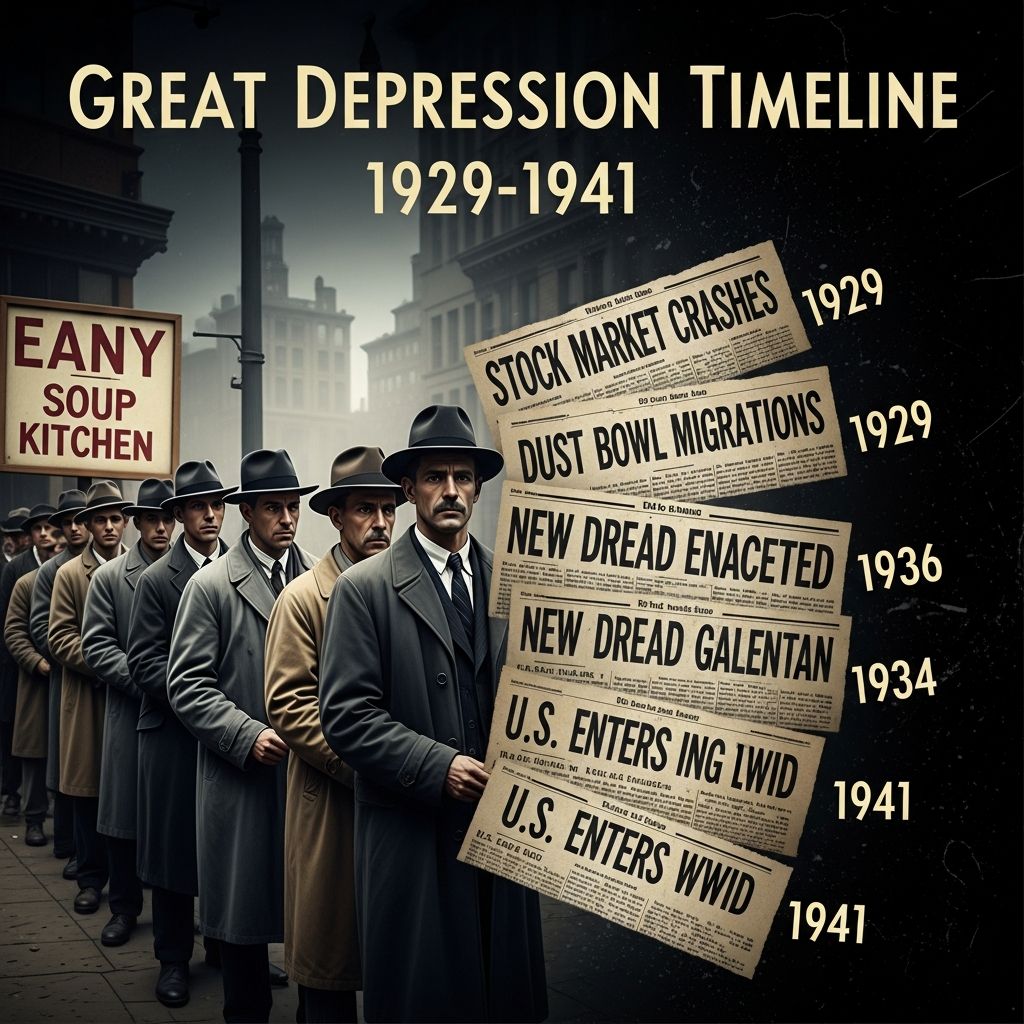
The Great Depression Timeline: 1929-1941
The Great Depression stands as the longest and deepest economic downturn in United States history and the modern industrial economy, lasting more than a decade from 1929 until the nation’s entry into World War II in 1941. This catastrophic period fundamentally transformed American society, government policy, and the role of federal intervention in the economy. Understanding the timeline of events from the initial stock market crash through the implementation of recovery programs provides crucial insight into how the nation navigated its greatest economic crisis.
The Stock Market Crash and Initial Collapse: 1929
The year 1929 marked the beginning of an economic catastrophe that would define a generation. Throughout May through September of that year, the stock market experienced nearly uninterrupted gains, with prices climbing approximately 20 percent over this period. However, warning signs emerged in August when a minor recession began two months before the eventual crash. During this period, steel production and automobile and house sales notably declined, construction stagnated, and consumer debt reached dangerous levels due to easy credit availability. Over $8.5 billion in margin loans for stocks were outstanding—an amount exceeding all currency circulating in the United States at that time.
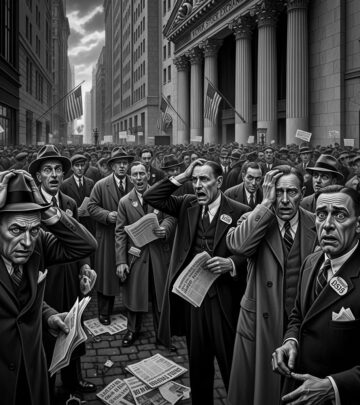
The catastrophe began on October 24, 1929, when the Wall Street Crash commenced with stocks losing over 11 percent of their value immediately upon the opening bell. Following a brief market recovery on October 25-27, the market collapsed entirely on October 29, 1929—forever known as “Black Tuesday”—when the New York Stock Exchange experienced a historic collapse with the Dow Jones closing down over 12 percent. On this single day, approximately 12.8 million shares of stock were sold, mostly at prices far below their values from just days earlier. The immediate aftermath was devastating: by 1929, just 200 corporations controlled over half of all American industry, concentrating economic power and amplifying the crisis’s impact.
The Deepening Crisis: 1930-1931
Economic Deterioration
The recession deepened throughout 1930, with the U.S. GDP contracting by 8.5 percent and nominal GDP falling to $92 billion. Prices declined slightly while wages held relatively steady, resulting in an annual inflation rate of negative 6.4 percent. Unemployment reached 9 percent, and banks began failing at an alarming rate with 1,350 banks closing their doors. In April 1930, the Dow reached a secondary closing peak of 294.07, followed by a long stagnation until a severe decline began in April 1931. This peak matched early-1929 levels but remained 30 percent below the September 1929 peak.
Agricultural and Trade Crisis
Agriculture faced particular hardship during this period. On June 17, 1930, Congress passed the Smoot-Hawley Tariff Act, placing additional stress on the weakening global economy primarily through the collapse in trade of agricultural products, which strained banks that had lent heavily to farmers. This act did not cause the Depression, but general consensus among economists holds that it did worsen conditions and stunted recovery efforts after 1933. Exports declined dramatically from $5.2 billion in 1929 to just $1.7 billion in 1933. Automobile sales fell below 1928 levels in May 1930, signaling broad-based economic weakness.
Banking Panics Begin
From September through December 1930, the first major round of U.S. bank failures occurred, with approximately $550 million in deposits lost. Over 300 banks failed in December alone. The year 1931 witnessed catastrophic banking deterioration, with 2,294 banks failing and taking nearly $1.7 billion in deposits with them. During this same period, 28,285 businesses failed at a daily rate of 133 failures. Unemployment rose to 16 percent, U.S. nominal GDP fell to $77 billion with growth of negative 8.5 percent, and the annual inflation rate reached negative 9.3 percent.
The Crisis Reaches Its Nadir: 1932-1933
Unemployment and Economic Collapse
By 1932, the economy had reached catastrophic levels. Unemployment rose to 23 percent, GDP growth declined by 13 percent, the annual inflation rate fell to negative 11 percent, and 1,700 banks failed. U.S. nominal GDP dropped to $60 billion, and over 13 million Americans were unemployed. The Dow Jones Industrial Index bottomed out on July 8, 1932, at 41.22—the lowest level recorded in the 20th century and representing an 89 percent loss from its peak in September 1929.
Government Response and Banking Crisis
The federal government began taking action to address the crisis. On June 6, 1932, Congress signed into law the Revenue Act of 1932, raising taxes on personal income, corporate income, and implementing sales taxes on various goods. Congress also established the Reconstruction Finance Corporation to lend $2 billion to banks, insurance companies, building and loan associations, and farming organizations. In July, the U.S. government discontinued open market operations, reflecting the severity of the financial crisis.
By 1933, the banking system faced complete collapse. More than 11,000 of the nation’s 25,000 banks had closed. On March 4, 1933, Franklin D. Roosevelt took office as president, immediately announcing a three-day “bank holiday” to prevent a third run on banks and to shore up the banking system.
New Deal Programs and Recovery Initiatives: 1933-1935
Emergency Banking and Relief Measures
The Roosevelt administration moved swiftly to implement recovery programs. The Federal Deposit Insurance Corporation (FDIC) was established to protect bank deposits and restore public confidence in the financial system. The Civilian Conservation Corps (CCC) was created to put young men to work in federal and state parks, providing employment and environmental benefits. The National Recovery Administration (NRA) was introduced to promote fair business practices and labor standards.
On November 9, 1933, Roosevelt established the Civil Works Administration (CWA) to assist unemployed workers through the winter months. Additionally, President Roosevelt budgeted $75 million to the Federal Emergency Relief Administration to purchase food for farmers, providing them with revenue and economic stimulus.
Second New Deal and Long-Term Programs
On April 8, 1935, Congress passed the Emergency Relief Appropriation Act, creating the Works Progress Administration (WPA) and providing almost $5 billion for work relief for the unemployed. This historic legislation funded projects including construction of airports, schools, hospitals, roads, and public buildings, marking the beginning of the Second New Deal. The WPA was formed to employ up to 8.5 million people on public works projects across the country.
On April 30, 1935, Roosevelt created the Resettlement Administration (RA) to help poor farmers either improve the use of their lands or relocate to better lands. The agency’s Historical Section began a major photodocumentary project documenting the Depression, preserving invaluable historical records.
Labor Rights and Social Security
On July 5, 1935, Congress passed the National Labor Relations Act, better known as the Wagner Act, to support workers’ right to organize and bargain collectively with employers over working conditions, benefits, and wages. The act also banned certain unfair business practices, fundamentally reshaping labor-management relations.
In 1935, the Social Security Act was signed into law, financed through payroll taxes and creating a safety net for elderly Americans, the disabled, and unemployed workers. This landmark legislation transformed the federal government’s role in social welfare and remains central to American life today.
Presidential Elections and Continuing Recovery: 1936-1940
Franklin D. Roosevelt was elected to a second term as president in 1936, demonstrating public confidence in his recovery programs. He was subsequently elected to a third term in 1940, an unprecedented achievement that reflected the nation’s trust in his leadership during the ongoing crisis.
End of the Great Depression: 1941
The Great Depression finally ended in 1941, though the transition occurred gradually rather than suddenly. The suffering American economy received a significant boost when fighting countries needed supplies and looked to America to manufacture them. After Pearl Harbor was bombed on December 7, 1941, America entered World War II. The U.S. enlisted more than 10 million men and women into the military. Since so many citizens were fighting in the war, those left at home worked in factories to produce supplies for the war effort, finally providing the massive government spending and economic stimulus that pulled the nation out of depression.
Key Economic Indicators During the Great Depression
| Year | Unemployment Rate | GDP Growth | Bank Failures | Inflation Rate |
|---|---|---|---|---|
| 1929 | ~3% | N/A (Pre-crash) | Minor | Positive |
| 1930 | 9% | -8.5% | 1,350 | -6.4% |
| 1931 | 16% | -8.5% | 2,294 | -9.3% |
| 1932 | 23% | -13% | 1,700 | -11% |
| 1933 | 25% | Recovery began | 9,000+ cumulative | Stabilizing |
Frequently Asked Questions
Q: What caused the Great Depression?
A: The Great Depression resulted from multiple factors including excessive stock speculation, easy credit availability, the stock market crash of October 1929, bank failures, declining consumer spending, and the Smoot-Hawley Tariff Act that disrupted international trade.
Q: How long did the Great Depression last?
A: The Great Depression lasted more than a decade, beginning in 1929 and ending in 1941 when the United States entered World War II and increased government spending on military production provided economic stimulus.
Q: What was the worst year of the Great Depression?
A: The worst year was generally 1932-1933, when unemployment reached 25 percent, the Dow Jones had fallen 89 percent from its peak, and more than 11,000 banks had failed.
Q: What were the New Deal programs?
A: New Deal programs included the CCC (Civilian Conservation Corps), WPA (Works Progress Administration), FDIC (Federal Deposit Insurance Corporation), CWA (Civil Works Administration), and the Social Security Act, designed to provide relief, recovery, and reform.
Q: How did World War II end the Great Depression?
A: World War II ended the Depression through massive government spending on military production and supplies. U.S. entry into the war in December 1941 led to the enlistment of over 10 million military personnel and increased factory production by those remaining at home.
Q: What was Black Tuesday?
A: Black Tuesday, October 29, 1929, was the day the New York Stock Exchange collapsed, with the Dow Jones closing down over 12 percent and approximately 12.8 million shares sold in a single day.
References
- Time Period: The Great Depression — Federal Reserve History. Accessed 2025. https://www.federalreservehistory.org/time-period/great-depression
- Timeline: The Great Depression 1929-1941 — Timetoast. Accessed 2025. https://www.timetoast.com/timelines/118094
- Timeline of the Great Depression — U.S. Library of Congress. Accessed 2025. https://en.wikipedia.org/wiki/Timeline_of_the_Great_Depression
- Great Depression Facts — FDR Presidential Library & Museum. Accessed 2025. https://www.fdrlibrary.org/great-depression-facts
- Timeline: The Great Depression and World War II, 1929–1945 — Gilder Lehrman Institute of American History. Accessed 2025. https://www.gilderlehrman.org/history-resources/online-exhibitions/timeline-great-depression-and-world-war-ii-1929-1945
- Great Depression and World War II, 1929-1945: Overview — Library of Congress. Accessed 2025. https://www.loc.gov/classroom-materials/united-states-history-primary-source-timeline/great-depression-and-world-war-ii-1929-1945/overview/
Similar Articles








Read full bio of Sneha Tete