The Great Depression of 1929: Causes, Effects & Recovery
Understanding the 1929 stock market crash and the decade-long economic crisis.

The Great Depression of 1929: Understanding History’s Greatest Economic Crisis
The Great Depression stands as one of the most significant and devastating economic events in modern history. Beginning in 1929 and lasting approximately a decade until the early 1940s, this worldwide economic catastrophe fundamentally reshaped financial systems, government policies, and the lives of millions of people across the globe. What started as a stock market correction in the United States quickly spiraled into a global economic disaster that touched virtually every industrialized nation, causing unprecedented unemployment, business failures, and widespread poverty that would define an entire generation.
Defining the Great Depression
The Great Depression was a severe global economic downturn that lasted from 1929 to 1939, characterized by dramatic declines in industrial production, international trade, and employment worldwide. In the United States alone, the depression represented the harshest adversity faced by Americans since the Civil War. The period was marked by high rates of unemployment and poverty, drastic reductions in industrial production and international trade, and widespread bank and business failures around the world. By 1933, the U.S. unemployment rate had risen to 25%, approximately one-third of farmers had lost their land, and 9,000 of its 25,000 banks had gone out of business.
Timeline of the Great Depression: Key Events
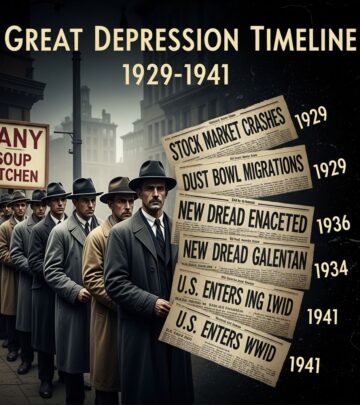
1929: The Wall Street Crash
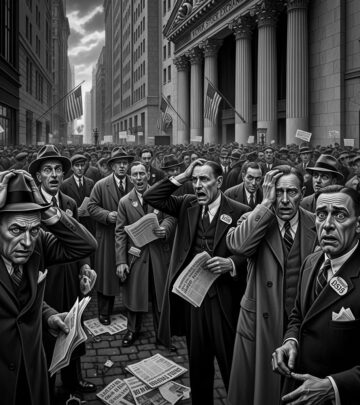
The Great Depression began in the United States as an ordinary recession in the summer of 1929. The downturn became markedly worse, however, in late 1929 and continued until early 1933. In October 1929, often referred to as “Black Thursday” on October 24, 1929, the stock market bubble burst. In less than a week, the market dropped by almost half of its recent record highs. Billions of dollars in wealth were lost, shattering confidence in the American economy and resulting in sharp reductions in spending and investment. Between the peak and the trough of the downturn, industrial production in the United States declined 47 percent and real gross domestic product (GDP) fell 30 percent.
1930-1931: Banking Panics and Tariff Wars
Following the initial stock market crash, a series of regional banking panics swept through the nation in 1930 and 1931. Banking failures cascaded as desperate bankers called in loans that borrowers could not repay. December 11, 1930 marked a particularly dark moment when the Bank of the United States, the fourth largest bank in the nation, failed. With more than $200 million in deposits, it represented the largest bank failure in U.S. history at that time. Meanwhile, President Herbert Hoover signed the Smoot-Hawley Tariff Act in 1930, which imposed steep tariffs on many industrial and agricultural goods. Rather than protecting American industries, this protectionist measure invited retaliatory measures from other nations, ultimately reducing output and causing global trade to contract dramatically.
1931-1933: The Deflationary Spiral
As the depression deepened, a vicious deflationary spiral took hold starting in 1931. Prices began to decline, though wages initially held steady. Share values, which had continued rising until October 1929, continued their slide until July 1932, accompanied by a complete loss of confidence in the financial system. Interest rates had dropped to low levels by mid-1930, but expected deflation and the continuing reluctance of people to borrow meant that consumer spending and investment remained depressed. From the fall of 1930 through the winter of 1933, the money supply fell by nearly 30 percent, decreasing average prices by an equivalent amount.
Farmers faced particularly dire circumstances, as declining crop prices combined with a Great Plains drought to cripple their economic outlook. At its peak, the Great Depression saw nearly 10% of all Great Plains farms change hands despite federal assistance efforts. By April 1933, around $7 billion in deposits had been frozen in failed banks or those left unlicensed after the March Banking Holiday.
Understanding the Causes of the Great Depression
Economists and historians have identified multiple interconnected factors that contributed to the Great Depression. Understanding these causes is essential for comprehending how such a severe economic collapse occurred and how policymakers might prevent similar crises in the future.
The Stock Market Crash of 1929
The stock market crash of 1929 served as the immediate trigger for the Great Depression. Throughout the 1920s, known as the “Roaring Twenties,” stock prices had climbed steadily as Americans invested heavily in equities, often using borrowed money. This speculative bubble eventually became unsustainable. When the market crashed in October 1929, consumer and business confidence collapsed almost overnight. The crash shattered faith in the American economy, resulting in sharp reductions in spending and investment that rippled throughout the entire economic system.
Banking System Failures and Financial Crises
Banking panics in the early 1930s proved to be one of the most destructive forces during the depression. As banks failed, they decreased the pool of money available for loans, choking off credit to businesses and consumers. The collapse of the banking system directly contributed to the decline in the money supply. Rather than stemming this decline, the Federal Reserve failed in what many consider its most serious omission. The Federal Reserve’s inaction allowed the banking crisis to spiral out of control, transforming what might have been a standard recession into a catastrophic depression.
The Gold Standard Constraint
The gold standard, which tied the value of currency to gold reserves, severely limited the policy options available to governments. The gold standard required foreign central banks to raise interest rates to counteract trade imbalances with the United States. These higher interest rates depressed spending and investment in those countries, spreading the American depression throughout the world and preventing coordinated international responses to the crisis.
Protectionist Trade Policies
The Smoot-Hawley Tariff Act of 1930 represented a critical policy error that substantially worsened the depression. By imposing steep tariffs on many industrial and agricultural goods, the act invited retaliatory measures from other nations. International trade, which was already fragile, collapsed under the weight of competing tariff barriers. By 1933, the economic decline pushed world trade to one-third of its level compared to just four years earlier. For countries significantly dependent on foreign trade, this collapse in international commerce proved particularly devastating.
Deflationary Monetary Collapse
As the banking system collapsed, a severe deflationary spiral developed. This deflation increased debt burdens; distorted economic decision-making; reduced consumption; increased unemployment; and forced banks, firms, and individuals into bankruptcy. With future profits looking poor, capital investment and construction slowed or completely ceased. The surviving banks, facing bad loans and worsening future prospects, became even more conservative in their lending, building up capital reserves and making fewer loans, which further intensified deflationary pressures.
The Devastating Impact and Effects
Economic Consequences
The economic devastation of the Great Depression was staggering in its scope and severity. Industrial production plummeted by 47 percent in the United States. Real GDP fell by 30 percent. Stock market values collapsed by approximately 80 percent from their 1929 peaks. The number of bank failures reached approximately 7,000 during the decade. These figures translate into real suffering for millions of people.
Employment and Unemployment Crisis
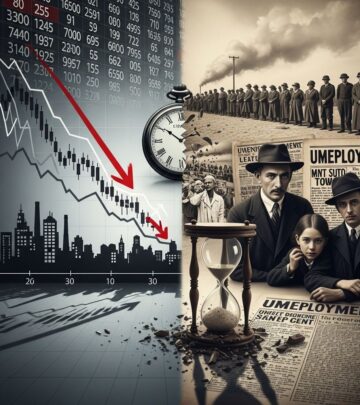
By 1933, unemployment in the United States reached an unprecedented 25 percent, meaning one in four workers could not find employment. In some industrial cities, unemployment exceeded 50 percent. Families lost their primary sources of income, savings, and homes. Marriage rates fell as people postponed starting families. The psychological toll of mass unemployment extended far beyond mere statistics, creating a sense of despair and social instability that persisted throughout the 1930s.
Agricultural and Rural Devastation
Farmers were hit particularly hard by the depression. About one-third of all farmers lost their land. Declining crop prices, combined with severe drought conditions on the Great Plains, created conditions of absolute destitution in rural America. The combination of economic collapse and environmental disaster created what became known as the Dust Bowl, forcing many rural families to abandon their farms and migrate westward in search of work.
Global Ramifications
The Great Depression was not confined to the United States. The economic contagion spread rapidly across the industrialized world. In Germany, which depended heavily on U.S. loans, the crisis caused unemployment to rise to nearly 30 percent and fueled political extremism, paving the way for Adolf Hitler’s Nazi Party to rise to power in 1933. Countries around the world experienced similar economic collapses, unemployment surges, and social upheaval.
Government Response and Recovery Efforts
The Hoover Administration’s Approach
President Herbert Hoover, who assumed office in March 1929, believed that capitalism could prevent major economic downturns through free-market mechanisms. He was unwilling to intervene heavily in the economy, assuming that the crash and depression would be over quickly and that government interference was unnecessary. As the depression deepened, Hoover did raise the top income tax rate to 25 percent out of concern about budget deficits, but these measures proved inadequate to address the crisis. His laissez-faire approach earned him a poor reputation as economic conditions deteriorated.
The New Deal and Franklin D. Roosevelt
In the 1932 presidential election, Hoover was defeated by Franklin D. Roosevelt, who promised dramatic government intervention to address the crisis. Following his inauguration on March 4, 1933, Roosevelt declared a national banking holiday to stabilize the banking system. From 1933 onward, Roosevelt pursued a set of expansive New Deal programs designed to provide relief to those suffering from the depression, create jobs through public works projects, and reform the financial system to prevent future crises. These programs fundamentally changed the role of the federal government in the American economy and laid the groundwork for the modern welfare state.
Recovery and the End of the Depression
Recovery from the Great Depression was slow and incomplete. The depression technically ended in 1939, and the full recovery was accelerated by defense spending and manufacturing related to World War II. By the early 1940s, the unemployment crisis had been resolved through a combination of New Deal programs, private sector recovery, and the massive expansion of defense industries as the United States prepared for and then entered World War II.
Modern Economic Understanding
Mainstream Economic Explanations
Modern mainstream economists continue to debate the precise causes and mechanisms of the Great Depression, with different schools of thought emphasizing different factors. Monetarist economists emphasize the role of money supply reduction, banking crises, credit reduction, and bankruptcies. Keynesian economists focus on insufficient demand from the private sector and inadequate fiscal spending by government. Both groups generally acknowledge that the Smoot-Hawley Tariff Act exacerbated what otherwise might have been a more standard recession. Irving Fisher’s debt deflation theory highlights how falling prices and accumulated debt created a vicious cycle that deepened the depression.
Frequently Asked Questions
Q: What exactly triggered the Great Depression?
A: The immediate trigger was the stock market crash in October 1929, which destroyed consumer and business confidence. However, underlying factors including banking instability, monetary collapse, and policy errors all contributed to transforming what could have been a standard recession into the worst economic crisis in modern history.
Q: How long did the Great Depression last?
A: The Great Depression lasted from 1929 until approximately 1939, spanning an entire decade. However, full recovery was not achieved until defense spending for World War II stimulated the economy in the early 1940s.
Q: Was the Great Depression a worldwide event?
A: Yes, while it originated in the United States, the Great Depression spread to virtually every industrialized nation. The collapse of international trade, the gold standard’s constraints, and the interconnected global economy meant that the depression affected countries across Europe, Asia, and beyond.
Q: Could the Great Depression have been prevented?
A: Many economists believe that better monetary policy, earlier intervention by central banks, and avoidance of protectionist trade policies like Smoot-Hawley could have prevented or significantly reduced the severity of the depression. The Federal Reserve’s failure to maintain the money supply is frequently cited as a critical policy error.
Q: What were the main effects of the Great Depression?
A: The primary effects included 25% unemployment in the United States, a 47% decline in industrial production, collapse of the banking system with over 7,000 bank failures, loss of one-third of all farmland, and widespread poverty and social upheaval globally. The depression also fundamentally changed government economic policy and the role of central banks.
References
- Great Depression — Britannica Encyclopedia. 2024. https://www.britannica.com/event/Great-Depression
- The Great Depression – Federal Reserve History — Federal Reserve History. 2024. https://www.federalreservehistory.org/essays/great-depression
- Great Depression Facts — FDR Presidential Library & Museum. 2024. https://www.fdrlibrary.org/great-depression-facts
- What Caused the Great Depression? — Federal Reserve Bank of St. Louis. 2024. https://www.stlouisfed.org/the-great-depression/curriculum/economic-episodes-in-american-history-part-5
- The Great Depression — Herbert Hoover Presidential Library-Museum. 2024. https://hoover.archives.gov/exhibits/great-depression
- Great Depression 1930s Timeline — Historic Newspapers. 2024. https://www.historic-newspapers.com/blogs/article/great-depression-timeline
Similar Articles








Read full bio of Sneha Tete