Government Shutdowns: Economic Toll
Explore how U.S. government shutdowns disrupt growth, furlough workers, and ripple through markets and states.
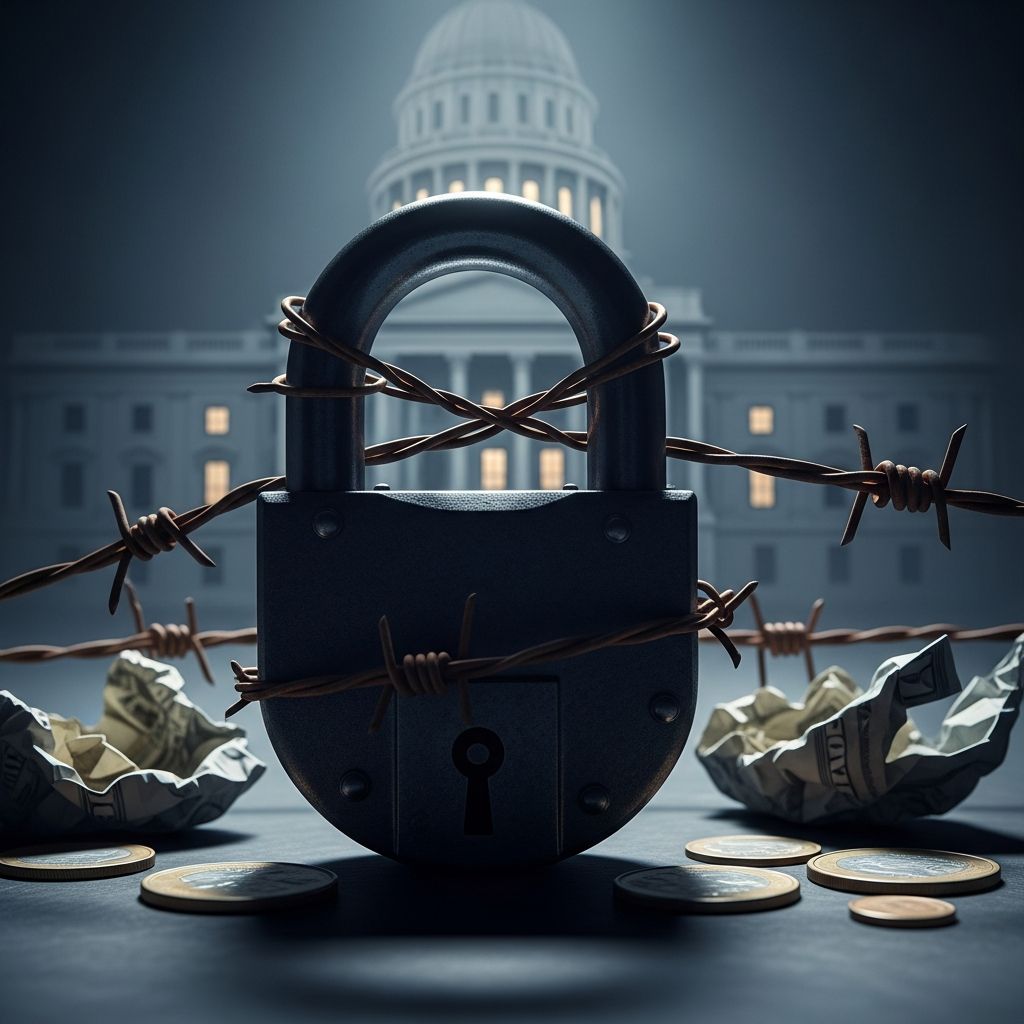
U.S. government shutdowns halt non-essential federal operations due to funding disputes, leading to furloughs, delayed payments, and broader economic disruptions. Recent events, including the record 43-day shutdown from October 1 to November 12, 2025, demonstrated these effects with GDP reductions estimated at 1.5 percentage points in Q4 2025.
Historical Context of Federal Funding Lapses
Government shutdowns occur when Congress fails to pass appropriations bills, forcing agencies to pause activities funded by annual discretionary spending. The 2018-2019 shutdown lasted 35 days, while the 2025 event extended to 43 days, the longest on record. These interruptions affect about 25% of federal operations, furloughing roughly 800,000 to 1.4 million workers initially, many later receiving backpay.
Prior shutdowns, such as those in 1995-1996 and 2013, provide benchmarks. The 2013 event cost an estimated $24 billion in lost productivity. Patterns show shutdowns cluster around budget deadlines, often tied to partisan disagreements over spending priorities like border security or debt limits.
Direct Costs to Federal Workforce and Operations
During shutdowns, non-essential employees face furloughs without pay, while essential staff work unpaid. In 2025, up to 1.4 million were impacted, with backpay authorized post-resolution but processing delays extending financial strain. Agencies like the IRS, National Parks Service, and FDA curtailed services, leading to closed sites and postponed inspections.
- Furloughed workers lose immediate income, reducing consumer spending by billions.
- Essential personnel, including air traffic controllers and border agents, operate without compensation, risking morale and safety.
- Contractors face payment halts, amplifying private-sector losses estimated at $2-3 billion per week in prolonged cases.
GDP and Growth Disruptions Quantified
Economists apply a rule-of-thumb: each week of shutdown trims 0.1-0.2 percentage points from annualized GDP growth via idled government activity. For the 43-day 2025 shutdown:
| Quarter | Estimated GDP Impact | Source |
|---|---|---|
| Q4 2025 | -1.5 percentage points | CBO, JPMorgan |
| Q1 2026 | +2.2 percentage points (rebound) | CBO |
| Cumulative by end-2026 | -$11 billion (real GDP) | CBO |
While much lost output rebounds, permanent losses persist—e.g., $3 billion from the 2018-2019 event due to unrecoverable productivity. Indirect effects, like delayed permits and loans, compound damages, potentially shaving 0.02% off annual GDP long-term.
Effects on Financial Markets and Monetary Policy
Shutdowns introduce uncertainty, prompting stock market dips and Treasury yield fluctuations. The 2025 event delayed key data releases, complicating Federal Reserve decisions on rate cuts. Investors shifted to safe assets, with equity indices falling 1-2% during peaks of impasse.
Federal payments backlog, including Social Security and tax refunds, slowed over quarters, muting Q4 growth but boosting Q1 as funds disbursed. Credit markets tightened briefly, with small business loan approvals dropping due to SBA closures.
State-Level Ramifications and Program Interruptions
States bear indirect burdens as federal grants pause and programs falter. The 2025 shutdown hit discretionary funding for education, housing, and health services, straining state budgets.
- Mandatory programs like SNAP and Medicare continue but face administrative delays.
- Discretionary aid, such as highway funds, halts, delaying infrastructure.
- National Guard and disaster relief slow, exacerbating local crises.
All 50 states reported impacts, with agriculture-heavy regions losing USDA inspections and tourism states closing parks.
Long-Term Economic Scars and Recovery Dynamics
Permanent GDP dents arise from foregone investment and talent attrition—furloughs prompt retirements or job switches. Businesses defer expansions amid uncertainty, with surveys showing 10-15% confidence drops.
Recovery involves catch-up spending, elevating subsequent quarters but not fully offsetting losses. CBO notes six-week events reduce end-2026 GDP by $11 billion in a $30 trillion economy—minor macro but painful micro. Repeated shutdowns erode institutional trust, potentially raising borrowing costs long-term.
Broader Societal and Sectoral Ripples
Beyond numbers, shutdowns disrupt research at NIH and NASA, delaying innovations. Aviation saw FAA staff strains, risking delays. Housing markets slowed via HUD pauses, and environmental monitoring lapsed.
Vulnerable populations suffer most: food assistance glitches hit low-income families, while veterans’ benefits backlog grew. Private sector echoes include supplier chains breaking for government contractors.
Lessons from Recent Shutdowns for Policymakers
Analyses urge automatic continuing resolutions to avert crises, as in some states. Bipartisan commissions recommend two-year budgets to buffer disputes. Trump administration warnings highlighted weekly $15 billion GDP hits, vindicated by post-event data showing robust but blunted 2025 growth.
Experts like those at Goldman Sachs and EY forecast steeper drags for extended shutdowns—up to 2.0 points if two months. Prevention hinges on fiscal discipline amid rising debt.
FAQs
What causes a government shutdown?
Congressional failure to approve funding by fiscal year-end (September 30), often over spending disagreements.
How many workers are affected?
Up to 1.4 million federal civilians, plus contractors; essential roles continue unpaid.
Is GDP loss permanent?
Mostly recoverable via rebound, but $3-11 billion permanent hits per major event.
Do markets crash during shutdowns?
Typically mild dips (1-2%), with quick rebounds post-resolution.
Can states mitigate impacts?
Limited; they front some funds but face federal grant shortfalls.
References
- US Government Shutdown: What’s the Impact? — J.P. Morgan. 2025-11-13. https://www.jpmorgan.com/insights/global-research/current-events/government-shutdown
- Government Shutdowns: Causes and Effects — Brookings Institution. 2026-01. https://www.brookings.edu/articles/what-is-a-government-shutdown-and-why-are-we-likely-to-have-another-one/
- President Trump Was Right About Everything — White House. 2026-02. https://www.whitehouse.gov/releases/2026/02/president-trump-was-right-about-everything-including-the-democrat-shutdown-costing-us-growth/
- Federal Government Shutdown: What It Means for States — National Conference of State Legislatures. 2025-10. https://www.ncsl.org/in-dc/federal-government-shutdown-what-it-means-for-states-and-programs
Similar Articles








Read full bio of medha deb