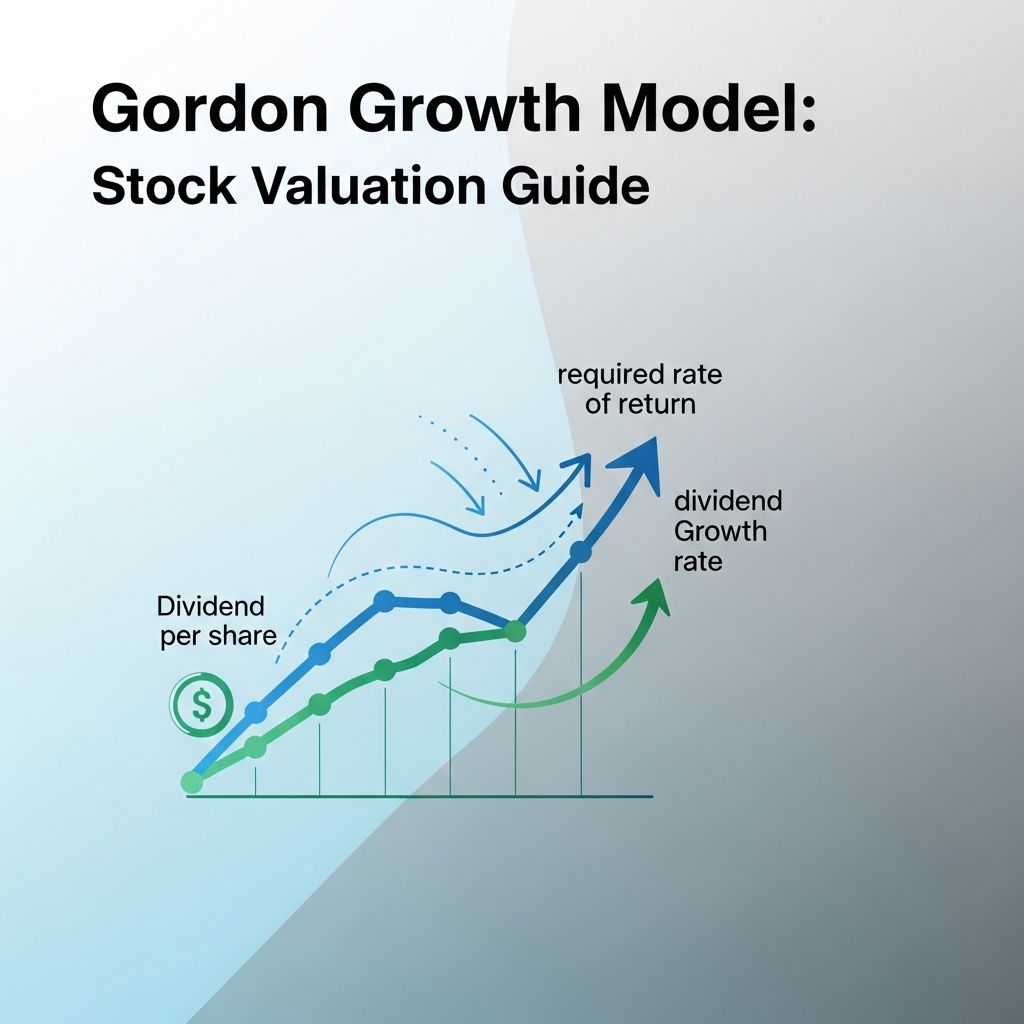
Gordon Growth Model: Stock Valuation Guide
Master the Gordon Growth Model for accurate stock valuation and investment decisions.
Understanding the Gordon Growth Model
The Gordon Growth Model (GGM), also known as the dividend discount model, represents one of the most fundamental approaches to determining a stock’s intrinsic value. Rather than relying solely on current market price, this valuation method calculates what a stock should theoretically be worth based on its expected future dividend payments. Finance professionals and individual investors alike utilize this model to make informed investment decisions by analyzing the present value of infinite future dividend streams.
The model operates on a straightforward principle: a stock’s value today equals the present value of all its future dividend payments. For companies that maintain steady dividend growth patterns, the Gordon Growth Model provides a practical framework for comparison between intrinsic value and current market price, allowing investors to identify potential undervalued or overvalued opportunities.
The Gordon Growth Model Formula
The Gordon Growth Model employs a simple yet powerful mathematical formula that captures the relationship between dividends, growth rates, and required returns. The basic formula is:
P = D₁ ÷ (r – g)
Where:
- P = The intrinsic value of the stock
- D₁ = The expected annual dividend per share for the following year
- r = The required rate of return (cost of equity)
- g = The expected constant dividend growth rate
Each component plays a critical role in determining the final valuation. The numerator (D₁) represents the next year’s expected dividend, while the denominator (r – g) reflects the spread between required return and growth rate. This spread is particularly important, as it directly influences the model’s sensitivity to assumption changes.
Key Components Explained
Expected Annual Dividend (D₁)
The first variable requires identifying what dividend payment investors can reasonably expect in the following year. This figure should be based on the company’s current dividend adjusted for anticipated growth, not on wishful thinking or overly optimistic projections. Analysts should consider historical dividend trends, earnings-per-share expectations, payout ratios, and management guidance when estimating D₁. This calculation forms the foundation for all subsequent valuations.
Required Rate of Return (r)
The required rate of return, also called the cost of equity, represents the minimum return investors demand for investing in a particular stock. This rate encompasses two components: the risk-free return (typically based on government bond yields) and the company’s specific risk premium. A company with higher business risk or financial instability will have a higher required return. Accurately determining this rate is essential, as the model is highly sensitive to changes in this variable.
Dividend Growth Rate (g)
Perhaps the most challenging variable to estimate accurately, the dividend growth rate must reflect realistic long-term expectations rather than temporary peaks or overly ambitious forecasts. This rate should be based on sustainable business growth, industry trends, and management’s demonstrated ability to maintain consistent dividend increases. The growth rate cannot exceed the required rate of return, as this would produce mathematically invalid results with negative or infinite valuations.
How to Calculate Intrinsic Value Using GGM
Step 1: Determine the Expected Annual Dividend
Begin by identifying the company’s most recent dividend payment and adjusting it for anticipated growth. If a company paid $2.00 per share annually and maintains a 5% growth rate, the next year’s expected dividend (D₁) would be $2.10. This figure becomes your numerator in the Gordon Growth Model formula.
Step 2: Identify the Dividend Growth Rate
Analyze historical dividend growth patterns and industry trends to establish a reasonable perpetual growth rate. Consider whether the company operates in a stable, mature sector or if it faces competitive pressures that might impact future growth. Conservative estimates generally prove more reliable than aggressive projections.
Step 3: Calculate the Required Rate of Return
Determine the cost of equity by considering the risk-free rate plus the company’s risk premium. A company with stable cash flows and strong market position might have a required return of 8%, while a more volatile company might require 12% or higher. This rate reflects what investors could earn elsewhere with comparable risk.
Step 4: Compute the Intrinsic Value
Apply all three variables to the Gordon Growth Model formula. For example, with D₁ of $2.10, a required return of 8%, and a growth rate of 5%, the calculation becomes: P = $2.10 ÷ (0.08 – 0.05) = $2.10 ÷ 0.03 = $70. If the stock currently trades at $65, it appears undervalued; if it trades at $75, it appears overvalued.
Practical Example of the Gordon Growth Model
Consider a practical scenario to illustrate how the model works in real-world investing. Suppose you’re evaluating a stock currently trading at $50 per share. The company has paid a current dividend of $2.00 per share and historically maintains a 5% annual dividend growth rate. Based on your analysis of the company’s risk profile and market conditions, you determine a required return of 8%.
Applying the Gordon Growth Model formula:
- D₁ = $2.00 × 1.05 = $2.10
- P = $2.10 ÷ (0.08 – 0.05)
- P = $2.10 ÷ 0.03
- P = $70
Since the calculated intrinsic value of $70 exceeds the current market price of $50, the stock appears undervalued by approximately 40%. This significant discount might represent an attractive investment opportunity, assuming your assumptions about growth rate and required return prove accurate.
Advantages of the Gordon Growth Model
The Gordon Growth Model offers several compelling advantages for investors and financial analysts. Its primary strength lies in simplicity—requiring only three easily identifiable inputs to calculate intrinsic value. This accessibility makes it valuable for individual investors without advanced financial training.
The model excels at helping investors make better investment decisions by considering multiple relevant factors including dividend payout requirements, historical dividend track records, and expected growth rates. By comparing intrinsic value to current market price, investors can identify potentially overvalued stocks that might indicate market bubbles or undervalued opportunities offering good value.
Additionally, the GGM provides a framework for understanding the relationship between growth rates, discount rates, and valuation. Even when the model’s assumptions prove imperfect, the analytical process forces disciplined thinking about what makes a company valuable.
Limitations and Weaknesses
Constant Growth Assumption
The model’s most significant limitation assumes companies grow at a constant rate indefinitely—a premise that rarely reflects reality. Many companies experience market fluctuations, competitive pressures, and cyclical patterns that prevent steady-state growth. High-growth companies and those in volatile sectors like technology often display growth characteristics incompatible with the single-rate model, making GGM less suitable for these investments.
Sensitivity to Input Changes
Small changes in assumptions can produce dramatically different valuations. If the growth rate drops from 5% to 2%, a $75 valuation might collapse to $60. Conversely, increasing growth from 5% to 8% could push valuation to $100. This extreme sensitivity means minor estimation errors can lead to significantly flawed conclusions.
Mathematical Constraints
The model produces mathematically invalid results if the growth rate equals or exceeds the required rate of return. When g ≥ r, the denominator becomes zero or negative, resulting in either infinite or negative valuations—outcomes that are conceptually meaningless. This constraint limits the model’s applicability to situations where growth rates are definitively lower than required returns.
Limited to Dividend-Paying Stocks
The Gordon Growth Model exclusively values dividend-paying stocks, excluding the vast universe of growth companies that reinvest earnings rather than distribute dividends. This limitation significantly restricts its application in modern portfolios heavily weighted toward technology and growth sectors that prioritize capital appreciation over current income.
Ignores Non-Dividend Factors
The model excludes important valuation drivers such as brand value, competitive advantages, management quality, and market conditions unrelated to dividends. A company with exceptional competitive positioning or breakthrough products might be undervalued despite steady dividend growth simply because the model focuses exclusively on cash distribution potential.
When to Use the Gordon Growth Model
The Gordon Growth Model proves most effective for mature, stable companies with consistent dividend histories and predictable growth patterns. Utility companies, established consumer staples firms, and dividend aristocrats with decades of consistent increases represent ideal candidates for GGM analysis.
The model works best when evaluating stocks in sectors with modest, sustainable growth rates where market disruption seems unlikely. Companies experiencing rapid growth phases, significant earnings volatility, or uncertain dividend policies should be evaluated using alternative methods such as multi-stage dividend discount models or comparable company analysis.
Practical Application and Strategic Implementation
Corporate finance professionals leverage the Gordon Growth Model in multiple strategic contexts. Chief Financial Officers use GGM analysis to model how different dividend growth rates affect stock valuation and cost of equity before implementing capital allocation decisions. The model reveals how seemingly modest adjustments to dividend growth rates create substantial valuation impacts, forcing honest conversations about sustainable growth versus short-term investor appeasement.
In acquisition scenarios, GGM establishes a basis for valuing target companies by forcing acquirers to validate growth assumptions that often prove overly optimistic. The model helps corporate managers navigate competing capital allocation demands by measuring the opportunity cost associated with dividend payments versus alternative uses of capital.
When implementing GGM analysis, analysts should compare results against industry peers to identify outliers requiring investigation. Running sensitivity analysis across multiple growth scenarios helps assess how assumption changes affect conclusions. Weighting management dividend guidance heavily while independently verifying the company’s financial planning capabilities ensures realistic projections.
Frequently Asked Questions
Q: What is the primary purpose of the Gordon Growth Model?
A: The Gordon Growth Model calculates a stock’s intrinsic value based on the present value of infinite future dividend payments, helping investors determine whether stocks are undervalued or overvalued compared to current market prices.
Q: Can the Gordon Growth Model be used for non-dividend-paying stocks?
A: No, the Gordon Growth Model specifically requires dividend payments to function. For non-dividend-paying stocks, investors should use alternative valuation methods such as discounted cash flow analysis or comparable company multiples.
Q: How sensitive is the Gordon Growth Model to changes in the growth rate?
A: The model is extremely sensitive to growth rate assumptions. Small changes of 1-2% can produce valuation swings of 20-30% or more, making accurate growth rate estimation critically important.
Q: What happens when the growth rate approaches the required rate of return?
A: As the growth rate approaches the required return, the denominator (r – g) approaches zero, causing the stock value to approach infinity. This indicates either overly optimistic growth assumptions or underestimated risk, suggesting the model may not be appropriate for that investment.
Q: Is the Gordon Growth Model suitable for technology companies?
A: The model is generally unsuitable for technology companies that prioritize growth over dividends or display high earnings volatility. Multi-stage valuation models better capture the dynamics of companies with variable growth rates across different life cycle stages.
References
- What Is the Gordon Growth Model? (Plus How to Use It) — Indeed Career Advice. May 16, 2025. https://www.indeed.com/career-advice/career-development/gordon-growth-model
- Gordon Growth Model – Guide, Formula, Examples and More — Corporate Finance Institute. https://corporatefinanceinstitute.com/resources/valuation/gordon-growth-model/
- How to Calculate Stock Value with the Gordon Growth Model (GGM) — McCracken Alliance. https://www.mccrackenalliance.com/blog/how-to-calculate-stock-value-with-the-gordon-growth-model-ggm
Similar Articles








Read full bio of Sneha Tete